
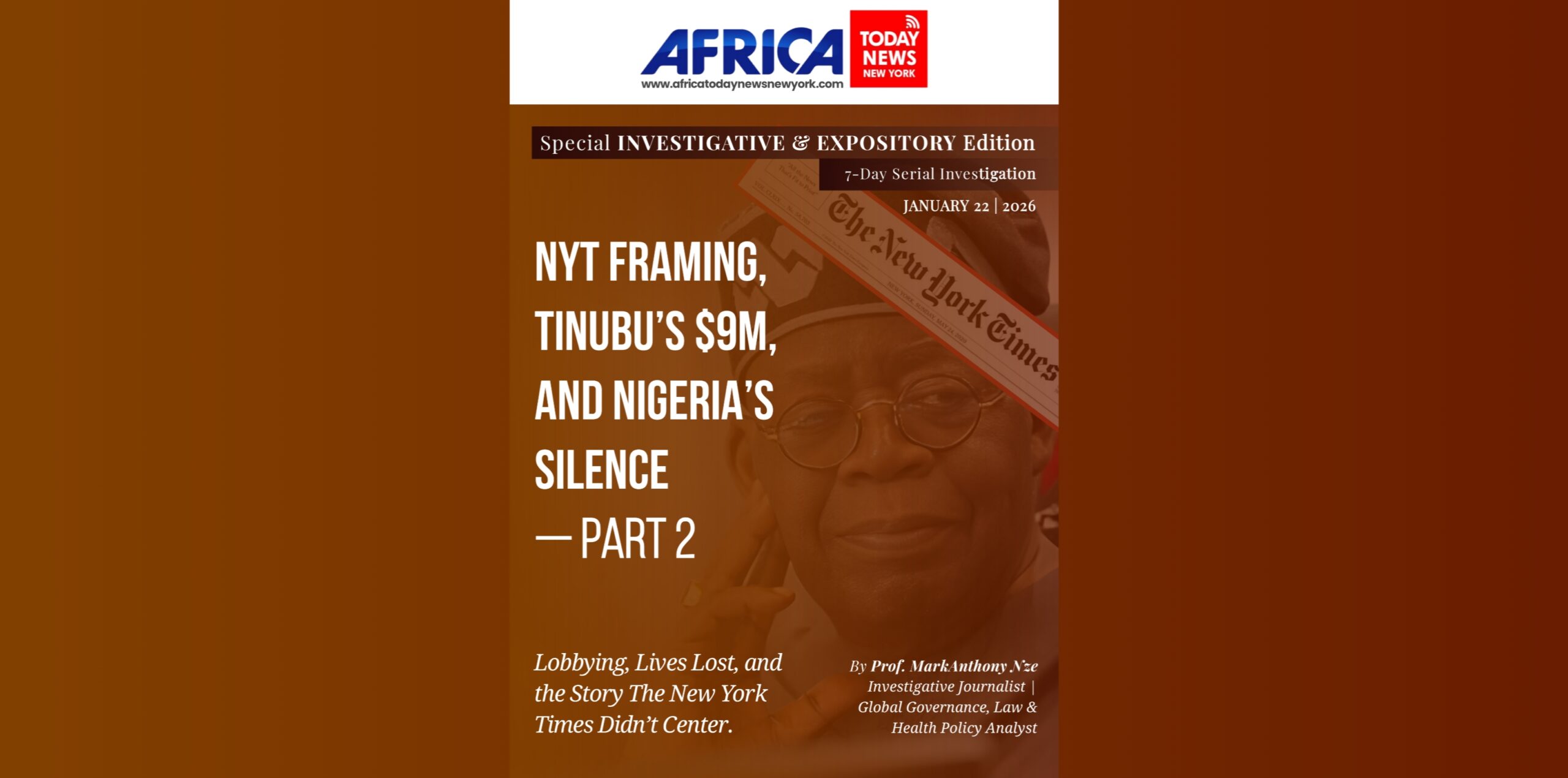
How Image Management Replaced Governance While Nigerians Paid the Price
The $9Million Question
There are moments in the life of a nation when budget lines become moral documents. When spending choices, stripped of rhetoric, reveal the hierarchy of a government’s values more clearly than any speech or policy statement ever could. Nigeria is living through such a moment.
This investigation is not about illegality. It is about prioritization. It is about what a government chose to fund at a time when its citizens were being killed, displaced, and abandoned at scale—and how that choice escaped sustained scrutiny in both domestic and international discourse.
At the height of one of the most violent and destabilizing periods in Nigeria’s recent history, the federal government authorized approximately $9 million in public funds for foreign lobbying and narrative management in the United States. This expenditure is not speculative. It is documented in filings submitted under the U.S. Foreign Agents Registration Act (FARA) and reported by independent Nigerian journalists (Center for Responsive Politics, 2024; U.S. Department of Justice, 2024; Premium Times Nigeria, 2025).
The question raised by this disclosure is not whether lobbying is legal. It is whether, at this moment in Nigeria’s trajectory, image management was elevated above human survival.
A Nation in Crisis
To understand the gravity of this decision, one must first understand the conditions under which it was made.
Nigeria today stands at the intersection of overlapping crises. According to the Institute for Economics & Peace (2024), the country remains among the world’s most terror-affected states, with civilian deaths driven by insurgency, armed banditry, and communal violence. The International Crisis Group (2023) identifies farmer–herder conflict as one of the most persistent sources of bloodshed, exacerbated by weak governance, elite accommodation, and fragmented security responses.
Amnesty International’s most recent report describes a pattern of recurring mass killings across multiple regions, noting that perpetrators frequently act with impunity due to inadequate investigations and political inertia (Amnesty International, 2024). The International Organization for Migration (2024) records millions of internally displaced persons, many displaced multiple times, reflecting not episodic instability but structural collapse.
These are not abstract indicators. They represent lives disrupted, communities erased, and a state struggling to perform its most basic function: the protection of its people.
At the same time, the Office for the Coordination of Humanitarian Affairs (2024) reports worsening humanitarian conditions across Nigeria, particularly in health access, food security, and civilian protection. The Nigeria Bureau of Statistics (2024) confirms rising multidimensional poverty, while the United Nations Development Programme (2024) places Nigeria among countries with stagnating or declining human development outcomes.
This was the backdrop against which $9 million was spent abroad.
The Paper Trail of a Choice
Under U.S. law, foreign governments that engage lobbyists must disclose the nature and cost of those engagements. Nigeria complied with these requirements. The filings, accessible through the U.S. Department of Justice’s FARA database, show payments to lobbying firms tasked with advocacy, strategic communication, and government engagement (U.S. Department of Justice, 2024).
The Center for Responsive Politics (2024) corroborates these disclosures, identifying Nigeria as one of the African governments with significant lobbying expenditures during this period. Reuters confirmed the timing of these engagements, noting that they occurred as insecurity and civilian casualties were mounting (Reuters, 2024).
These records establish three facts beyond dispute:
1. The funds were spent.
2. The amount was substantial.
3. The spending occurred amid a deepening national emergency.
What remains unexplained is why.
Read also: NYT Framing, Tinubu’s $9m, And Nigeria’s Silence—Part 1
Why Timing Matters More Than Legality
Legality is not the threshold of ethical governance. Timing is.
The $9 million expenditure did not occur during a period of stability or recovery. It occurred while:
● Entire communities were being displaced by violence.
● Hospitals were overwhelmed and under-resourced.
● Security forces struggled to contain multiple armed threats.
● Public trust in institutions continued to erode.
The International Budget Partnership (2023) emphasizes that in low- and middle-income countries, discretionary spending carries amplified consequences. Choices made at the margins of national budgets often determine whether populations receive protection or are left exposed.
In this context, $9 million is not a marginal sum.
In Washington, it is a routine lobbying budget, and in Nigeria, it is the equivalent of emergency health infrastructure, displacement response, or regional security investment.
This is not moral rhetoric. It is fiscal reality.
What Lobbying Does—and Does Not Do
Foreign lobbying has a defined function. According to the Congressional Research Service (2021), it is designed to shape perception, facilitate access, and influence policy discourse. It does not improve domestic governance. It does not provide security. It does not save lives.
The European Parliament (2019) warns that excessive reliance on external lobbying by fragile states often signals governance failure rather than diplomatic sophistication. When states turn outward to manage reputation while internal systems decay, the result is a widening gap between image and reality.
Transparency International (2022) further cautions that such practices, though legal, can erode democratic accountability by redirecting attention away from domestic performance and toward international optics.
Nigeria’s experience fits this pattern with uncomfortable precision.
The Silence That Followed
What makes the $9 million expenditure particularly troubling is not merely its existence, but the absence of public justification.
There was no comprehensive government explanation linking the spending to measurable national benefit. No parliamentary debate open to public scrutiny. No cost–benefit analysis made available to citizens. No evidence that the expenditure improved security, healthcare access, or humanitarian outcomes.
As the International Budget Partnership (2023) notes, accountability requires more than compliance with procurement rules. It requires explanation—an articulation of why public resources were allocated as they were.
In this case, explanation never came.
Narrative Management and Media Blind Spots
This silence might have provoked sustained media scrutiny. Instead, it largely passed unexamined.
Research on media framing demonstrates how sustained narrative emphasis can shift public attention away from structural failures toward more palatable explanations (Electronic Frontier Foundation, 2022). When coverage centers on diplomatic optics or foreign political dynamics, domestic accountability often recedes from view.
This is not unique to Nigeria. But in Nigeria’s case, the consequences are acute.
The Human Rights Watch (2024) report documents ongoing abuses and failures of protection. The World Bank (2024) identifies institutional weakness as a key barrier to development. The World Justice Project (2023) ranks Nigeria poorly on rule-of-law indicators, reflecting deep structural deficits.
None of these conditions are alleviated by lobbying.
Who Benefited, and Who Paid
The beneficiaries of the $9 million expenditure are identifiable: political incumbents and international reputation management structures.
The costs were borne elsewhere—by displaced families, underfunded hospitals, overstretched security services, and communities left to absorb violence without protection.
Budgets, as political theorists have long observed, are moral documents. They reveal what a government values when forced to choose.
In this case, the choice was clear.
Conclusion: When Image Replaces Responsibility
This investigation does not claim corruption. It claims misalignment—between need and response, between crisis and priority.
Nigeria’s decision to invest heavily in foreign lobbying during a period of national emergency reflects a deeper pathology: the substitution of perception for performance.
The tragedy is not that Nigeria sought to manage its image. The tragedy is that it did so while failing to protect its people.
And the tragedy deepens when global media, intentionally or not, decline to interrogate that choice with the rigor it deserves.
Part II has traced the money.
Part III turns to what that money did not buy: functioning hospitals, protected communities, and lives spared.
Because ultimately, the question is not how Nigeria was seen abroad.
It is how many Nigerians paid the price at home.
Professor MarkAnthony Ujunwa Nze is an internationally acclaimed investigative journalist, public intellectual, and global governance analyst whose work shapes contemporary thinking at the intersection of health and social care management, media, law, and policy. Renowned for his incisive commentary and structural insight, he brings rigorous scholarship to questions of justice, power, and institutional integrity.
Based in New York, he serves as a full tenured professor and Academic Director at the New York Center for Advanced Research (NYCAR), where he leads high-impact research in governance innovation, strategic leadership, and geopolitical risk. He also oversees NYCAR’s free Health & Social Care professional certification programs, accessible worldwide at:
https://www.newyorkresearch.org/professional-certification/
Professor Nze remains a defining voice in advancing ethical leadership and democratic accountability across global systems.
Selected Sources (APA 7th Edition)
Amnesty International. (2024). Nigeria: Harvest of death—Three years of bloody clashes between farmers and herders.
https://www.amnesty.org/en/documents/afr44/9753/2024/en/
Arriola, L. R., & Johnson, M. C. (2019). Ethnic militias, state power, and civil violence in Nigeria. African Affairs, 118(472), 1–27.
https://academic.oup.com/afraf/article/118/472/1/5369185
Center for Responsive Politics. (2024). Foreign lobbying disclosures: Nigeria.
https://www.opensecrets.org/fara
Congressional Research Service. (2021). Foreign lobbying and the Foreign Agents Registration Act (FARA) (IF10447).
https://crsreports.congress.gov/product/pdf/IF/IF10447
Electronic Frontier Foundation. (2022). Media framing, power, and narrative control.
https://www.eff.org/issues/free-speech-and-media
European Parliament. (2019). Foreign lobbying, transparency, and democratic accountability.
https://www.europarl.europa.eu/thinktank/en/document/EPRS_STU(2019)637967
Human Rights Watch. (2024). World report 2024: Nigeria.
https://www.hrw.org/world-report/2024/country-chapters/nigeria
Institute for Economics & Peace. (2024). Global terrorism index 2024.
https://www.visionofhumanity.org/resources/global-terrorism-index-2024/
International Budget Partnership. (2023). Nigeria budget credibility and public spending accountability.
https://www.internationalbudget.org/country/nigeria/
International Crisis Group. (2023). Stopping Nigeria’s spiralling farmer–herder violence.
https://www.crisisgroup.org/africa/west-africa/nigeria
International Organization for Migration. (2024). Nigeria displacement tracking matrix.
https://dtm.iom.int/nigeria
Nigeria Bureau of Statistics. (2024). Multidimensional poverty index.
https://www.nigerianstat.gov.ng/
Office for the Coordination of Humanitarian Affairs. (2024). Nigeria humanitarian needs overview.
https://www.unocha.org/nigeria
Premium Times Nigeria. (2025). Nigeria spends millions on foreign lobbying amid domestic crisis.
https://www.premiumtimesng.com/
Reuters. (2024). Nigeria’s security crisis deepens as civilian deaths mount.
https://www.reuters.com/world/africa/
Transparency International. (2022). Exporting corruption: Progress report 2022.
https://www.transparency.org/en/publications/exporting-corruption-2022
United Nations Development Programme. (2024). Human development report 2023/2024.
https://hdr.undp.org/
U.S. Department of Justice. (2024). Foreign Agents Registration Act (FARA) database.
https://www.justice.gov/nsd-fara
World Bank. (2024). Nigeria development update: Turning the corner.
https://www.worldbank.org/en/country/nigeria
World Justice Project. (2023). Rule of law index 2023.
https://worldjusticeproject.org/rule-of-law-index/global/2023