
The priciest myth about social media is also the laziest: that it isn’t “serious.” In 2026, that view isn’t just old—it’s economically illiterate. Social platforms have matured into global distribution rails, brand-building pipelines, and job-creation engines with measurable ROI. The Interactive Advertising Bureau projects $37 billion in U.S. creator-economy ad spend for 2025, growing ~4× faster than the overall media market and up 26% year-over-year—evidence that brands aren’t dabbling; they’re reallocating budgets at scale. At the same time, sector analyses forecast a market in the hundreds of billions through 2033, underscoring a long-run structural shift, not a fad.
No modern story personifies this transformation better than Khaby Lame—the Senegalese-Italian creator who became TikTok’s most-followed star by saying almost nothing at all. His ascent is not a fairy tale; it’s a disciplined playbook: design a universal format, publish with relentless cadence, build trust at global scale, and convert attention into enterprise value.
From job loss to global signal
Lame didn’t start with connections or a studio. In March 2020, the then-22-year-old factory worker in Italy lost his job as the pandemic shuttered workplaces. From his family’s apartment, he began posting short videos—minimal props, zero voiceover, maximal clarity. His signature format—silently puncturing over-engineered “life hacks,” then demonstrating the obvious fix with an open-palmed shrug—wasn’t just funny; it was globally legible. By stripping away language, he removed friction across borders. Time profiled the strategy in 2022: humor carried by expression, timing, and shared human exasperation—what Lame himself framed as a “universal language.”
That deliberate simplicity made his content export-ready on day one. No slang to translate, no captions to localize—just a repeatable visual joke anyone could “read.”
Read also: Zero To Revenue: Build A Business In 90 Days—Part 1
Consistency is the hidden capital
A common misconception is that creators break out through one lucky viral hit. Lame’s career argues the opposite: one viral post opens a door; consistent publishing builds the house. On algorithmic platforms, cadence compounds. Each upload is a new entry point; weekly output trains recommendation systems; months of reliable delivery build recall; years of service convert attention into trust.
The results are on record. Lame overtook Charli D’Amelio to become TikTok’s most-followed account on June 22–23, 2022, as reported contemporaneously by The Verge. As of January 29, 2026, he remains No. 1 with ~160.4 million followers, according to the maintained ranking of most-followed TikTok accounts. That scale is not vanity—it’s leverage equivalent to programming a global broadcast channel.
When attention becomes enterprise
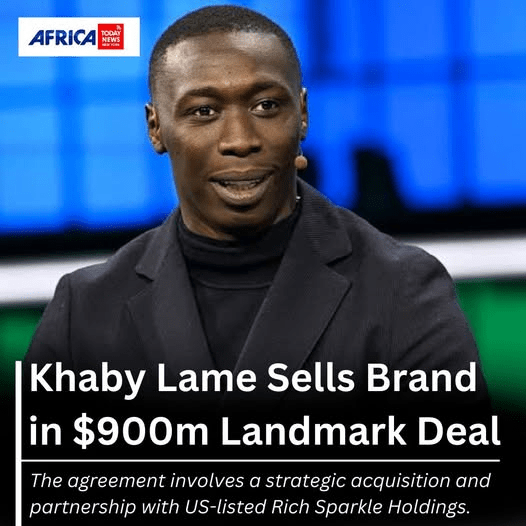
Scale plus trust unlocks more than ad revenue. It creates licensable IP, partnerships, and operating companies that mirror traditional studios. In late January 2026, multiple outlets reported that Lame sold his operating company (Step Distinctive Limited) to Rich Sparkle in a deal valued near $900 million–$975 million, with a component authorizing an AI “digital twin” of his likeness and voice for multilingual, always-on commerce. People placed the headline value at $975 million; other reputable coverage cited a figure near $900 million—but either way, the order of magnitude is unprecedented for a single creator’s business. Forbes also covered the transaction and, more broadly, has repeatedly ranked Lame among the top-earning creators, estimating $16.5 million in 2023 and $20 million in 2025. These aren’t mere celebrity paydays; they’re market signals that professionalized creator operations command institutional valuations.
This is the deeper lesson for skeptics: creators now build acquirable assets—audiences, formats, data, and brand equity—that businesses can price, buy, and scale. The corporate structures may be new, but the fundamentals—distribution, IP, monetization—are classic media economics.
Why public institutions care
If the creator economy were just “content,” global institutions wouldn’t enlist creators for public-interest work. Yet on January 31, 2025, UNICEF named Khaby Lame a Goodwill Ambassador, explicitly citing his global reach and connection with young people. That appointment recognizes platforms as civic megaphones—capable of mobilizing awareness for education, health, and emergency relief at internet speed.
Five principles ambitious creators can apply (without copying the surface)
1) Start with what you control.
Lame had no studio, writers’ room, or expensive gear—only a clear, repeatable concept. Constraint became a brand asset: clean framing, predictable beats, authentic delivery. In a world where production tools are commoditized, differentiation shifts to taste and system.
2) Build a format, not just videos.
A format is a promise to both the audience and the algorithm. Lame’s modular sequence—problem, eye-roll, obvious fix, signature gesture—turns each clip into a familiar “unit” the system knows how to recommend and the audience knows how to enjoy. That’s why his approach travels across cultures without subtitles.
3) Design for global legibility.
Every dependency you remove—language, insider slang, culture-specific cues—expands your total addressable audience. Lame’s near-silent delivery didn’t just lower production cost; it multiplied reach, helping power his ascent to 160M+ followers and sustained No. 1 status.
4) Be consistent enough to be discovered.
Virality is stochastic; cadence is controllable. Treat your output like training: frequency (reps), structure (form), retention (endurance). Over time, consistency compounds into recognition—and as the June 2022 milestone shows, leadership on the world’s most discovery-driven stage.
5) Treat your channel like a business ledger.
Creators who endure track inputs (posting frequency, hook retention), brand metrics (sentiment, safety), and commercial outcomes (CPMs, conversion). Advertisers are increasing spend—$37B projected for 2025, growing roughly 4× faster than the overall media market—because well-run channels deliver measurable performance.
A professional path, not a pastime
Still think social media is “unserious”? Consider the institutional behaviors, not the anecdotes:
- Budget flows: Brand dollars are following attention with uncommon velocity—$37Bin U.S. creator ad spend projected for 2025
- Asset formation: Top creators aren’t just selling posts; they’re structuring rights, IP, data, and operations that acquirers value in the hundreds of millions.
- Public-interest integration: Agencies like UNICEFnow formalize creator roles because distribution plus trust moves people.
The path Lame walked—from a laid-off factory worker in March 2020 to a global media leader with nine-figure deal headlines—wasn’t luck in a viral slot machine. It was the product of repeatable craft: a universal format, high-frequency publishing, relentless quality control, and a brand that stayed safe enough for the world’s biggest advertisers.
What this means for you
- Pick a solvable problemyour audience feels daily, then design a format that resolves it quickly and memorably.
- Ship on a schedule. You can’t control who shares a post, but you can control whether you publish three times a week for a year.
- Engineer for clarity. Remove friction (jargon, complicated setups) so ideas travel farther, faster.
- Act like a media operator. Track your metrics, protect your reputation, and negotiate partnerships that align with your long-term positioning.
- Think in assets. Every tested hook, refined series, and owned data point is equity you’re building in your own distribution company.
The youth who dismiss social media as unserious are usually reacting to its loudest corners. But the Khaby Lame story is not chaos—it’s structure. Treat platforms as apprenticeships in public: learn the grammar, build a durable format, publish with discipline, compound attention into trust, and convert that trust into enterprise value. If you do, you won’t just watch history on your phone—you’ll help write it.
Key Sources: IAB’s 2025 Creator Economy report (spend $37B, ~4× faster growth), Grand View Research (market ~$205.25B in 2024 to ~$1.345T by 2033; ~23.3% CAGR), The Verge (June 22–23, 2022 milestone), People (deal $975M) & Times of India (near $900M range), Forbes 2023 (earnings $16.5M) & Forbes 2025 (earnings $20M), UNICEF (Goodwill Ambassador, Jan 31, 2025), TIME (format as global, nonverbal language), Inc. (March 2020 job-loss origin).