
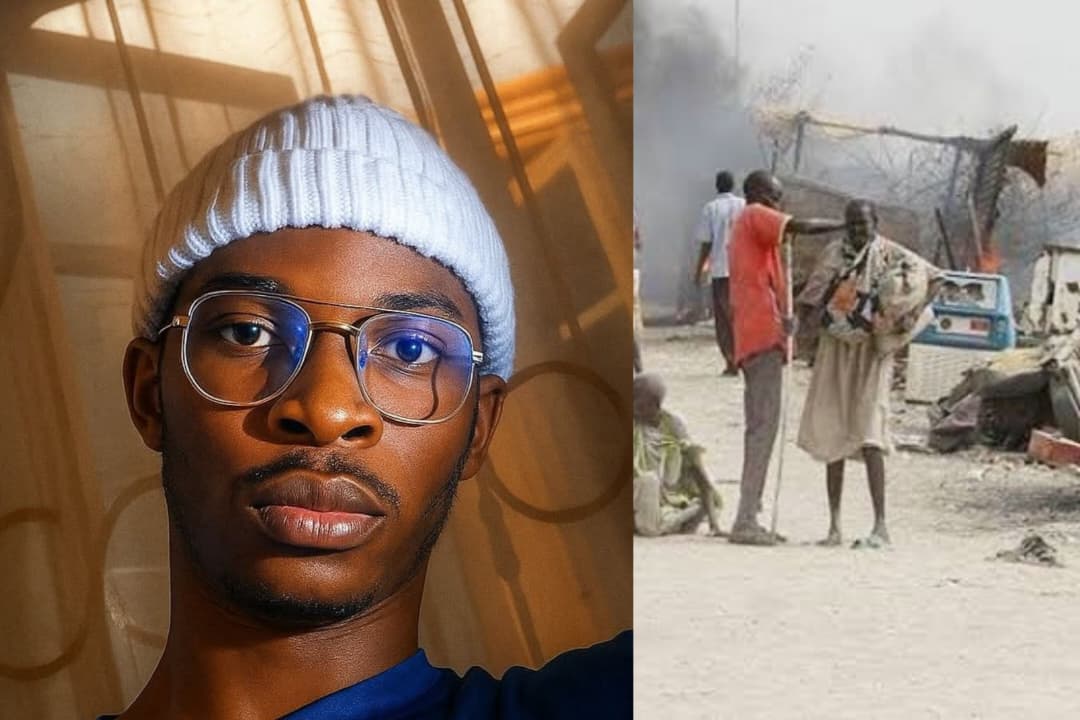
For many Nigerians, whether they were born into a certain religious belief system or converted to it, the worship center is imprinted in their psyche as a refuge, a last bastion of safety. But in present-day Nigeria, the realm of imagination and the realm of reality have ceased to coincide. The worship center, once a refuge, is now a hunting ground for the bloodthirsty insurgents.
Just consider, if you will, the attack that occurred in Kurmin Wali village in Kaduna State, in which 177 members of the Evangelical Church Winning All were kidnapped in one night. This is just one more reminder. But imagine yourself standing in the middle of all this, with nothing but sticks and cutlasses to protect yourself from danger that is approaching you with AK-47s. That is not bravery. That is suicide.
Civilians are not allowed to match weapons. But the government has not matched responsibility too. They limit civilians’ self-defense. However they do not maintain life and property. These days, if you browse the internet all day without reading any news of kidnapping, massacre, or violent raid, something does not seem right. Normal has itself become abnormal. Violence has become the background noise.
Statistics obtained from the National Bureau of Statistics reveal that at least 1,043 lives were lost in Benue State between May 2023 and May 2025. At least two million Nigerians were abducted, nationwide, between May 2023 and April 2024, with more than 6.8 million dollars demanded as ransom in one year. These are not mere rumors. These are indicators of the failed security environment.
But somehow, the Federal Government of Nigeria insists everything is under control.
“The situation is not so bad,” Information Minister Mohammed Malagi declared. “Today, we can move freely at any time, day or night, from here to Kaduna or to Kano without anybody stopping us.”
One must wonder which Nigeria he lives in.
Across the northern states, farmers can’t farm. Traders can’t trade. Bandits have essentially set up parallel governments, collecting “taxes” from entire communities—millions of naira extracted as tribute just to survive another month. With roughly 370,000 police officers spread across over 200 million citizens, Nigeria’s police-to-population ratio falls dangerously below UN standards. Rural communities have been left hanging in the wind.
Which brings us to the desperate question now echoing from villages, highways, and yes, even worship halls: If the State cannot protect us, should we be allowed to protect ourselves?
The Cruel Math of Unarmed Resistance
But presently, the force has tilted to extremes; fighting herders invade villages with nothing to defend them. Kidnappers walk around with guns. Bandits rule the forests with machine guns trumping pleas. And the people being terrorized can only confront terror with prayers. It’s an absolute catch-22. How do the civilians go about protecting themselves in the best possible way when their aggressors are already militarized? You can’t bring a cutlass to a gunfight and survive, right?
The government warns that if it allows civilians to be armed, it would create a bad precedent. And it’s right about this. What the government is not seeing here, however, is the equally bad precedent it creates when it demands compliance from those it does not intend to defend. Against whom? Each other?
Our religious and cultural backgrounds are not much help either. Many Nigerians have been raised to be submissive, to suffer in silence, to turn the other cheek, and to pray more. These are excellent religious virtues, but they don’t equip one psychologically when prayer is confronted with bullets. Prayer can calm the mind, but it will not hold off the kidnapper. Thus, individuals find themselves trapped—between the violence that follows them and the laws that criminalize their existence.
Why Guns Aren’t the Answer Either
To be frank, flooding the Nigerian society with guns will not solve any problems. Rather, problems would abound. This is because there’s this fallacious narrative that guns are associated with safety, which is simply not true. For example, in a Nigerian society in which pride, alcohol, squabbled egos, and pure rage already cause rough disputes to spill over into full-blown fights, injecting this society with more guns would simply give them more final encounters—fights that become final in death and instances of road rage becoming actual murder cases.
Just walk down any Nigerian street on any given day and witness how tempers fray over parking spaces, traffic, or an offended ego. Then consider this happening with everyone toting a gun. It’s no longer security, just a recipe for mass disaster.
Apart from the evident gun personality challenges, the bitter truth is that Nigeria simply does not have the infrastructure for managing guns responsibly. There are no national criminal records. Mental assessments have yet to become a reality. Identity verification systems are questionable, to say the least. Address systems are literally broken. A country that cannot effectively monitor its people cannot effectively monitor its guns.
Once the weapons are out in the civilian population, the government will not be able to recall them. There will be a collusion of corruption in the issuing of the weapons, ensuring the issue of the weapons becomes a black market activity. Guns will outpace the response of any institution. This is a story of what has happened elsewhere, and the end result is not good.
What the Law Actually Says
Legally speaking, Nigeria was deliberately shaped to prevent civilian militarization. Gun control sits under the Nigeria Police Force through the Firearms Act. The Constitution, in Section 214, bars any second, parallel armed force. Section 33 enshrines the right to life and assigns the duty of protection squarely to the State, not to ordinary citizens. A heavily armed civilian populace doesn’t resemble democracy; it resembles a powder keg of disorder ready to blow.
The Real Moral Failure
But what does this mean for a vulnerable member of a Nigerian society who is neither able to protect himself nor rely on the state for protection on his behalf? He is left alone. That is it. That is the tragedy here. Not that Nigerians want guns, but that Nigerians feel as if they need guns. Any country that tells its people to arm themselves has already admitted that it has failed them.
Here’s the thing the government fails to understand: if it wants to implement a no-civilian-weapons policy, it must address the issues of public security that have created the demand for weapons in the first place. You cannot ask people to be unarmed and then fail to provide them with security in the face of danger. The government needs to hear the voices of the people and address the issue of insecurity, instead of gaslighting us about it.
What Must Actually Be Done: A Real Security Prescription
If Nigeria is to genuinely protect its citizens, arming the streets is not the solution to the problem. The answer to the solution is in revamping the State—and that begins with tangible, structural changes, not a series of press releases whose only function is to provide a sense of comfort to the masses in the name of being a
Here is what needs to happen, and it needs to happen NOW.
Establish the State Police with Full Autonomy
You can’t protect 200 million people with one command center. The threats that are there in Zamfara State are not necessarily the threats that are found in Anambra and Rivers State. Local crimes call for local intelligence and local response time. What we need is state police forces who are constitutionally backed, not some kind of politics-based militias or the governors’ personal fire departments, but professional ones who are regulated by the law, trained in the service of the public, and not beholden to any particular political ideology. Otherwise, we shall remain firefighting with a federal fire truck but only when the fire is already consuming everything in its path.
Read also: White House Justifies Minneapolis Case Despite Video Proof
Developing a True National Identity and Record System
A country that fails to accurately identify its citizenry fails to properly regulate any serious matter: firearms, elections, and policing. It’s high time Nigeria integrated our National Identification Number, voting roll, bank verification numbers, criminal records, and immigration rolls into a functional system.
This is not negotiable. This is essential security infrastructure. With this in place, criminals fall through the cracks, licenses are worth less than the paper they are printed on, and law enforcement has to operate in the dark.
Improvements in Police Hiring, Training, and Culture
We not only want more cops on the street but also improved ones. This will entail reviewing their psychology profiles, selection conducted independently of political considerations, training for improved performance, education on human rights, improved forensic services, and accountability through the use of body cameras with meaningful digital reporting.
A police officer should never find himself in a position where he is perceived as a danger to the community he is protecting. A police officer should symbolize protection. Until the police can demonstrate that they are worthy of public trust, people will continue to galvanize around private security.
Establish Intelligence Fusion and Early Warning Systems
Most attacks in Nigeria are not a surprise and a one-time incident. They’re actually predictable. A community tends to feel when something is coming; it’s when it comes too slowly that it’s not taken seriously enough. There should be intelligence fusion centers, early warning systems, technological surveillance, and ways for concerned citizens to report incidents. Safety should be proactive rather than reactive. Safety should occur prior to the threat.
Secure Our Borders and Stop Weapons Inflow
You cannot solve internal violence while external weapons keep pouring in. Nigeria must modernize border patrol, deploy drones and sensors, collaborate meaningfully with neighboring countries, and actively disrupt arms trafficking routes. Most of the guns killing Nigerians didn’t originate here. They crossed our borders. Stopping that flow would save more lives than arming civilians ever could.
Meanwhile, the government’s priorities raise more questions than answers. Reports suggest that nearly $9 million was spent on foreign lobbying efforts, allegedly to reshape international perceptions about the ongoing violence in Nigeria. Funds that could have strengthened border patrols, intelligence networks, or local security infrastructure were instead funneled into crafting narratives. There were even claims that the administration could have acquired military-grade equipment through legitimate channels but deliberately chose the path of lobbying.
Protect High-Risk Communities With Special Security Zones
Some areas are already known danger zones. The government must designate special security corridors, heavily protected farming belts, secured travel routes, and community defense programs supported by the state—not left to private militias. People shouldn’t have to negotiate their survival with criminals.
Reform the Law on Self-Defense
Self-defense must stop being treated like a crime. Nigeria needs clear legal definitions of reasonable self-defense, judicial guidelines that protect victims rather than just punishing survivors, and fast-track courts for security-related cases. Citizens shouldn’t risk prison for staying alive.
A chilling example of how Nigeria criminalizes survival is the case of Sunday Jackson in Adamawa State. Jackson, a farmer, confronted a herdsman whose cattle had trampled and destroyed his crops. When the herdsman attacked him with a knife, Jackson acted in clear self-defense, overpowering the aggressor and fatally wounding him.
What should have been a straightforward case of self-preservation became a Kafkaesque nightmare. In 2018, Jackson was arrested and charged with culpable homicide. He pleaded not guilty, insisting he had acted solely to defend his life and property. Instead of swift justice, his trial dragged on for years, largely ignored by the media, leaving him in detention.
In 2021, a judge sentenced Jackson to death by hanging. The judgment flagrantly ignored constitutional requirements for timely justice under Section 294(5), turning procedural delay into a blatant miscarriage of justice. Appeals were made, yet both the Appeal Court and the Supreme Court rejected his self-defense claim. This is not a question of law alone—it is a stark demonstration of how the State abandons the very people it is constitutionally sworn to protect.
Stop Performing Safety—Start Delivering It
Security is not press statements. It’s not reassurance. It’s definitely not denial. Security is presence. It’s prevention. It’s protection. If the government keeps insisting the situation is “not so bad” while citizens bury their loved ones, then the problem is no longer just insecurity—it’s dishonesty.
The Nigerian government’s indifference to its citizens’ plight is so entrenched that it often requires external interference to spur action. Take, for example, the recent attention drawn by statements and pressure linked to U.S. President Donald Trump. If not for this intervention, the government would have likely remained as lax and dismissive as ever, treating the suffering of its people as a problem for someone else to notice.
Conclusion
Gun ownership among civilians may evoke feelings of empowerment, but it amounts to surrender. When the state steps back and tells ordinary people to fend for themselves in a war zone, nations lose their footing. Serious countries do not leave survival to scared civilians armed with pistols facing off against organized crime with military-grade firepower. The answer isn’t an armed populace. It’s a government truly for the people-one that treats its duty to protect life as a real obligation worthy of hard reforms, not easy denials. Until that happens, every incident-every kidnapping, every funeral-remains a stark reminder of what occurs when the State abandons its people and then forbids them from defending themselves.