
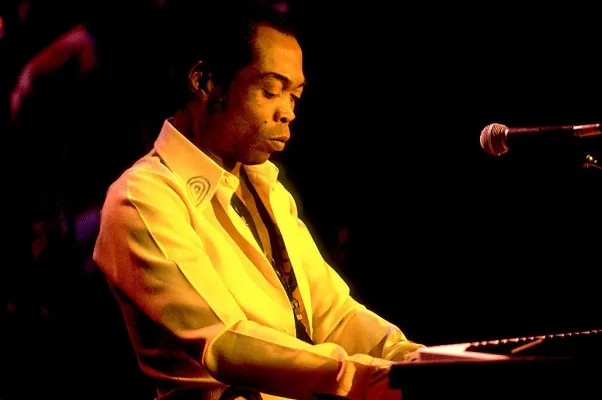
Early February 2026 delivered one of those exquisitely Nigerian moments where the country accidentally tells the truth about itself. Seun Kuti—custodian-in-practice of an inheritance he didn’t ask for but has refused to dilute—and social media firebrand VeryDarkMan (VDM) visited Fela Anikulapo-Kuti’s gravesite at the Kalakuta Museum in Ikeja, Lagos. Photos making the rounds show Seun pouring libation as both men kneel beside the grave; other images show rams and goats brought for the rite. The act was widely described as ancestral homage—ritual respect, not a church service, not a mosque sermon, not a PR stunt dressed as piety.
And then came the predictable choir of outrage: the quick-mouthed, the under-read, the spiritually insecure—people who treat any African metaphysics as contamination, while routinely outsourcing their own sacred imagination to imported vocabularies they barely understand.
Let’s speak plainly. The moral panic wasn’t about theology. It was about hierarchy.
Because the average Nigerian who condemned that graveside rite is not truly allergic to mediation, reverence, or symbolic devotion. They are allergic to African mediation, African reverence, and African symbolic devotion—especially when it refuses to perform embarrassment. They can handle “pray through,” “anointing,” “mantles,” “holy water,” “seed,” “special offerings,” and an entire economy of spiritual middlemen—so long as the packaging is recognisably foreign or institutionally approved. But pour libation on the grave of an African revolutionary, and suddenly everyone is a doctrinal purist.
That is not righteousness. That is colonial residue pretending to be faith.
Read also: Silence Is Betrayal: Nigeria’s Moral Reckoning
Seun Kuti: the kind of heir worth respecting
Seun Kuti deserves praise precisely because he has not tried to become palatable. He leads Egypt 80—his father’s former band—not as a nostalgia act, but as a living instrument of pressure against complacency. He is Fela’s youngest son, yes, but he has done the harder thing: he has refused to behave like a museum guide in his own bloodline. (I am not even his fan.) He can be weird, and—like VDM—sometimes overly loquacious, sometimes too loud for tone-policed spaces. (I do not always agree with him, and I do not always agree with VDM.) But truth does not require fandom. The truth remains: those men did well. They showed up. They made an impact. (I may disagree with both Seun and VDM on many things.) Yet what they did here deserves recognition because it was noble. They honoured Fela boldly, without shame, and without begging anybody for permission. (I support this act not because I am their fan, but because it was the right thing to do.)
The graveside homage is consistent with that refusal. You don’t sanitize Fela, then claim you “respect” him. You don’t iron out his spiritual and cultural context, then expect the public to take your admiration seriously. If you want the icon, you must tolerate the icon’s actual universe—its Yoruba cosmology, its political rage, and its uncompromising disdain for respectable hypocrisy.
Read further: Prof. Nze Seeks Review Of U.S. Visa Practices Affecting Scholars
VDM: crude instrument, real social function
VDM is not an academic. He’s not polished. He doesn’t speak in committee-approved syntax. But Nigeria is not a country currently governed by finesse; it is governed by impunity, public amnesia, and selective accountability. In societies like that, “refinement” is often just a nicer costume for cowardice.
So when Seun frames VDM as socially “necessary” (a sentiment widely circulated in Nigerian online discourse), he’s naming a familiar civic reality: institutions go quiet; informal actors get loud. Sometimes that loudness is ugly. Sometimes it is clarifying. In this case, it did something valuable: it dragged the country into an argument about what Africans are allowed to honour without apology.
And the country failed the test—loudly.
Kalakuta is not a vibe. It is a wound.
The most embarrassing part of the backlash is how many people condemn Kalakuta rituals while knowing almost nothing about what Kalakuta represents.
On 18 February 1977, Kalakuta Republic was attacked by about 1,000 soldiers—a state assault so notorious it still sits in the historical memory like a scar you can feel even when you’re not touching it. The compound was battered and razed; residents were brutalised. Fela’s mother, Funmilayo Ransome-Kuti, was thrown from a window during the violence and later died from her injuries—an atrocity that should permanently disqualify the Nigerian state from any moral superiority over the man it tried to crush.
So when people clutch pearls over libation at that graveside, understand what they’re really doing: they’re performing moral disgust at a ritual while remaining strangely unmoved by the violence that made the site sacred in the first place.
That isn’t faith. It’s sentimentality weaponized against memory.
Fela is bigger than Seun and VDM—and that is exactly why this matters
Let’s settle this without false modesty: Fela is more important than Seun and VDM to Africans. Not because they are “small,” but because Fela is a continental reference point—a cultural engine that reshaped the grammar of resistance.
This is not romantic talk. It is measurable in legacy, recognition, and institutional attention. In January/early February 2026, the Recording Academy posthumously honoured Fela with a Grammy Lifetime Achievement Award, presented at the Special Merit Awards in Los Angeles—an establishment accolade that underscores what Africans have said for decades: Fela belongs to world history, not just Nigerian nostalgia.
And the archival seriousness is equally telling. A major Lagos exhibition—reported by Reuters—showcased 440 items spanning personal artifacts, photographs, artwork, performance video, and programming built around his legacy. That is not how cultures treat “mere entertainers.” That is how cultures treat architects of public consciousness.
So yes: Seun and VDM are contemporary figures operating inside the noisy churn of Nigeria’s present. Fela is a force that explains Nigeria’s past and interrogates its future. If you cannot grasp why Africans might treat him with reverence—spiritual or symbolic—then you do not understand the scale of what he did.
The “idolatry” argument is intellectually lazy
Some critics will insist: “It’s worship. Worship is wrong.” Fine—let’s grant them their pious vocabulary for a moment.
Even within Christianity and Islam, there are layered practices of reverence: saints, scholars, prophets, intercession, veneration, pilgrimage, relics, sacred spaces, holy days, and communal remembrance. Human beings do not relate to the divine in sterile abstraction; they build ladders of meaning—figures, places, rituals—because memory is how communities stay coherent.
What offends the critics, then, is not the existence of ladders. It is the wrong ladder. An African one.
The deeper issue is that many Africans have been trained—by history, by schooling, and by missionary narratives, and by modern respectability politics—to assume that African spiritual languages are automatically “demonic,” while foreign spiritual languages are automatically “civilised.” That training sits beneath the outrage like a software program running in the background.
And it is precisely that program Seun and VDM disrupted by refusing to act ashamed.
Fela’s persecution makes the outrage look even more ridiculous
Fela was not a harmless icon. He was not a playlist. He was a political problem for the powerful. He was jailed repeatedly, harassed incessantly, and targeted by the state. His longest imprisonment—after a 1984 arrest—kept him locked up for 20 months, with human rights advocates and public critics widely arguing the case was politically motivated.
This is what people forget when they moralize from their sofas: the freedom to condemn Seun and VDM online is partly built on the kind of defiance Fela embodied—defiance that cost blood, property, and family.
If you enjoy the aesthetic of rebellion but resent its spiritual and cultural roots, you are not a principled believer. You are a consumer of rebellion—tourist-minded, commitment-avoidant.
The honest conclusion Nigerians keep dodging
Here is the uncomfortable thesis Nigerians should face without whining: many Africans accept Jesus and Muhammad with reverence but panic when Africans are asked to treat African greatness with comparable seriousness.
Not because African greatness is inferior. Because too many of us have been trained to treat African seriousness as a threat.
That’s why the condemnation is so loud. Loudness is what insecurity sounds like when it borrows scripture.
So I will say it cleanly: Seun Kuti and VDM did not disgrace Nigeria by honouring Fela at Kalakuta. They embarrassed only the people who have turned faith into an excuse for self-erasure. They reminded us—without speeches, without seminars—that a continent cannot keep outsourcing its sacred imagination and still claim dignity.
Fela does not need anyone’s permission to be honoured. The question is whether Africans will stop begging for permission to honour their own.
And if that sentence irritates you, good. Discomfort is often the first sign that a lie has been touched.