
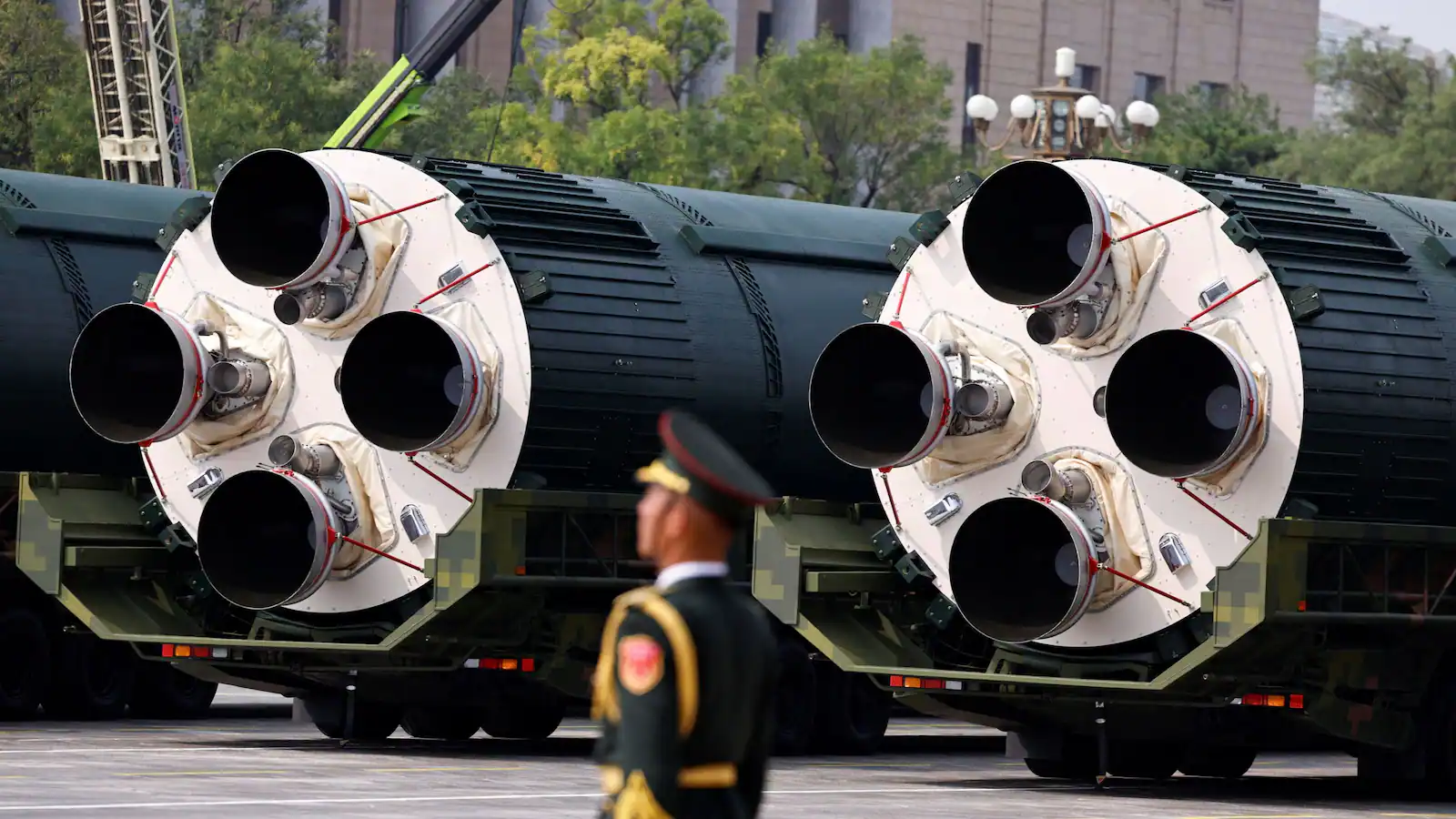
The United States on Friday accused China of carrying out a covert nuclear explosive test in 2020 and urged the launch of a broader arms control agreement that would include Beijing as well as Russia, as the last remaining U.S. Russian strategic arms treaty expired.
The allegation was made at a global disarmament conference in Geneva by U.S. Under Secretary of State for Arms Control and International Security Thomas DiNanno, who said Washington had evidence that China had conducted at least one “yield producing” nuclear test in violation of commitments under the Comprehensive Nuclear Test Ban Treaty (CTBT).
“I can reveal that the U.S. government is aware that China has conducted nuclear explosive tests, including preparing for tests with designated yields in the hundreds of tons,” DiNanno told delegates. He said one such test took place on June 22, 2020.
DiNanno said the Chinese military had tried to hide its activities by using techniques designed to weaken the ability of international monitoring systems to detect underground explosions. He said Beijing used “decoupling”, a method intended to reduce seismic signals, to conceal nuclear explosions from global sensors.
The U.S. allegations came one day after the New START treaty, which limited U.S. and Russian deployments of strategic nuclear missiles and warheads, expired. Its lapse leaves Washington and Moscow without any binding constraints on their arsenals for the first time since 1972.
China did not directly address the accusation. Shen Jian, Beijing’s ambassador on disarmament, told the conference that China had always acted prudently and responsibly on nuclear issues.
“China notes that the U.S. continues in its statement to hype up the so called China nuclear threat. China firmly opposes such false narratives,” Shen said. “It is the culprit for the aggravation of the arms race.”
China and the United States have both signed but not ratified the CTBT, which bans all explosive nuclear tests. Russia signed and ratified the treaty but withdrew its ratification in 2023. None of the three countries is legally bound by the treaty, but all have observed voluntary moratoriums on nuclear testing.
Robert Floyd, executive secretary of the Vienna based Comprehensive Nuclear Test Ban Treaty Organization (CTBTO), said the treaty’s global monitoring system had not detected any event consistent with a nuclear weapons test at the time cited by the United States.
“The international monitoring system did not detect any event consistent with the characteristics of a nuclear weapon test explosion,” Floyd said. “Further detailed analyses have not altered that determination.”
Diplomats attending the conference said the U.S. claims were new and concerning. Some said the lack of corroboration from the CTBTO monitoring system raised questions about the evidence Washington was relying on.
Read further: US Arrests Benghazi Attack Suspect, Faces Charges In Court
Daryl Kimball, executive director of the Arms Control Association, said any credible information about secret tests by China or Russia should be taken to the treaty’s governing body and addressed through technical discussions.
“Any U.S. resumption of testing in response to such allegations would not only be technically unnecessary but foolish and counterproductive because it would set off a chain reaction of nuclear testing by other nuclear armed states,” Kimball said.
U.S. President Donald Trump ordered the Pentagon in October to resume preparations for nuclear weapons testing, saying other countries were doing so, though he did not identify them or provide details.
The U.S. accusation comes as Washington is pushing for a new arms control framework that would replace New START and include China, which is rapidly expanding its nuclear arsenal.
In a post published on Substack, U.S. Secretary of State Marco Rubio said Russia and China should not expect the United States to stand still while they expanded their nuclear forces.
“We will maintain a robust, credible, and modernized nuclear deterrent,” Rubio wrote.
DiNanno told the Geneva conference that a bilateral treaty covering only Washington and Moscow no longer reflected current realities.
“Today, the United States faces threats from multiple nuclear powers. In short, a bilateral treaty with only one nuclear power is simply inappropriate in 2026 and going forward,” he said.
Read also: Oman Talks: A Fragile Opening Between US And Iran
He reiterated U.S. projections that China would have more than 1,000 nuclear warheads by 2030. China has previously said it maintains a much smaller arsenal and has no intention of engaging in an arms race.
Beijing has estimated to possess about 600 warheads, compared with roughly 4,000 each for the United States and Russia, according to publicly available assessments.
Shen said China would not take part in trilateral negotiations at this stage.
“In this new era we hope the U.S. will abandon Cold War thinking and embrace common and cooperative security,” he said.
Trump this week described talks with Chinese President Xi Jinping on trade and broader security issues as “very positive” and is due to visit Beijing in April. The White House did not say whether nuclear arms control featured in those discussions.
The expiry of New START has raised concern among security analysts that the world’s two largest nuclear powers will be forced to rely on worst case assumptions about each other’s intentions, increasing the risk of miscalculation.
Russia’s Foreign Minister Sergei Lavrov said on Friday that Moscow was ready for any scenario following the treaty’s expiration but preferred dialogue with Washington. The Kremlin said U.S. and Russian officials had agreed in talks in Abu Dhabi this week that both sides would act responsibly.
Russia has said that any future arms control talks should also include the nuclear forces of Britain and France, a position both countries reject.
At the Geneva forum, Britain said China, Russia and the United States should come to an understanding, adding that it shared U.S. concerns about the pace of Beijing’s nuclear buildup. France said agreement between the states with the largest arsenals was crucial at a time when nuclear norms were weakening.
Security analysts said a comprehensive new treaty would likely take years to negotiate, given tensions over Ukraine, the Middle East and other flashpoints, as well as the development of new weapons technologies.
For now, no formal talks on a successor to New START have been announced. U.S. officials said discussions on the future of arms control would continue through diplomatic channels, while China and Russia have both said they are not prepared to enter new negotiations under current conditions.