
Israeli President Isaac Herzog’s Australia visit on Monday drew sharply contrasting reactions, underscoring the country’s deepening divisions over Israel’s war in Gaza.
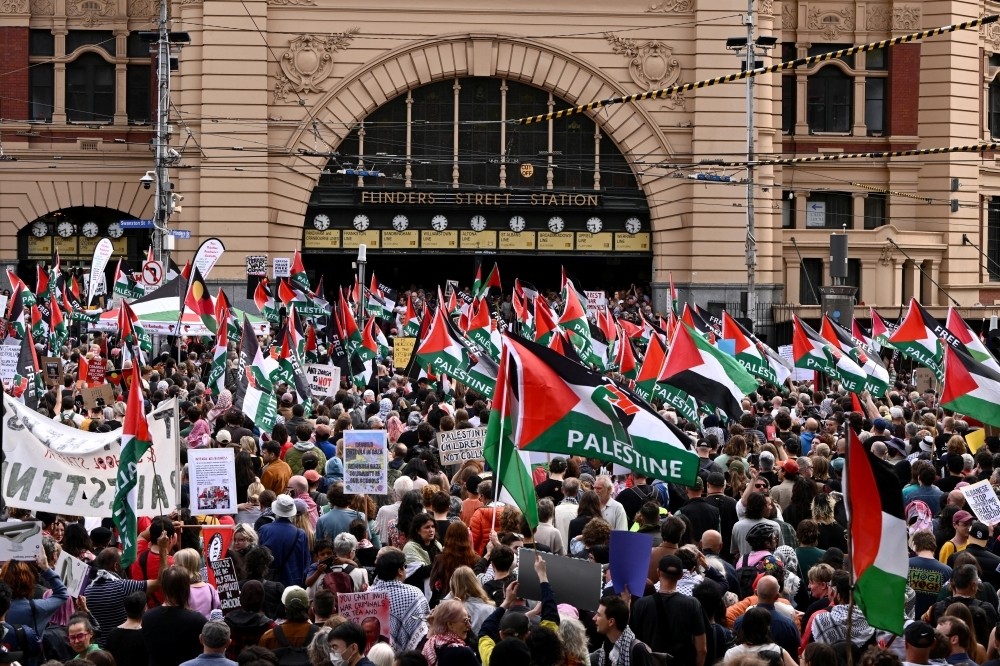
While the federal government rolled out a formal welcome to signal solidarity with Jewish Australians after a deadly attack in Sydney, thousands of protesters filled city streets calling Herzog a war criminal and demanding his arrest.
Prime Minister Anthony Albanese invited Herzog to Sydney as a gesture of unity following a December 14 attack at a Hanukkah festival near Bondi Beach that killed 15 people, the deadliest terror incident in Australia’s history. The invitation came amid heightened concern about antisemitism and social cohesion, but it also ignited anger among pro-Palestinian activists and civil liberties groups who oppose Israel’s military campaign in Gaza.
Within hours of Herzog’s arrival, those tensions played out publicly—through court filings, mass demonstrations, and clashes between police and protesters—making the Isaac Herzog Australia visit protests one of the most contentious diplomatic moments Australia has faced in recent years.
Herzog landed in Sydney on Monday and laid a wreath at the Bondi Pavilion, near the site of the December massacre. The ceremony was intended to honor the victims and reassure Australia’s Jewish community that the government stands with them in the face of violence.
Albanese has repeatedly emphasized the need for national unity since the attack, urging Australians to reject hatred and avoid importing overseas conflicts into domestic politics. Inviting Israel’s largely ceremonial head of state was meant to reinforce that message, according to officials familiar with the decision.
For some survivors, the symbolism mattered. Yvonne, who survived the Bondi attack after sheltering under a picnic table with her 2-year-old son as gunmen fired on the crowd, said Herzog’s presence brought comfort.
“It means we’re not alone. He’s come from the other side of the world,” she said. “It means wherever we are in the world, we are supported by Israel. It means a lot.”
Major Jewish organizations, including the Executive Council of Australian Jewry and the Australian Jewish Association, welcomed Herzog’s visit and condemned the protests, saying they risked inflaming tensions and retraumatizing a community still in mourning.
Read Also: Israel Knew About Hamas Attack Plan A Year Ago
At the same time, activists opposed to Israel’s actions in Gaza mobilized nationwide. As many as 30 protests were planned across Australia to coincide with Herzog’s visit, reflecting the intensity of public feeling around the conflict.
The largest demonstration took place outside Sydney Town Hall, where thousands of pro-Palestinian protesters gathered Monday evening. Police moved in to disperse the crowd, deploying pepper spray and making multiple arrests as scuffles broke out.
New South Wales Police Assistant Commissioner Peter McKenna told reporters that 27 people were arrested. Ten were charged with assaulting police, while 17 faced offenses related to failing to comply with directions to move on.
The Palestine Action Group condemned what it described as a “brutal attack” by police on what it said was a peaceful protest. Lawyers representing the group had earlier argued in court for the right to demonstrate within areas affected by newly imposed government restrictions during the visit.
Footage circulating on social media appeared to show police forcibly dispersing a group of Muslims praying in the street. In response, the Australian National Imams Council issued a statement calling the police conduct “shocking, deeply disturbing, and entirely unacceptable,” and urged authorities to respect religious freedom and the right to peaceful assembly.
Police said their actions were necessary to maintain public order and ensure safety, citing intelligence about potential disruptions and the need to enforce protest conditions during a high-profile foreign visit.
Calls for Herzog’s arrest added another layer of controversy. Some activists argue that as Israel’s head of state, he bears responsibility for alleged war crimes in Gaza. Israel’s government strongly denies accusations of genocide or systematic violations of international law.
Legal experts note that such calls face steep hurdles. As a visiting head of state, Herzog is protected by diplomatic immunity under international law, and his role is largely ceremonial. Executive authority over Israel’s military campaign rests with Prime Minister Benjamin Netanyahu and his cabinet.
Read Also: Isreali War: Death Toll Hit 2,700 As US, UK Evacuate Citizens
Herzog has repeatedly defended Israel’s actions since Hamas’ October 7 attack, which Israel says killed more than 1,200 people and saw hundreds taken hostage. Israel’s subsequent military offensive in Gaza has killed more than 70,000 Palestinians, according to the Palestinian Ministry of Health, a figure cited by international media while noting the ministry does not distinguish between civilians and combatants.
The Isaac Herzog Australia visit protests highlight how overseas conflicts can sharpen domestic fault lines, particularly in multicultural societies. Albanese’s government has framed the visit as an act of solidarity with victims of terrorism and a stand against antisemitism. Critics counter that hosting an Israeli leader during an ongoing war sends the wrong signal and marginalizes Palestinian voices.
Civil liberties advocates have also raised concerns about protest restrictions and police powers, warning that measures introduced for security reasons could set precedents that outlast the visit.
For now, the government appears determined to hold its line. Officials insist that supporting Jewish Australians after a mass-casualty attack does not preclude concern for Palestinian civilians or criticism of Israel’s policies.