
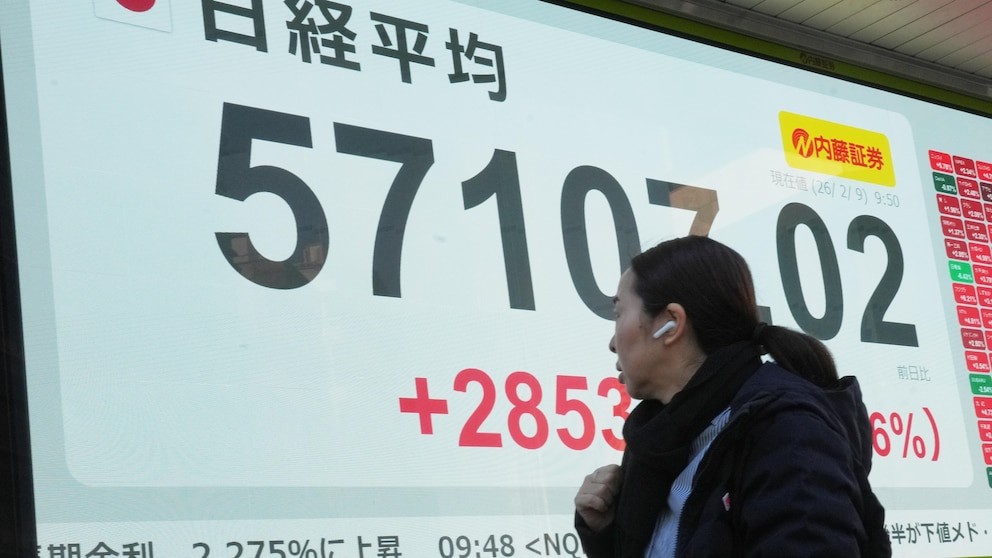
Japanese equities climbed to an unprecedented level on Monday after Prime Minister Sanae Takaichi’s ruling Liberal Democratic Party secured a commanding parliamentary majority in a snap election, strengthening expectations of expanded fiscal support and business-friendly reforms.
The benchmark Nikkei 225 rose sharply at the start of trading, at one point surpassing the 57,000 threshold for the first time, before easing to close 3.9% higher at 56,363.94, a record finish. Market participants attributed the rally to political clarity following the vote and to investor anticipation of policy continuity under Takaichi’s administration.
Official results showed the LDP winning 316 seats in Japan’s 465-member lower house, marking the first time a single party has achieved a two-thirds majority since the modern parliamentary system was established in 1947. Coalition partner the Japan Innovation Party secured 36 additional constituencies, bringing the governing bloc’s total to 352 seats and giving it a dominant legislative position.
The outcome gives Takaichi broad scope to advance economic measures without relying heavily on opposition support. Speaking to reporters after the result became clear, she said her government would pursue a “responsible yet aggressive” fiscal stance and confirmed that she did not plan to reshuffle the cabinet formed less than four months ago. “We bear an extremely heavy responsibility to focus on steadily delivering on the campaign pledges we have made,” she said, according to Kyodo.
Takaichi, Japan’s first female prime minister, called the early election only weeks after taking office in October. The gamble contrasted with the difficulties faced by her predecessors, under whom the LDP lost its majority amid corruption controversies and struggled to contain rising living costs. Analysts said the strong mandate has eased concerns about political instability that had weighed on markets in recent years.
Read Also: Moon City Project Takes Priority Over Mars, Musk Announces
Investment strategist Yuka Marosek said the combination of electoral certainty and anticipated policy changes could reinforce the ongoing rally in Japanese equities. The result and expected measures such as “stimulus, tax tweaks, and deregulation” would be “additional fuel for an existing bull trend,” she said.
However, reactions across asset classes were more mixed. Chris Scicluna, head of research at Daiwa Capital Markets Europe, said equity investors had “long been believers in Takaichi,” citing her pledge to end austerity and increase investment in sectors including defence and artificial intelligence. At the same time, he noted that bond and currency investors were more cautious. “Japanese government debt’s extremely high and investors in bonds and the yen want to know how she intends to finance her plans,” he said.
Japan’s public finances remain under close scrutiny, with government debt among the highest relative to economic output in the developed world. Takaichi has pledged tax cuts and higher spending to stimulate growth, but officials have not yet detailed funding mechanisms. Economists say the balance between fiscal expansion and debt sustainability will be a central test for the new administration.
Domestic concerns about living costs played a significant role in the campaign. Japan has long experienced low inflation, making recent increases in grocery prices, rent and utilities more politically sensitive. Voters interviewed at polling stations said household budgets had become strained, reflecting broader anxieties about economic security.
Longer-term structural challenges also loom. The country’s ageing population continues to shrink the labour force while driving up social care expenses, adding pressure on public finances and complicating efforts to accelerate growth. The government has signalled that deregulation and targeted investment could help offset demographic headwinds, though policy specifics are still emerging.
Read Also: Bullion Gains Grow As Traders Monitor Currency, Economy
Beyond economic policy, Takaichi has consolidated support among conservative LDP members by reviving discussion of revising Japan’s pacifist constitution and promoting traditional social values. At the same time, her campaign style — including distinctive fashion accessories that gained popularity among younger supporters — helped broaden her appeal beyond the party’s traditional base, according to political analysts.
Internationally, the election result drew swift reactions. U.S. President Donald Trump congratulated Takaichi on social media, calling it an “Honor” to have endorsed her before the vote and saying, “The wonderful people of Japan, who voted with such enthusiasm, will always have my strong support.” The two leaders have cultivated a close working relationship since Trump’s visit to Tokyo shortly after Takaichi assumed office, where he appeared alongside her at a public event with U.S. troops.
Japan’s foreign policy direction is likely to remain closely aligned with Washington, particularly in areas such as defence cooperation and technology policy. Takaichi is scheduled to travel to the United States in March for a second meeting with Trump, which officials say will focus on economic collaboration and regional security issues.
With the election settled, attention now shifts to how quickly the government will translate its expanded parliamentary majority into legislation. Lawmakers are expected to begin deliberations on fiscal measures and potential regulatory changes when the new session of parliament convenes, with investors watching for details on stimulus plans and funding proposals in the weeks ahead.