
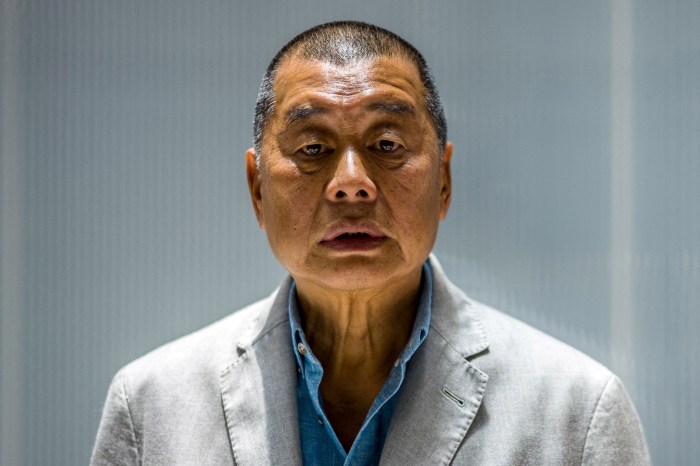
A Hong Kong court on Monday sentenced pro-democracy media tycoon Jimmy Lai to 20 years in prison under Beijing’s national security law, bringing to a close the city’s most prominent and politically sensitive prosecution since the law was imposed in 2020.
The sentence ends a legal saga that has lasted nearly five years and has drawn global attention to the shrinking space for dissent and press freedom in the Chinese-ruled city.
Lai, 78, the founder of the now-closed Apple Daily newspaper, was convicted last year on two counts of collusion with foreign forces and one count of seditious publication. The High Court ruled that the offences were of a “grave nature”, placing them in the most serious sentencing category, which carries penalties ranging from 10 years to life imprisonment.
In delivering the sentence, the court said Lai played a central role in the offences, describing him as the “mastermind” and driving force behind the activities that formed the basis of the charges.
Lai, who is also a British citizen, has denied all wrongdoing. In earlier court statements, he described himself as a “political prisoner” and said he was being persecuted for his beliefs.
Given his age and health, the 20-year term is likely to keep him behind bars for the rest of his life.
Before being led away from the courtroom, Lai stood expressionless as several people in the public gallery wept.
Six former senior Apple Daily employees, an activist and a paralegal were also sentenced on Monday in the same case. Their prison terms ranged from six years and three months to 10 years, the court said.
Those convicted included publisher Cheung Kim-hung, associate publisher Chan Pui-man, editor-in-chief Ryan Law, executive editor-in-chief Lam Man-chung, executive editor-in-chief for English news Fung Wai-kong, and editorial writer Yeung Ching-kee.
The sentencing drew swift condemnation from press freedom and human rights groups.
“The rule of law has been completely shattered in Hong Kong,” said Jodie Ginsberg, chief executive of the Committee to Protect Journalists. “This decision is a final blow to press freedom in the city.”
Elaine Pearson, Asia director of Human Rights Watch, said the sentence amounted to “a life term by another name” and urged governments to press for Lai’s release.
Lai’s case has also been raised by foreign leaders. British Prime Minister Keir Starmer said last month he had discussed Lai’s detention during talks with Chinese President Xi Jinping. The United States has repeatedly called for his freedom.
Beijing and Hong Kong authorities have dismissed international criticism, saying Lai’s case has nothing to do with press freedom and that the courts are acting independently.
Read also: China Condemns Islamabad Explosion, Backs Pakistan Security
Lai was first arrested in August 2020, weeks after Beijing imposed the national security law on Hong Kong in response to mass pro-democracy protests the year before. The law criminalises secession, subversion, terrorism and collusion with foreign forces, with penalties of up to life imprisonment. Since its introduction, dozens of activists, politicians and journalists have been arrested or jailed.
Apple Daily, once Hong Kong’s most outspoken pro-democracy newspaper, became an early target. Its newsroom was raided multiple times, senior staff were arrested and its assets were frozen.
Unable to pay staff or operate financially, the paper shut down in June 2021. Its final edition sold about one million copies, with long queues forming outside newsstands across the city.
Lai’s family and lawyers have warned that he is in fragile health. They say he suffers from heart palpitations and high blood pressure and that long-term imprisonment poses serious risks.
His daughter, Claire Lai, said in a statement that the family would continue to push for his freedom. “We will never stop fighting for my father,” she said.
Security around the sentencing was tight. Police searched and questioned several people near the West Kowloon court complex, including individuals carrying Apple Daily memorabilia.
The case has become a symbol of the wider clampdown on media and civil society in Hong Kong.
According to the Hong Kong Journalists Association, dozens of reporters have faced harassment, intimidation and legal pressure in recent years. Many independent outlets have closed, while foreign media organisations have downsized or relocated staff.
Reporters Without Borders says nearly 900 journalists lost their jobs in Hong Kong in the four years after the national security law took effect.
Hong Kong’s government rejects claims that press freedom has been destroyed, saying media remain free as long as they operate within the law.
Lai’s supporters argue the law has been used to silence dissent and dismantle independent journalism in a city that once prided itself on open debate and a free press.
For many in Hong Kong, Monday’s sentencing marked the end of an era.
Lai, a self-made businessman who built a media empire after fleeing mainland China as a child, had long been a vocal critic of the Chinese Communist Party and a prominent backer of Hong Kong’s pro-democracy movement. With his conviction and the closure of Apple Daily, few major platforms remain for organised opposition voices in the city.
As Lai was taken back into custody, the courtroom emptied quietly, with police escorting observers from the building under heavy security.
The next stage of his case is expected to focus on appeals, though legal experts say the chances of overturning the verdict under the current system are slim.