
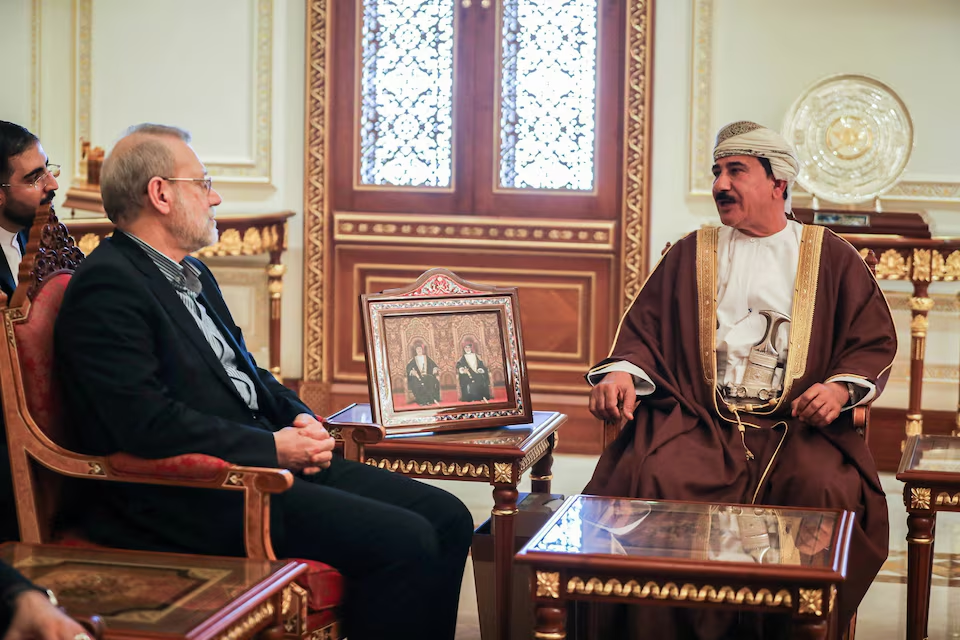
A senior Iranian security official met Oman’s sultan Tuesday to discuss pathways toward what both sides described as a “balanced and just” agreement with the United States, four days after indirect talks in Muscat aimed at preventing military escalation over Tehran’s nuclear program.
Ali Larijani, secretary of Iran’s Supreme National Security Council and a close adviser to Supreme Leader Ayatollah Ali Khamenei, held nearly three hours of discussions with Sultan Haitham bin Tariq at the royal palace, Oman’s state news agency reported. The meeting came as Washington and Tehran attempt to navigate competing demands over uranium enrichment, ballistic missiles, and sanctions relief, negotiations complicated by mutual distrust, regional tensions, and domestic political pressures in both capitals.
Oman News Agency said Larijani and the sultan “discussed the latest developments in the Iranian-American negotiations” and explored “ways to reach a balanced and just agreement between the two sides,” stressing the importance of returning to dialogue to bridge differences and promote regional and global peace and security. Iranian state media said the meeting lasted nearly three hours, suggesting substantive engagement rather than ceremonial courtesy, a detail analysts noted as potentially significant given the high stakes and narrow diplomatic opening.
Larijani also met Foreign Minister Badr al-Busaidi, Oman’s chief intermediary in the U.S.-Iran talks, with photographs showing what appeared to be a letter or document in a plastic sheath placed beside the Omani diplomat during their session.
Read Also: Oman Talks: A Fragile Opening Between US And Iran
Iran has historically communicated positions in writing when dealing with Americans, a practice dating to decades of severed diplomatic relations and deep mutual suspicion. Iranian media initially reported Larijani would deliver an important message but later described al-Busaidi as having “handed over a letter” to the Iranian official, a formulation that left unclear whether Tehran received a U.S. communication or delivered Iran’s response to last week’s discussions.
The talks followed Friday’s inaugural round of indirect negotiations in Muscat, which both sides characterized cautiously as a constructive beginning that justified continued diplomacy despite fundamental disagreements. Iranian Foreign Minister Abbas Araghchi, who led Tehran’s delegation, described the session as a “good start” and said both governments intended to continue discussions, though no date or venue for the next round has been announced.
Esmaeil Baghaei, Iran’s foreign ministry spokesman, said Monday that Tehran had gauged Washington’s seriousness during Friday’s talks and found sufficient consensus to proceed. “After the talks, we felt there was understanding and consensus to continue the diplomatic process,” Baghaei said, though he provided no specifics on what understandings were reached or what issues remained unresolved beyond broad statements about respecting Iran’s rights and lifting sanctions.
The diplomatic engagement unfolds against a backdrop of heightened military tensions and recent violence. President Donald Trump positioned a naval flotilla in the Persian Gulf and threatened strikes if Iran attempts to rebuild its nuclear program, which the United States and Israel attacked in June during a 12-day conflict that killed more than 600 people in Iran according to Tehran’s health ministry. American B-2 bombers dropped massive ordnance penetrators on the Fordow uranium enrichment facility buried deep inside a mountain, while Tomahawk cruise missiles struck the Natanz and Isfahan nuclear sites—attacks Trump claimed “completely and totally obliterated” Iran’s enrichment capabilities though subsequent intelligence assessments suggested significant underground components survived.
Since those strikes, Iran has said it halted enrichment activity, though satellite imagery published last week showed new construction at damaged facilities that analysts interpreted as efforts to obscure ongoing work from overhead surveillance.
Read Also: New START Treaty Expires; U.S. Seeks New Nuclear Arms Pact
Tehran maintains its nuclear program serves solely peaceful purposes and that enrichment for civilian energy and medical isotopes falls within rights guaranteed under the Nuclear Non-Proliferation Treaty, a position the United States and its allies reject given Iran’s production of uranium enriched to 60 percent purity, a threshold close to weapons-grade that officials in Washington and Jerusalem say has no civilian justification.
Trump also threatened military intervention in January after Iranian security forces killed thousands of protesters during nationwide demonstrations sparked by economic collapse, soaring inflation, and currency devaluation. The president warned Tehran “we are locked and loaded and ready to go” and said the United States would “come to their rescue” if Iran shot peaceful demonstrators, though he ultimately held off from strikes as the protests were violently suppressed and back-channel communications through Oman indicated Tehran’s willingness to resume nuclear negotiations.
The current diplomatic process centers on overlapping but competing demands. Washington insists Iran relinquish its stockpile of uranium enriched to 60 percent, estimated by the International Atomic Energy Agency at more than 440 kilograms last year, sufficient for approximately 10 nuclear weapons if further enriched to 90 percent, and accept permanent limitations on enrichment levels and quantities.
Trump has repeatedly called for total prohibition on Iranian enrichment, a condition Tehran has rejected as violating its treaty rights and national sovereignty.
The United States also seeks to expand negotiations beyond the nuclear file to include Iran’s ballistic missile program, one of the Middle East’s largest and most capable arsenals. Tehran says its missiles are defensive, non-negotiable, and essential to deterring adversaries including Israel and the United States, which maintain overwhelming conventional military superiority. Baghaei said Monday the U.S. “must act independently of foreign pressures, especially Israeli pressures that ignore the interests of the region and even the U.S.” when formulating negotiating positions, a reference to Prime Minister Benjamin Netanyahu’s expected efforts during a Washington visit Wednesday to demand any agreement include missile restrictions.