
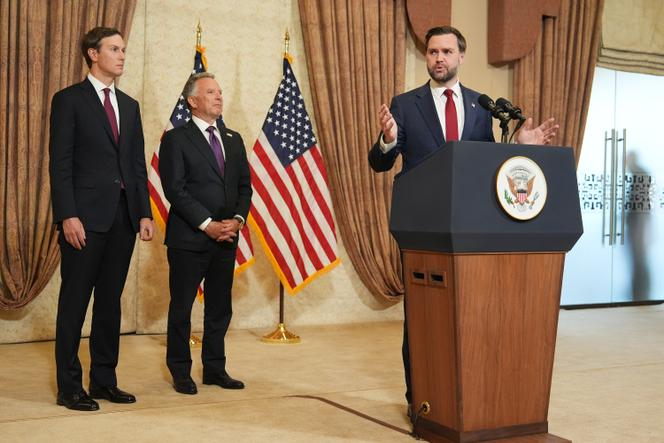
The split surfaced over Lebanon. Vice President JD Vance, speaking at the White House last week, criticized Israeli strikes on civilian infrastructure in Beirut, arguing the bombings — meant to degrade Hezbollah after the group’s attacks on Israel — were working against the peace process Washington has spent months building with Tehran. Secretary of State Marco Rubio took the opposite position days later, touring the Gulf and repeatedly framing Israel’s Lebanon campaign as a justified response to Hezbollah aggression. Asked directly about Vance’s remarks, Rubio sidestepped the question and instead described a Hezbollah assault on an Israeli checkpoint earlier in the week.
Neither man addressed the other by name. Neither needed to.
The disagreement traces back further than Lebanon. Vance spent his pre-administration career arguing that foreign wars drained American lives and money for little return. Rubio built his Senate reputation as a hawk, pushing confrontational policy toward Iran, Russia and Cuba. Those instincts now sit inside the same administration, attached to two men who polling and political analysts alike treat as the most likely contenders for the Republican nomination in 2028.
That timeline matters. Whatever daylight exists between Vance and Rubio today reads, to most observers, as an early staking-out of ground for a future primary.
Read also: France Presses Lebanon Peace Plan As Israel Rejects Demand
Both were dispatched abroad last week specifically to shore up support for the preliminary U.S.-Iran accord signed June 17, and both delivered strikingly different messages while doing it. Vance traveled to Switzerland for talks with Iranian officials and emerged sounding almost evangelical about the relationship’s potential, telling reporters Sunday he saw room for a fundamentally more cooperative future between Washington and Tehran. He has floated Gulf states financing Iran’s reconstruction. In an interview released Thursday, he disclosed that the U.S. had invited an Iranian intelligence official to work as a deconfliction liaison with the Pentagon in Qatar — a level of operational coordination that would have been unthinkable months earlier.
Rubio, touring the United Arab Emirates, Kuwait and Bahrain, spent his trip doing something closer to damage control. Gulf allies have signaled concern that the interim accord gives Tehran too much, and Rubio worked to reassure them their interests would not be sacrificed for speed. On Tuesday, he explicitly ruled out asking those allies to help fund Iran’s reconstruction, calling the idea “far down the road” — directly undercutting a possibility his own vice president had been promoting. By Thursday, in a separate meeting with regional officials, he was drawing harder lines: “While we want a deal, we don’t want a deal at any price.”
The White House response was immediate and uniform: there is no daylight at all. Spokeswoman Anna Kelly said the administration operates as a single camp behind the president’s commitment to preventing Iran from acquiring a nuclear weapon. State Department spokesman Tommy Pigott went further, calling the entire premise of a Rubio-Vance split a “tired and fake” narrative and insisting the administration remains “100% in lockstep” behind Trump. A separate State Department official said the U.S. position on Lebanon was equally unified, framed around restoring full Lebanese government sovereignty over its own territory.
Not everyone is buying the unity message. Michael Rubin, a senior fellow at the American Enterprise Institute, put it plainly: Rubio and Vance represent different strains of Republican foreign policy at their core, whatever language the White House uses to paper over it.
Read also: Israel Opens Ground Push In Southern Lebanon
Those strains run deeper than two officials. They run through the party’s voters. A Reuters/Ipsos poll that closed Monday found only 52% of Republicans believe the current Iran conflict has left the U.S. in a stronger position — a number that suggests roughly half the party isn’t convinced its own administration’s approach is working.
What keeps Rubio and Vance from breaking openly is Trump himself. Both men backed his capture of Venezuelan leader Nicolas Maduro. Both backed his February strike on Iran. Both backed the pivot to peace talks that followed. And when a reporter pressed Rubio on Thursday about exactly how far his views diverge from the vice president’s, he gave the only answer the moment allowed: “Everyone here is aligned behind the president.”
It is true, and it is also beside the point. Two men auditioning for the same job in 2028 are using the same talking points this week. What happens when Trump is no longer the one writing them is the question nobody in the administration is answering yet.