
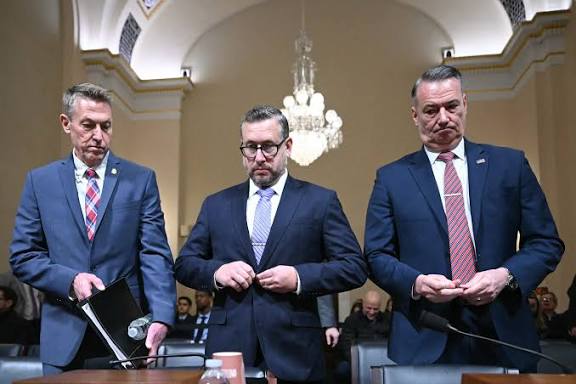
WASHINGTON — The heads of the agencies implementing President Donald Trump’s immigration policies appeared before Congress on Tuesday to answer questions about enforcement operations within U.S. cities, amid rising scrutiny following recent incidents involving federal officers.
Todd Lyons, acting director of U.S. Immigration and Customs Enforcement (ICE); Rodney Scott, commissioner of U.S. Customs and Border Protection (CBP); and Joseph Edlow, director of U.S. Citizenship and Immigration Services (USCIS) testified before the House Committee on Homeland Security.
Lawmakers focused on the agencies’ methods for arresting and deporting immigrants, as well as their conduct during domestic operations.
The hearings mark the first congressional appearances for all three officials since last summer, when the Department of Homeland Security (DHS) received a substantial budget increase and enforcement activities accelerated nationwide. The testimony comes at a time when public approval of the administration’s immigration policies has declined, according to recent polls.
ICE, under Lyons’ leadership, has expanded staffing significantly, enabling a broader deployment of officers to cities across the United States. These operations have emphasized increasing arrests and deportations, sparking debate over their impact on local communities and potential civil rights implications. Members of Congress pressed Lyons on a memorandum he issued last year authorizing ICE officers to enter private residences without a judge-issued warrant to detain individuals subject to deportation.
Read Also: Maxwell To Refuse Congressional Questions, Lawyer Says
Critics have argued that the directive conflicts with long-standing agency practice and Fourth Amendment protections against unlawful searches.
Scott, overseeing CBP, has directed an expanded role for Border Patrol agents in domestic arrests and removals. Traditionally responsible for controlling borders and regulating cross-border movement, the agency’s increased interior presence has drawn attention and criticism. Under the leadership of commander Gregory Bovino, teams of agents were deployed to cities including Los Angeles, Chicago, Charlotte, and New Orleans, where they were accused in some instances of broadly questioning and detaining individuals suspected of being in the country illegally. Bovino defended the operations, stating that targets were identified through intelligence and that any use of force was justified.
The heightened enforcement focus followed a January incident in Minneapolis in which two protesters were fatally shot during demonstrations against federal immigration operations. One individual, Alex Pretti, was killed when a CBP officer and a Border Patrol agent discharged their weapons; the other, Renee Good, was shot by an ICE officer.
Following the shootings, Bovino was reassigned and the administration dispatched border czar Tom Homan to oversee operations in Minneapolis directly.
USCIS, the agency responsible for immigration benefits and asylum adjudications, has also faced scrutiny.
Measures under Edlow’s direction include additional vetting for refugees already admitted to the United States and a temporary pause on decisions in pending asylum cases.
Critics contend these steps have contributed to processing delays and heightened uncertainty for applicants, while the agency maintains the procedures are intended to uphold legal and security standards.
Read Also: Clintons To Testify In House Epstein Investigation
The administration has consistently argued that its enforcement measures target individuals who have committed crimes or otherwise pose a risk to public safety. Officials contend that criticism has largely come from activist groups opposed to immigration enforcement, and that federal personnel are acting within the law. Lawmakers, however, questioned the balance between public safety objectives and adherence to constitutional protections, particularly in light of the Minneapolis shootings.
During the hearing, committee members raised broader concerns about DHS funding and oversight. Some members advocated for budgetary constraints tied to limits on officer conduct, while others emphasized the need to maintain operational flexibility to address national security and immigration priorities.
DHS agencies have seen significant increases in funding since 2017, enabling the hiring of additional ICE officers and CBP personnel and the deployment of new enforcement initiatives.
The congressional session also highlighted the tension between federal immigration enforcement and local jurisdictions. Several city leaders have expressed opposition to intensified federal operations within their communities, arguing that aggressive interior enforcement can strain public trust and complicate local policing efforts. Federal officials counter that enforcement targets are selected based on intelligence and criminal history, and that the operations are necessary to uphold federal law.
Testimony revealed ongoing internal debates over policy implementation. Lyons and Scott were pressed on agency protocols for warrantless entries and the use of force, while Edlow faced questions about the procedural and legal basis for additional refugee vetting and asylum case suspensions. The hearing provided lawmakers with the first comprehensive opportunity to question all three officials simultaneously since the nationwide escalation of interior enforcement.
The session concluded without a vote on funding restrictions or new legislative measures, but lawmakers indicated continued oversight will follow. Committee members signaled plans to request documentation on enforcement operations, internal guidelines, and incident reports related to use-of-force cases. DHS officials said they would provide the requested materials for review.
The next scheduled oversight activity will include follow-up briefings and document submissions from ICE, CBP, and USCIS, with lawmakers expected to evaluate whether current procedures comply with statutory and constitutional requirements. No additional operational directives or policy changes were announced at the conclusion of Tuesday’s hearings.