
The United States Environmental Protection Agency on Thursday rescinded a 2009 scientific determination that greenhouse gases endanger public health, a step that removes the legal basis for many federal climate regulations and marks a major shift in U.S. environmental policy under President Donald Trump’s administration.
The action overturns the so called endangerment finding, adopted during President Barack Obama’s administration, which concluded that carbon dioxide and other greenhouse gases contribute to climate change and pose risks to human health and welfare. The determination has served for more than a decade as the foundation for rules regulating emissions from vehicles, power plants and other industrial sources under the Clean Air Act.
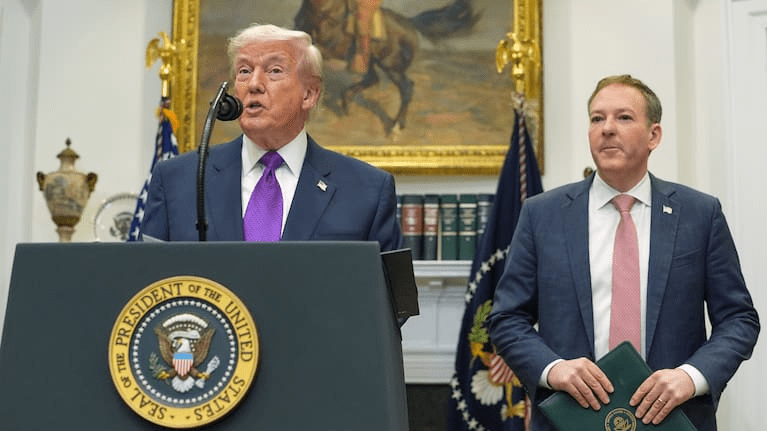
At a White House ceremony, Trump praised the move as a sweeping rollback of federal regulation. He described the finding as “one of the greatest scams in history” and said it “had no basis in fact” or law. “Over the generations, fossil fuels have saved millions of lives and lifted billions of people out of poverty all over the world,” he said, calling the repeal “the single largest deregulatory action in American history, by far.”
EPA Administrator Lee Zeldin, who attended the event, said the finding had enabled excessive federal oversight. He called it “the Holy Grail of federal regulatory overreach” and said previous administrations relied on it to justify wide ranging climate policies affecting transportation and energy production.
Read also: Portugal Home Affairs Chief Resigns Over Tempest Management
The 2009 determination followed a 2007 U.S. Supreme Court ruling that greenhouse gases qualify as pollutants under the Clean Air Act, obligating the agency to assess whether they endanger public health or welfare. The EPA’s affirmative finding allowed federal regulators to set emissions standards for passenger cars and heavy duty trucks and later to impose requirements on power generation and oil and gas operations.
With the finding withdrawn, emissions standards for automobiles tied directly to greenhouse gas limits are expected to lapse unless replaced by new regulations. Legal specialists say the decision could also affect rules governing power plants and industrial facilities because many depend on the same statutory authority.
The EPA also said it would end certain tax incentives linked to automatic engine start stop systems installed by some automakers to reduce fuel consumption and emissions. Zeldin said the technology was unpopular with drivers.
The agency issued the new rule after Trump directed it in an executive order to review “the legality and continuing applicability” of the finding. Conservatives have long argued that climate regulations based on the determination impose significant costs on industry and consumers.
Environmental organisations and several former officials said they expected immediate legal challenges. Courts have previously upheld the agency’s authority to regulate greenhouse gases under the Clean Air Act, and legal scholars said the repeal is likely to be reviewed for compliance with administrative law standards requiring agencies to justify reversals of established findings.
Ann Carlson, an environmental law professor, said overturning the determination would have broad consequences for federal policy and could trigger extensive litigation. Gina McCarthy, a former EPA administrator and White House climate adviser, criticised the decision, saying the agency has an obligation to address pollution and climate related risks.
Democratic Senator Ed Markey also condemned the action, saying it endangered public health and environmental protections.
Supporters of the change said it would reduce regulatory burdens on manufacturers and energy producers and allow greater flexibility in domestic energy development. Industry groups have argued that emissions rules tied to the finding contributed to higher compliance costs and influenced vehicle design and fuel standards.
Read further: Moon City Project Takes Priority Over Mars, Musk Announces
The endangerment finding had supported a series of federal policies intended to limit warming linked to rising greenhouse gas concentrations. Scientists have associated those emissions with increasing global temperatures and a higher likelihood of extreme weather events including heat waves, floods and wildfires.
The EPA’s rule will be published in the Federal Register, beginning a period during which affected parties can file legal challenges. Federal courts are expected to determine whether the agency’s reversal satisfies statutory requirements and whether the underlying scientific record justifies the change.