
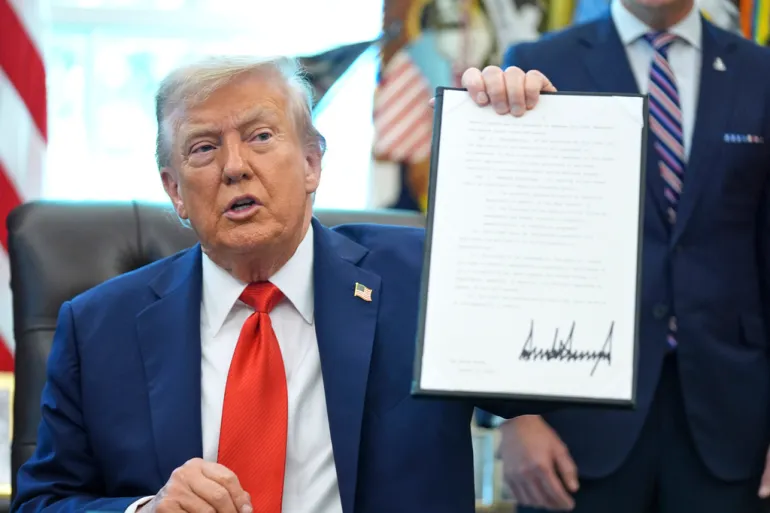
President Donald Trump signaled Friday he intends to issue an executive order compelling election administrators to mandate voter identification, bypassing Congress after legislative efforts stalled.
Trump announced the planned action in a social media post, expressing impatience with the pace of congressional action on the matter. “This is an issue that must be fought, and must be fought, NOW,” he wrote.
“If we can’t get it through Congress, there are Legal reasons why this SCAM is not permitted. I will be presenting them shortly, in the form of an Executive Order.”
The Republican president did not specify what legal justifications he would invoke. His statement came two days after the House of Representatives approved legislation requiring documentary proof of citizenship before voter registration. That bill faces steep odds in the Senate, where it lacks sufficient support to overcome procedural hurdles.
Federal law already prohibits non-citizens from participating in U.S. elections, and documented instances of voter fraud remain exceptionally rare. Nevertheless, Trump and Republican allies have persistently alleged widespread electoral irregularities. Trump continues to claim falsely that he won the 2020 presidential election, despite bipartisan confirmation from election officials that the results were accurate.
With polling showing declining approval ratings, Trump has focused attention on November’s midterm elections, which will determine congressional control for the final two years of his term. He has warned publicly that a Democratic majority in the House could lead to a third impeachment.
Trump was impeached twice during his first term—once for abuse of office and again for inciting insurrection following the January 6, 2021 attack on the Capitol by his supporters.
The midterm contests featured prominently in Friday’s message. Trump urged Republican candidates to emphasize voter identification requirements in their campaigns. “Republicans must put this at the top of every speech – It is a CAN’T MISS FOR RE-ELECTION IN THE MIDTERMS, AND BEYOND,” he wrote.
Public opinion data suggests broad support for identification requirements. A 2025 Pew Research Center study found that 95 percent of Republicans and approximately 71 percent of Democrats favored requiring photo identification before voter registration.
Democratic leadership and voting rights organizations have opposed such measures, arguing they create barriers for low-income and marginalized citizens who may lack ready access to identity documents. Advocates contend these requirements could disenfranchise eligible voters.
Roughly 36 states currently maintain voter identification laws, though they vary considerably in stringency and what forms of documentation they accept.
Read also: U.S. Sends Second Aircraft Carrier To Middle East Amid Tensions
Congress has considered similar legislation previously, including last year. The current push has intensified as the midterms approach and Trump pressures states to cede greater federal authority over election administration.
The Constitution assigns states responsibility for determining “times, places and manner of holding elections,” meaning electoral processes operate at state and local levels rather than under federal control.
Trump has suggested overriding that constitutional structure. Speaking with conservative podcaster Dan Bongino earlier this month, he proposed federal takeover of voting procedures. “We should take over the voting, the voting, in at least, many, 15 places,” he said. “The Republicans ought to nationalise the voting.”
Those remarks coincided with renewed congressional consideration of the Safeguard American Voter Eligibility Act, introduced earlier this month. The legislation initially required citizenship documentation not only at registration but before each ballot cast, mandating passports or birth certificates—documents many Americans do not possess.
That provision was subsequently modified, but critics have challenged other elements, including requirements that state voter rolls be transmitted to federal authorities, as unconstitutional overreach.
The House passed the bill Wednesday with 218 votes in favor and 213 opposed. Only one Democrat, Henry Cuellar, supported the measure.
Senate prospects remain dim. The legislation appears unlikely to attract the 60 votes needed to overcome a filibuster, the procedural mechanism allowing the minority party to block legislation in the 100-member chamber.
Trump attacked the filibuster and Democrats in his Friday post. “We cannot let the Democrats get away with NO VOTER I.D. any longer. These are horrible, disingenuous CHEATERS,” he wrote.
He also urged the Supreme Court to reject Democratic priorities, describing them as “corrupt,” “deranged,” “demented” and “evil.”
The Brennan Center for Justice, an advocacy organization, called on the Senate to defeat the voter identification push. “These bills are part of a broader federal agenda to sow distrust in our elections, undermine election administration, and discourage Americans from making their voices heard,” the group said in a statement.
Read also: US Forces Gear Up For Potentially Prolonged Iran Operations
“Congress should stand firm once again and reject the SAVE Act.”
Legal scholars have questioned whether Trump possesses constitutional authority to impose voter identification requirements through executive action. The Constitution’s delegation of election administration to states limits federal power to intervene in such matters absent congressional legislation.
Previous attempts by presidents to alter election procedures unilaterally have faced court challenges. Any executive order Trump issues would likely draw immediate legal scrutiny from civil liberties organizations and state governments defending their constitutional prerogatives.
The timing of Trump’s announcement, with midterms eight months away, suggests the issue may serve primarily as a campaign talking point for Republican candidates rather than an immediately executable policy change.