
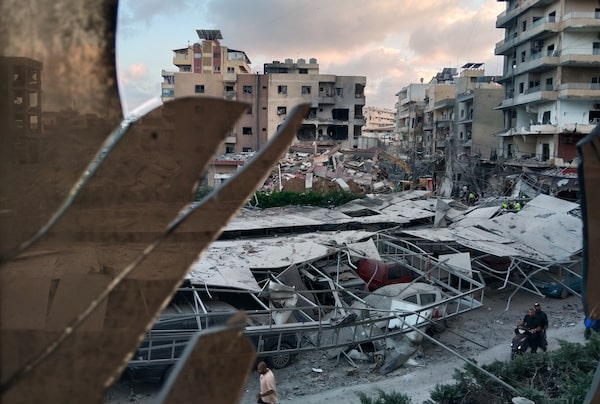
The guns in southern Lebanon did not stop when Donald Trump announced they would. By the time the US president had finished describing the agreement he brokered between Israel and Hezbollah on Monday, Israeli armor was already rolling deeper into Lebanese territory than at any point in a quarter-century, and rockets were crossing northward into Israel before Tuesday morning had fully arrived.
What was declared a ceasefire was, on examination, something considerably more modest.
The arrangement covers Beirut. Israel agreed to suspend strikes on the capital and the dense southern suburbs where Hezbollah has built its command architecture over decades. The militia, communicating through layers of intermediaries — the United States has designated it a terrorist organization and has never dealt with it directly, at any level, under any administration — pledged to hold off attacks on Israeli soil.
Everything south of the city, where Israeli ground forces are pressing toward the Zaharani River in the most ambitious territorial advance since the 1982 invasion, falls outside the agreement’s scope entirely.
Benjamin Netanyahu made that geography plain within hours of Trump’s announcement: military operations in southern Lebanon would continue.
Trump appeared to have announced one thing. Netanyahu was implementing another.
The Israeli prime minister’s statement was not a clarification. It was a correction — delivered publicly, without apparent embarrassment — of the deal his ally in Washington had just presented to the world as a breakthrough. The prime minister gave no indication that Israeli forces would halt their push. He made no commitment regarding the Zaharani objective. The partial ceasefire’s geographic limits, which Lebanon’s embassy in Washington acknowledged would not end the conflict, had already been tested before the ink could dry.
Two projectiles crossed from Lebanon into northern Israel in the early hours of Tuesday.
Israeli air defenses intercepted both. No casualties were reported, but the launches — whoever fired them — underscored that the southern front, accounting for most of the killing in a war that has cost thousands of Lebanese and Israeli lives since March, was operating on its own calendar.
Read also: Oil Prices Surge As Iran Walks Away From Peace Talks
Hezbollah’s own response to the ceasefire added a different layer of ambiguity. Hassan Fadlallah, a lawmaker aligned with the militia, said the group would welcome a comprehensive ceasefire covering all Lebanese territory — but framed it as a prerequisite to the withdrawal of Israeli troops rather than as something Hezbollah was prepared to implement unilaterally. He did not say whether the group had stopped firing. He did not say when it would. The pledge was conditional on a process that has not begun.
Lebanon’s government said it would send negotiators to Washington on Wednesday to push for exactly that expansion — to convert Monday’s Beirut-only arrangement into something that covers the whole country and creates the conditions for an Israeli withdrawal. That conversation, if it happens, will take place while Israeli forces are actively advancing in the south and while the broader architecture holding the US-Iran ceasefire together is under visible strain.
Read more: US Bombs Iran Military Sites; Tehran Retaliates On Air Base
That wider context is what transforms a Lebanon story into a global one. Tehran has never accepted Washington’s insistence that the Hezbollah war and the US-Iran war are legally or diplomatically separable. Iranian Foreign Minister Abbas Araqchi articulated the opposite position without qualification on Monday, stating that any ceasefire between Iran and the United States extends by definition to every active front, Lebanon included. For Iran, there is one war. The United States is fighting it on two fronts and calling them different conflicts.
Iranian state media complicated the picture further. Reports circulated Monday afternoon that Tehran was suspending its indirect talks with Washington, with Lebanon’s ongoing destruction cited as the cause. No senior Iranian official confirmed the reports.
Trump, asked directly by NBC whether he had heard from Tehran, said he had not. His response to the possibility that three months of negotiations were unraveling — negotiations he has claimed since mid-March to be on the verge of concluding — was striking. He described the talks as having become tedious and expressed something close to contempt for their continuity. The peace process he had staked considerable political capital on apparently no longer held his attention.
Behind that performance lay a hardening material reality. Esmaeil Qaani, commanding the Revolutionary Guards’ Quds Force, announced Monday that Iran was weighing an expansion of its maritime blockade to include the Bab El Mandeb Strait — the narrow passage at the southern tip of the Red Sea through which an enormous volume of trade between Asia and Europe moves. Iran has held the Strait of Hormuz effectively closed since late February, when the US-Israeli strikes on Iranian territory triggered the closure of a waterway that previously carried one-fifth of global oil and liquefied natural gas supply. Adding Bab El Mandeb would not double an existing problem. It would create a different order of disruption — severing two of the three principal arteries of maritime commerce simultaneously, with cascading effects on energy markets, shipping insurance, and supply chains running through Europe, Africa, and the Indo-Pacific.
Oil markets had already moved sharply on Monday in response to the diplomatic turbulence before the partial ceasefire provided a measure of relief.
Wednesday’s talks in Washington carry the weight of all of this. Lebanon’s delegation will arrive asking Israel to extend a geographic truce that its own prime minister has already partially disavowed. They will do so while Israeli forces hold Lebanese soil and Hezbollah’s exact commitments remain undefined. Whether the conversation produces anything useful will depend on whether Netanyahu can be moved on the south — where Israeli military commanders believe they are close to objectives they have spent months pursuing — or whether Washington concludes the Beirut arrangement is the ceiling of what is achievable for now, and moves to stabilize the Iran talks on that limited foundation.
The Zaharani River is still several kilometers away. Israeli troops are moving toward it regardless of what was announced in Washington. The distance they cover before Wednesday may say more about the ceasefire’s actual terms than anything declared on Monday.