
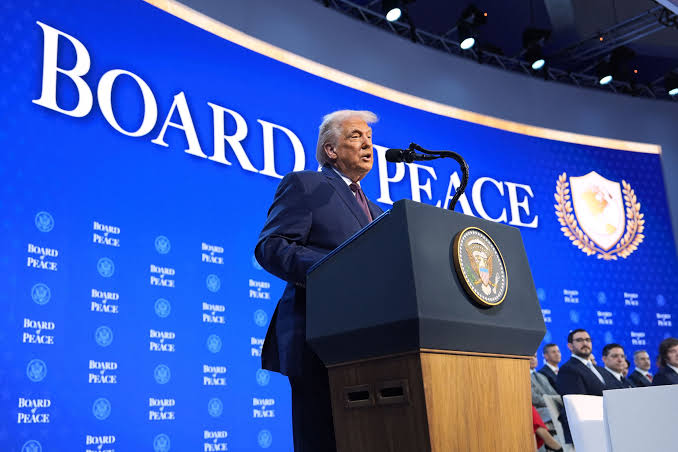
U.S. President Donald Trump said member states of a newly formed international body known as the Board of Peace are expected to announce more than $5 billion in funding for reconstruction and humanitarian assistance in Gaza at a meeting scheduled for Thursday, marking the group’s first formal gathering since its creation earlier this year.
In a post published Sunday on his Truth Social platform, Trump said participating countries had also agreed to contribute thousands of personnel to a United Nations-authorised stabilisation mission and to support the development of a local police force in the Palestinian territory.
The proposed deployment is intended to help maintain order following months of conflict between Israel and Hamas, although operational details have not been publicly released.
The meeting will be held at the Donald J. Trump Institute of Peace in Washington, a facility recently renamed by the U.S. State Department.
Delegations from more than 20 countries are expected to attend, including several heads of state, according to the president’s statement. U.S.
Officials have not yet published a full list of participants or outlined how contributions will be distributed among humanitarian relief, infrastructure rebuilding, and security arrangements.
The Board of Peace was unveiled by Trump in January during the World Economic Forum in Davos as part of a broader diplomatic initiative aimed at ending hostilities in Gaza and establishing a postwar governance and reconstruction framework.
The administration has described the body as a multilateral mechanism designed to coordinate funding, security assistance and political oversight during the territory’s recovery phase.
Read Also: Trump Plans Executive Order To Require Voter ID At Polls
Regional powers from the Middle East, including Turkey, Egypt, Saudi Arabia, Qatar and Israel, have joined the initiative, alongside several emerging economies such as Indonesia.
Participation from traditional Western allies of the United States, however, has been more limited. Governments including Croatia, France, Italy, New Zealand and Norway have declined to take part, according to officials familiar with the discussions, reflecting differing views over the structure and financing requirements of the organisation.
Under the board’s membership rules, permanent members are required to contribute $1 billion to secure a seat, a provision that has drawn criticism from some diplomats and policy analysts who argue the arrangement risks favouring wealthier states.
Critics have described the funding requirement as creating a potential “pay-to-play” system resembling, in influence if not design, the United Nations Security Council. U.S. officials have defended the model, saying guaranteed financial commitments are necessary to ensure rapid reconstruction funding and sustained participation.
The creation of the Board of Peace was endorsed through a United Nations Security Council resolution last year as part of a wider plan promoted by the Trump administration to halt fighting between Israel and Hamas.
Negotiations involving regional mediators led both sides to accept the framework, culminating in a ceasefire that officially took effect in October after months of conflict that devastated large parts of Gaza and displaced significant portions of its population.
Despite the agreement, tensions have persisted. Both Israel and Hamas have repeatedly accused each other of violating ceasefire terms, and sporadic violence has continued in the enclave.
Gaza’s Health Ministry says more than 590 Palestinians have been killed by Israeli forces since the truce began. Israeli authorities, meanwhile, report that four Israeli soldiers have died in attacks carried out by Palestinian militants during the same period. Independent verification of casualty figures has been limited.
Read Also: Donald Trump Moves To Reverse Key Obama Climate Policy
Humanitarian conditions in Gaza remain severe, according to international aid agencies, which have warned that damaged infrastructure, limited access to medical supplies and widespread displacement continue to pose challenges despite the cessation of large-scale combat operations.
Aid groups have called for sustained funding commitments and clearer governance arrangements to prevent instability during reconstruction.
Trump’s statement did not specify how the proposed stabilisation force would be structured or which countries would lead the mission.
Previous discussions among diplomats have centred on whether regional states or a broader multinational contingent would assume primary responsibility for security functions.
Any deployment operating under a United Nations mandate would require coordination with existing humanitarian and monitoring mechanisms already active in the territory.
Officials involved in planning the Thursday meeting said the gathering is expected to focus on formalising pledges, outlining governance mechanisms for reconstruction projects and establishing timelines for deploying personnel.
The administration has framed the initiative as a step toward long-term stability, though several participating governments have emphasised that implementation will depend on continued adherence to the ceasefire by both parties.
The Board of Peace’s future role remains tied to political negotiations over Gaza’s administration once reconstruction begins, an issue that has yet to be resolved publicly.
Diplomats say discussions are ongoing regarding local governance structures, security oversight and the involvement of Palestinian authorities.
Further announcements, including confirmation of funding allocations and operational plans for the stabilisation mission, are expected following the conclusion of Thursday’s meeting in Washington.