
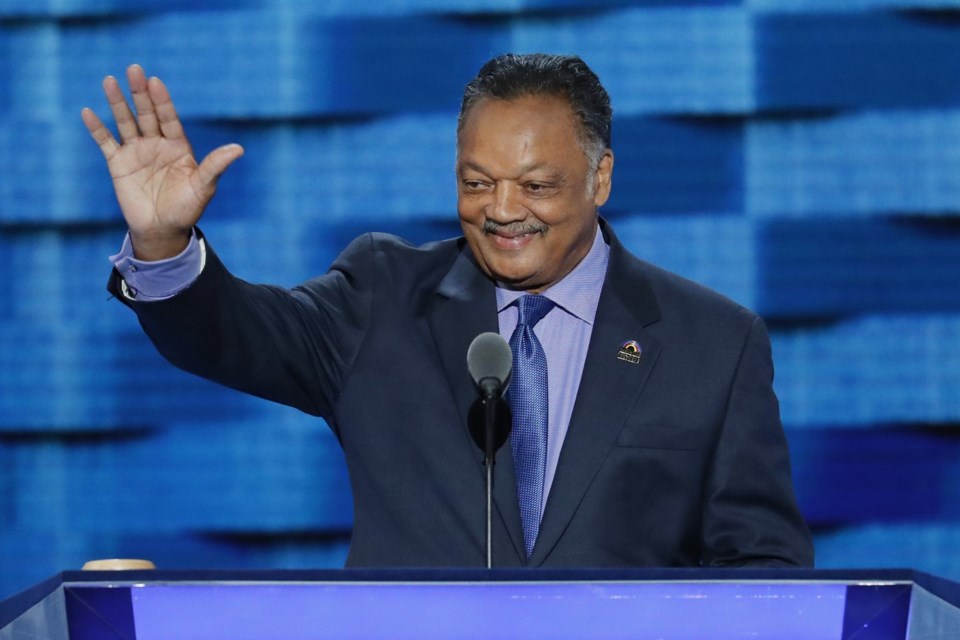
Jesse Jackson emerged from the crucible of the 1960s civil rights movement to become one of the most consequential bridges between street-level activism and presidential politics in modern American history. A protégé of Martin Luther King Jr., Jackson translated protest into electoral strategy, recasting the Democratic Party’s coalition and expanding the boundaries of who could plausibly seek the White House.
His significance lies not only in biography but in architecture. Jackson helped redesign the political map of the United States at a time when the country was still negotiating the meaning of civil rights victories. He was the first African American to mount a serious campaign for a major-party presidential nomination and achieve measurable success at the ballot box—an achievement that would reverberate decades later in the candidacies of Barack Obama and Kamala Harris.
Born Jesse Louis Burns on 8 October 1941 in Greenville, South Carolina, Jackson entered a segregated society structured to constrain Black mobility. His mother, Helen Burns, was 16 when he was born and faced expulsion from her Baptist church after becoming pregnant by Noah Robinson, a married neighbour. When Jackson was two, Helen married Charles Jackson, who adopted him. He maintained relationships with both men, later describing them as dual paternal influences.
Religion formed the moral spine of his upbringing. The Black church had long functioned as a centre of political organisation and resistance, and Jackson absorbed that tradition early. As a student, he excelled—class president, multi-sport athlete, and a young man determined to outrun the limitations of Jim Crow.
A football scholarship took him to the University of Illinois, but he later transferred to North Carolina A&T, a historically Black institution. Jackson said racial discrimination limited his opportunities at Illinois, though records also indicate academic challenges. At North Carolina A&T, his political consciousness sharpened. In 1960, he joined fellow students in a silent protest at a whites-only public library. The demonstration resulted in arrests but ultimately contributed to desegregation—an early lesson in disciplined confrontation.
After graduating in 1964, Jackson moved to Chicago and began theological training. There, he attracted the attention of Martin Luther King Jr., whose Southern Christian Leadership Conference (SCLC) was expanding its reach beyond the South. Within that framework, Jackson established Operation Breadbasket, an initiative designed to leverage Black consumer power. The strategy was straightforward: patronise businesses that employed Black workers and boycott those that did not. Economic pressure became a tool of civil rights.
Read Also: Legendary Godfather Actor Robert Duvall Dies Aged 95
Still in his twenties, Jackson rose quickly within the SCLC. Then came April 1968. He was present at the Lorraine Motel in Memphis when King was assassinated. Jackson later said he cradled his mentor’s head as he died, though other witnesses did not corroborate that detail. What is uncontested is that Jackson stepped forward publicly in the immediate aftermath, signalling continuity rather than collapse within the movement.
King’s death altered the trajectory of civil rights leadership. Jackson increasingly framed inequality as rooted in class divisions as much as race. The defining struggle, he argued, was between the “haves” and “have-nots.” That reframing broadened the constituency he sought to mobilise, extending beyond African Americans to poor and working-class communities of multiple backgrounds.
Internal disagreements eventually fractured Operation Breadbasket. In 1971, Jackson formed Operation PUSH (People United to Serve Humanity), expanding his organisational footprint. PUSH advocated for inner-city education, corporate affirmative action, and broader economic inclusion. Jackson became a national voice, skilled at blending sermon and policy argument.
Controversy accompanied prominence. Allegations surfaced that he had made antisemitic remarks in private conversations. As an ordained minister born from an unwanted pregnancy, he opposed abortion, even as the Democratic Party increasingly aligned itself with reproductive rights following Roe v Wade. In 1977, Jackson wrote that life was a gift from God and should not be terminated, positioning himself at odds with many party leaders.
Foreign policy further complicated his profile. In 1983, he travelled to Syria and secured the release of a captured American pilot, Lt Robert Goodman. The mission elevated his stature. He also advocated for a Palestinian state and once described Israel’s prime minister as “a terrorist,” drawing criticism. During the height of the Cold War, he pledged never to use nuclear weapons first and proposed significant reductions in defence spending—stances seen by critics as unrealistic in a bipolar geopolitical order.
Against this backdrop, Jackson announced his first presidential campaign in 1984. Black youth unemployment hovered around 50 percent. The Reagan administration’s economic policies were reshaping the social safety net. Jackson offered an alternative narrative anchored in what he called the “Rainbow Coalition”—a multiracial alliance of the marginalised. He copyrighted the term and later institutionalised it as a political organisation.
“Our nation is a rainbow,” he declared at the 1984 Democratic National Convention, urging unity across racial and economic lines. The message was expansive rather than exclusive, appealing to farmers, labourers, minorities, and the urban poor.
His 1984 campaign secured more than three million votes in the Democratic primaries, placing him third. That result demonstrated that a Black candidate could compete nationally within a major party. He returned in 1988 with a stronger organisation and sharper discipline, delivering a widely remembered convention speech that ended with the refrain “keep hope alive.” The cadence would echo two decades later in Obama’s “hope and change” campaign.
Jackson never captured the nomination. Yet his campaigns altered the Democratic Party’s internal calculus. Issues such as universal healthcare and reparations for descendants of enslaved people gained renewed prominence within party debates. He proved that mobilisation around economic justice could transcend racial silos.
In later years, Jackson assumed the role of elder statesman within Democratic politics. His influence endured even as personal and family scandals complicated his legacy. Revelations of marital infidelity surfaced. His son, Jesse Jackson Jr., who served as a congressman from Illinois, faced legal troubles involving financial impropriety.
Read Also: Iran Talks To Proceed With Trump Playing Behind-The-Scenes
Health challenges marked his final chapter in public life. In 2017, Jackson disclosed a diagnosis of Parkinson’s disease. That diagnosis was later revised to progressive supranuclear palsy, a degenerative brain condition with similar symptoms. He gradually withdrew from the political stage.
Assessing Jackson’s career requires balancing aspiration and controversy. He was a gifted orator who channelled the frustrations of citizens who felt excluded from the promise of American democracy. He navigated the tension between moral conviction and electoral pragmatism. He expanded the terrain on which presidential politics could be contested.
His legacy is embedded in institutional memory. When Obama won the presidency in 2008, he did so along pathways Jackson had helped clear—normalising the idea of Black candidacy at the highest level and reframing coalition politics. Kamala Harris’s ascent to the vice presidency further underscored the structural shift.
Jackson’s project was never confined to race alone. It sought to align economic justice with democratic participation in an increasingly diverse society. That ambition, ambitious and imperfectly realised, reoriented American political discourse.
In bridging protest and the ballot, Jesse Jackson reshaped the architecture of possibility.