
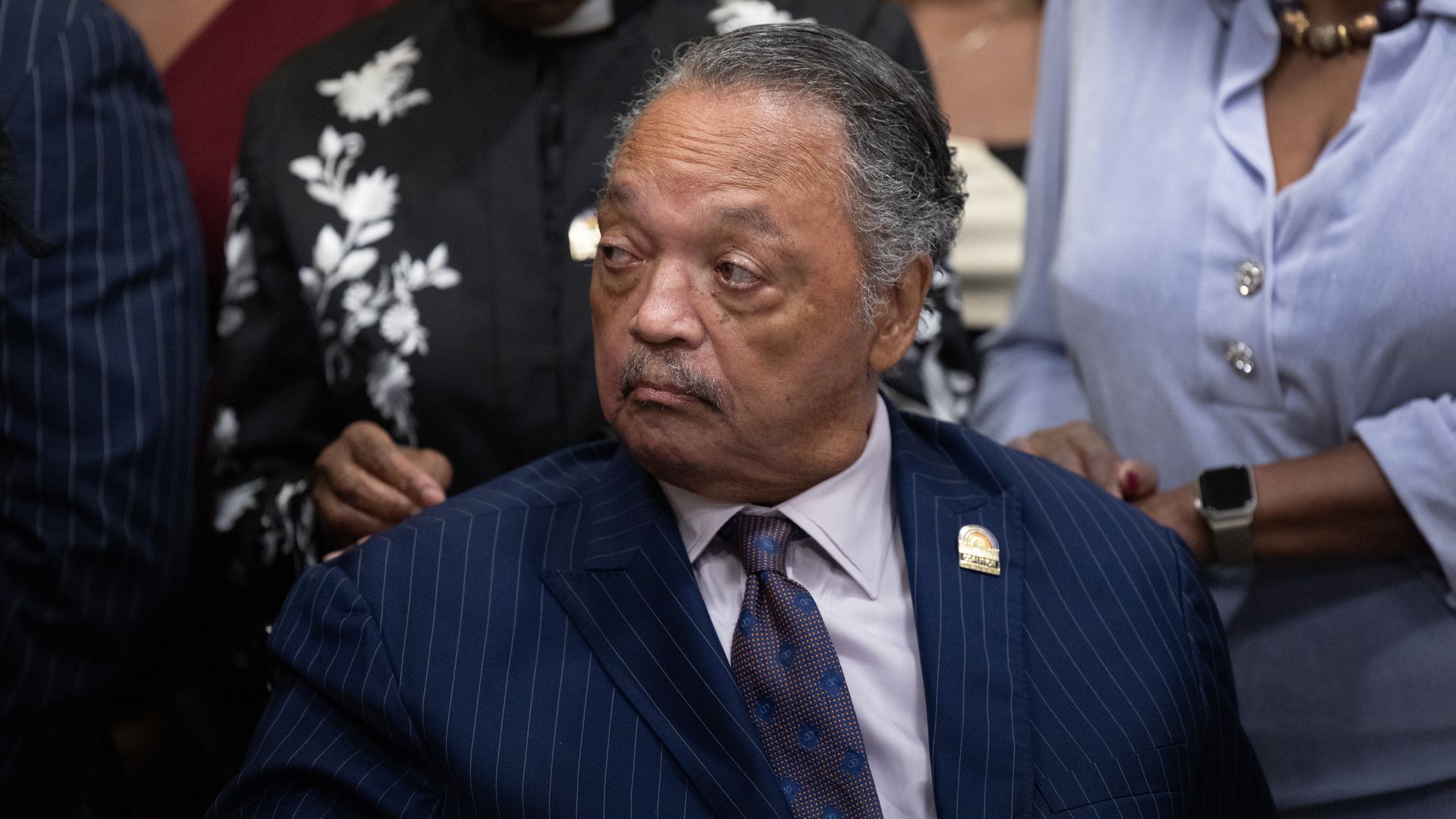
A request to allow the late Rev. Jesse Jackson Sr. to lie in honor at the United States Capitol has been declined by House Speaker Mike Johnson, according to sources familiar with the discussions. The decision has prompted renewed scrutiny of how Congress confers symbolic recognition on national figures and how precedent shapes those determinations.
Rev. Jesse Jackson Sr., one of the most consequential civil rights leaders of the late twentieth century, leaves behind a complex and enduring public legacy. A protégé of Dr. Martin Luther King Jr., Jackson emerged as a national voice through his leadership of Operation PUSH and later the Rainbow Coalition. He ran for president twice, in 1984 and 1988, expanding the political imagination of Black Americans and reshaping coalition politics within the Democratic Party. His campaigns drew unprecedented multiracial support and broadened the platform of social justice issues within national discourse.
Read Also: Senegal Condemns Jail Terms For Fans Over AFCON Final
In declining the request, Speaker Johnson cited prior precedent governing the Capitol’s ceremonial honors. Lying in honor at the Capitol is a rare distinction. It differs from lying in state, which is typically reserved for presidents, military leaders, and certain senior government officials. Lying in honor has historically been granted to private citizens who made extraordinary contributions to the nation, but its application has remained limited and politically sensitive.
According to individuals familiar with internal deliberations, Johnson’s office reviewed how Congress handled similar requests in the past when prominent public figures died. The Speaker’s decision reflects what aides described as an effort to maintain consistency with earlier congressional practice rather than to weigh Jackson’s legacy independently of institutional guidelines.
The Capitol Rotunda has served as the symbolic center of national mourning for generations. The criteria for such honors, however, are not codified in statute. Decisions are typically made through consultation between congressional leadership and, in cases involving lying in state, the president. For lying in honor, the authority rests with the leadership of the House and Senate.
In recent years, Congress has used the Rotunda to commemorate a range of figures whose impact transcended elected office. Civil rights icon Rosa Parks lay in honor in 2005, becoming the first woman and second Black American to receive that distinction. In 2020, the body of the late Rep. John Lewis lay in state, marking a formal congressional tribute to a legislator whose career was rooted in the same movement that shaped Jackson’s activism.
Jackson’s life intersected with both figures. As a young organizer, he stood on the balcony of the Lorraine Motel in Memphis in 1968 when Dr. King was assassinated. He later built national networks aimed at expanding economic opportunity and political participation for marginalized communities. Through diplomatic initiatives, he also negotiated the release of hostages abroad and engaged in informal foreign policy efforts, often operating outside traditional government channels.
The Speaker’s refusal does not prevent private or community memorial services from proceeding, nor does it preclude other forms of congressional recognition. Members of Congress may introduce resolutions honoring Jackson’s life and contributions. Such measures often pass by voice vote, allowing lawmakers to pay tribute without conferring the more formal Rotunda ceremony.
The decision nevertheless highlights the inherently political dimension of public memorialization. Capitol honors carry symbolic weight that extends beyond individual legacy. They signal which narratives of American history receive institutional endorsement at the highest level. For supporters of Jackson, his decades of activism, presidential candidacies, and influence on civil rights policy warrant national recognition commensurate with his stature. Critics may point to the controversial aspects of his long public career, which included periods of political tension and polarizing rhetoric.
Speaker Johnson’s reliance on precedent suggests an effort to avoid reopening broader debates about criteria. Congressional leadership often faces competing pressures in such cases: honoring contributions to the nation while guarding against politicization of ceremonial spaces. The absence of clearly defined standards leaves room for interpretation, but it also means each decision can set a new benchmark.
For African American communities, particularly those who came of age during the civil rights and post–civil rights eras, Jackson’s influence was formative. His presidential campaigns mobilized voters who had rarely seen themselves reflected in national tickets. His advocacy for economic justice and voting rights contributed to legislative conversations that shaped policy well beyond his candidacies.
From a global perspective, Jackson’s activism resonated beyond U.S. borders. He engaged in dialogues with leaders in Africa and the Caribbean and maintained a visible presence in international human rights advocacy. His approach to coalition-building echoed movements for racial equity and democratic participation across the Global South.
The question of whether such a figure should receive the Capitol’s highest ceremonial tribute underscores broader tensions within American political culture. Recognition at the Rotunda is not merely about personal accomplishment; it reflects collective judgments about national identity and historical memory. Those judgments are inevitably shaped by contemporary political alignments.
Read Also: Israel Caps Al-Aqsa Access To 10,000 for Ramadan Prayers
In the absence of a Rotunda ceremony, Jackson’s legacy will continue to be assessed through scholarship, public reflection, and community remembrance. The debate surrounding this decision illustrates how institutions navigate the intersection of history, symbolism, and governance.
Speaker Johnson’s office has not publicly elaborated beyond citing precedent. As Congress prepares to mark Jackson’s passing through other forms of acknowledgment, the episode serves as a reminder that ceremonial honors are neither automatic nor apolitical. They are expressions of institutional values at a given moment in time.
For observers both within the United States and abroad, the development offers insight into how American institutions manage the legacy of transformative yet contested figures. Rev. Jesse Jackson Sr.’s imprint on civil rights, electoral politics, and global advocacy is secure. Whether the Capitol Rotunda becomes part of that legacy remains, by decision of congressional leadership, unresolved.