
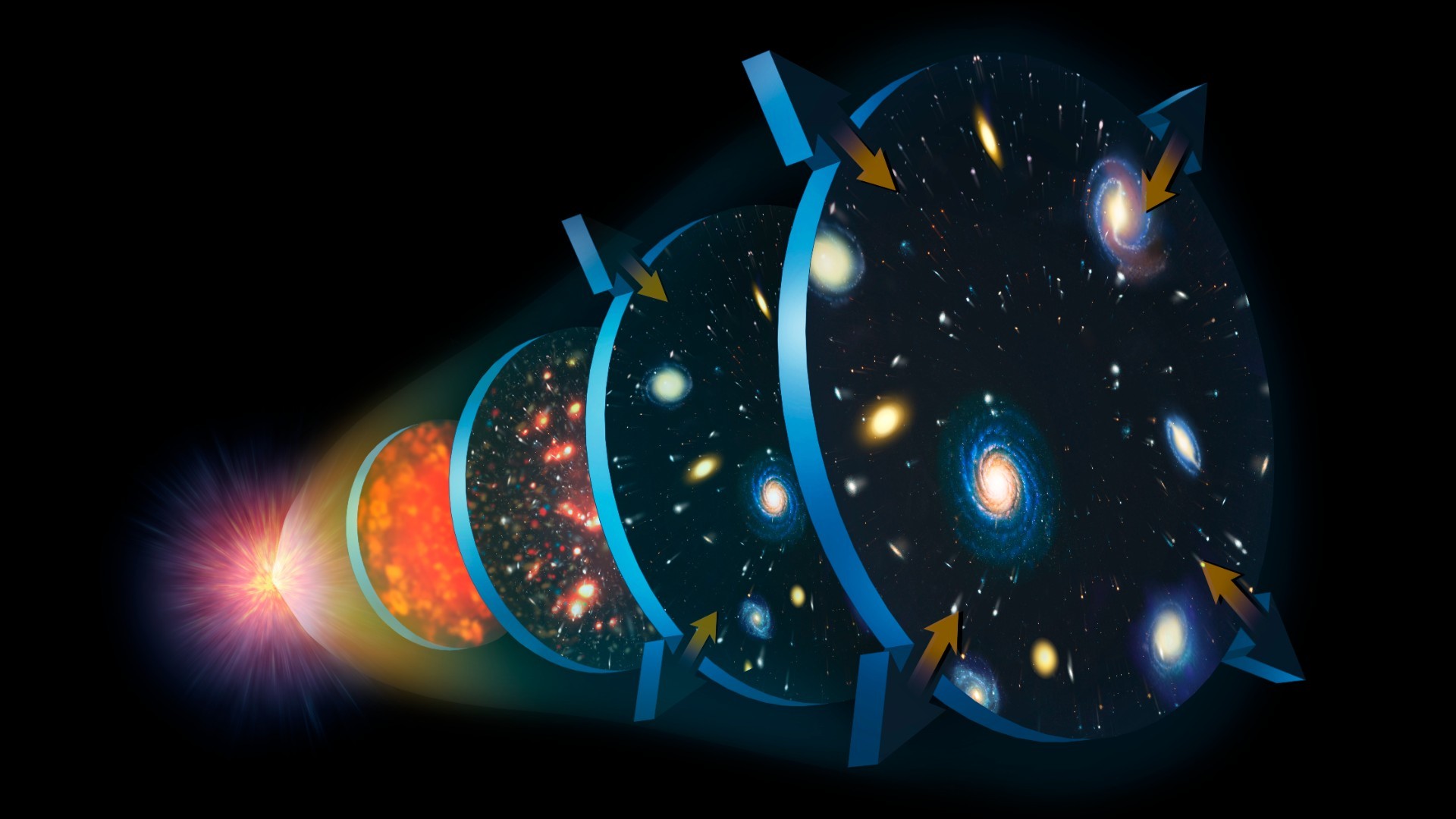
In the quiet precision of deep-space observation, the James Webb Space Telescope has delivered a finding that reaches far beyond astronomy. Fresh measurements from the observatory confirm that the universe is expanding at a rate significantly faster than long-standing theoretical models predict. What once lingered as a technical inconsistency has now hardened into evidence that the current framework of cosmology may be incomplete.
At the center of this development lies a persistent scientific riddle known as the “Hubble tension.” For more than a decade, astrophysicists have struggled to reconcile two different calculations of how quickly the universe is stretching outward. One method looks back nearly to the beginning of time, analyzing radiation left over from the Big Bang—often called the cosmic microwave background. That approach, grounded in models of the early universe, produces an expansion rate of roughly 68 kilometers per second per megaparsec.
A second method examines the modern universe directly. By measuring the brightness and distance of specific types of stars and stellar explosions in faraway galaxies, scientists can determine how fast those galaxies are receding from us today. These direct observations consistently yield a faster rate: approximately 74 kilometers per second per megaparsec.
Read Also: JPMorgan Faces ECB’s Largest Penalty In History
The gap between those two figures may appear modest. In cosmology, however, it is profound. Even a small divergence in expansion rates implies that either the early-universe model is flawed or present-day measurements are systematically distorted. For years, some researchers suspected that limitations in telescope sensitivity or calibration errors could explain the discrepancy. The new data from the James Webb Space Telescope sharply narrows that possibility.
Launched to extend humanity’s observational reach deeper into cosmic history, the Webb telescope has now been used to re-examine the very stars that anchor modern expansion measurements. Its infrared capabilities allow astronomers to peer through cosmic dust and obtain more precise readings of stellar brightness. The results align with previous findings from older instruments. The higher expansion rate remains intact.
That confirmation alters the debate. The discrepancy can no longer be dismissed as observational noise. Instead, it suggests that the prevailing model of how the universe evolved from its earliest moments may be missing key components.
The dominant cosmological framework—often referred to as the standard model of cosmology—assumes that the universe’s structure and growth are governed by known forms of matter, dark matter, and dark energy, operating under established physical laws. Calculations derived from the cosmic microwave background, particularly those informed by data from the European Space Agency’s Planck Space Observatory, fit elegantly within that model. Yet those early-universe predictions now appear misaligned with direct measurements of the present cosmos.
This divergence has sharpened attention on dark energy, the mysterious force thought to be accelerating cosmic expansion. If the universe is expanding faster than predicted, the properties attributed to dark energy may be incomplete—or fundamentally misunderstood. Some researchers are exploring the possibility that dark energy changes over time rather than remaining constant, as assumed in standard equations. Others are investigating whether undiscovered subatomic particles or previously unrecognized interactions influenced the early universe in subtle but consequential ways.
Nobel laureate Adam Riess, who led the recent study confirming the discrepancy, has described the result not as a marginal statistical anomaly but as a signal of “new physics.” Riess was previously awarded the Nobel Prize for work establishing that the universe’s expansion is accelerating. His current findings extend that legacy, suggesting that the acceleration may be governed by mechanisms yet to be identified.
The implications extend beyond theoretical physics. Cosmology underpins humanity’s understanding of time, scale, and destiny. An accurate expansion rate informs estimates of the universe’s age, its future trajectory, and the evolution of galaxies—including our own. If the underlying equations require revision, then the timeline of cosmic history may also require recalibration.
For policymakers and scientific institutions, the confirmation underscores the importance of sustained investment in fundamental research. Space-based observatories such as the James Webb telescope are not merely instruments of discovery; they are arbiters in disputes that shape the boundaries of scientific knowledge. Without Webb’s improved precision, the Hubble tension might have remained unresolved, vulnerable to doubts about instrumentation.
The episode also highlights the iterative nature of science. For much of the twentieth century, the expansion of the universe—first measured by Edwin Hubble—stood as one of astronomy’s defining achievements. Subsequent decades layered refinement upon refinement, building a coherent narrative of cosmic evolution. Yet the present finding demonstrates that even well-established frameworks can encounter limits. Precision measurements have reached a point where small inconsistencies expose deeper theoretical gaps.
Across research centers in North America, Europe, and Asia, teams are now exploring alternative models. Some hypotheses propose early episodes of rapid expansion that differ slightly from conventional assumptions. Others suggest that neutrinos or other exotic particles behaved differently in the universe’s infancy. None have yet secured consensus. What has changed is the level of urgency.
The James Webb telescope’s confirmation effectively shifts the burden of proof. Rather than questioning whether the discrepancy exists, researchers must now determine which aspect of current theory fails to account for reality. That shift reframes the Hubble tension from a technical puzzle into a structural challenge to cosmology.
It would be premature to predict a wholesale rewriting of physics. Scientific revolutions unfold gradually, often through incremental adjustments rather than dramatic upheaval. Yet history suggests that persistent anomalies can lead to transformative insight. The discovery of cosmic acceleration in the late 1990s, for example, reshaped modern astrophysics and introduced dark energy into mainstream theory. Today’s tension may foreshadow a similar recalibration.
Read Also: King Charles Attends London Fashion Week Amid Andrew Arrest
For observers beyond the scientific community, the development offers a reminder that certainty in fundamental science remains provisional. The universe continues to resist complete explanation, even as technology grows more sophisticated. Each improvement in measurement can expose layers of complexity that previous generations could not detect.
In confirming that the cosmos is expanding faster than predicted, the James Webb Space Telescope has not provided final answers. It has, instead, clarified the question. The universe appears to operate according to principles not yet fully mapped. Whether those principles involve new forces, new particles, or revised mathematical structures remains to be seen.
What is clear is that the debate has entered a new phase. The Hubble tension is no longer a suspicion. It is an empirical fact demanding theoretical response. And in that demand lies the possibility of a deeper, more comprehensive understanding of how the universe began—and how it will continue to unfold.