
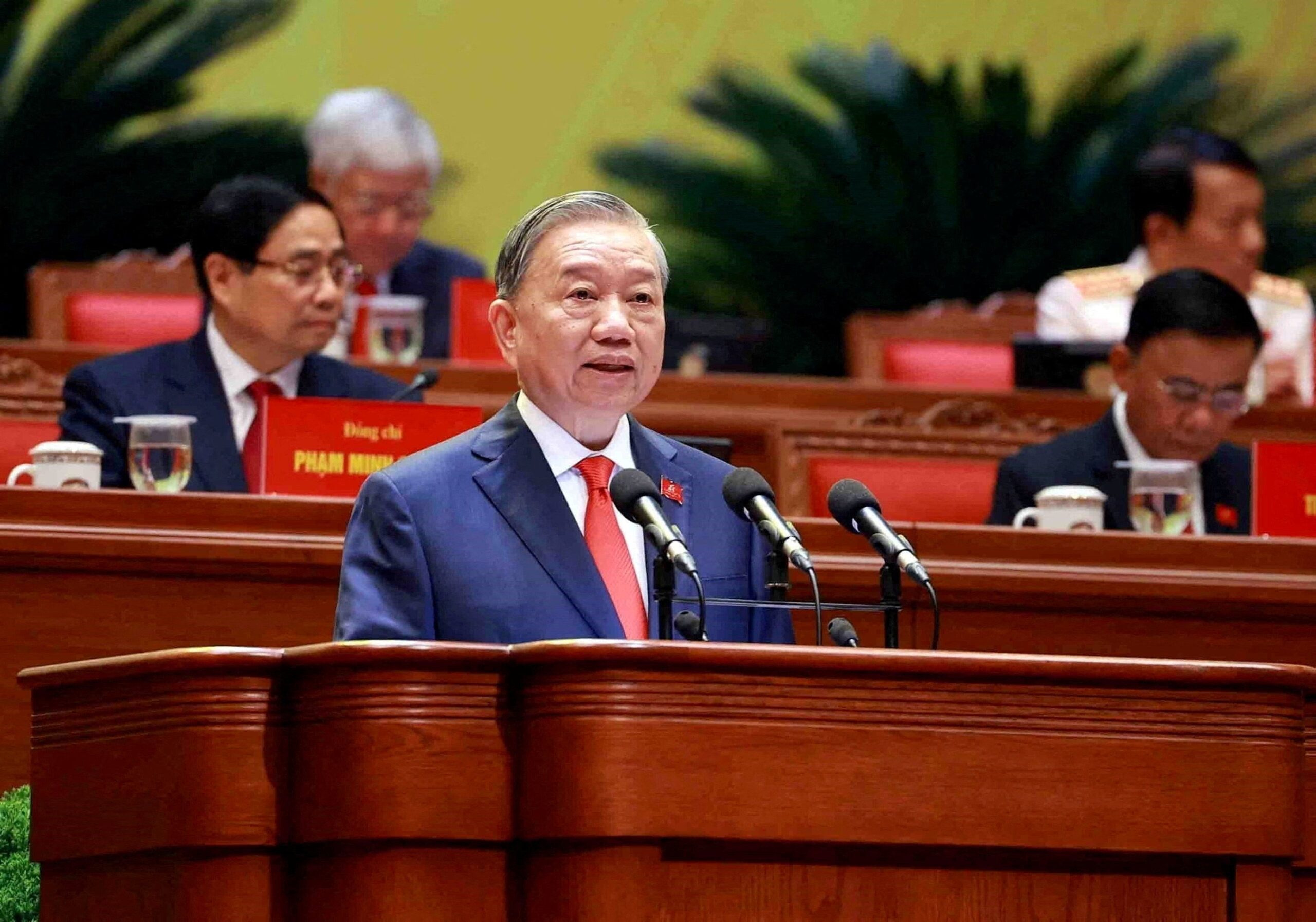
The U.S. President Donald Trump met with Vietnam’s highest-ranking leader, Tô Lâm, at the White House on Friday, hinting at a possible change in the U.S. export policy of advanced technologies to Vietnam as both nations move to strengthen economic ties in the wake of changing global trade dynamics.
As per a report published on the Vietnamese government’s news website, Trump assured Lâm that he would make efforts to delist Vietnam from the U.S. lists that restrict the country’s access to certain advanced technologies.
This would help ease restrictions on high-tech trade and investment between the two nations, which have increased their trade ties in recent years as companies look to diversify their supply chains away from China.
This was the first direct, in-person interaction between the two leaders since Trump’s return to power. Lâm was in Washington for the inaugural meeting of the Board of Peace, an event that brought together global political and institutional leaders.
The Vietnamese side reported that the talks covered economic cooperation, technology transfer, and overall bilateral relations.
The details from the Vietnamese side showed that the two leaders also talked about ways to enhance cooperation in aviation, manufacturing, and information technology, which are considered key sectors for Hanoi’s plan to shift higher in the global value chain.
Read Also: Trump Orders Release Of UFO Files
U.S. export controls have always restricted the transfer of certain semiconductor and advanced computing technologies to a number of countries, including Vietnam, mainly for national security reasons.
However, any change in these conditions would have to undergo interagency approval within the U.S. administration and might also be subject to review by lawmakers who are concerned about the security of technology.
The White House did not immediately issue a press release with specific policy commitments following the meeting on Friday.
The meeting took place just after the announcement of commercial agreements worth more than $30 billion, with particular attention to the Vietnamese carriers’ purchase of 90 aircraft from Boeing, a U.S. manufacturer.
Industry experts have pointed out that the agreements reflect the rapid growth of the aviation industry in Vietnam and the interest of the United States in increasing exports to the fast-growing economies of Southeast Asia.
Vietnam has become a major manufacturing location over the past decade, attracting global corporations looking for alternative locations to China due to geopolitical tensions and changes in tariff structures.
The United States is currently one of Vietnam’s largest export destinations, although Hanoi has been trying to improve its diplomatic and economic relationship with Washington without renouncing its traditional policy of maintaining a balance of relations with the major powers.
Trade policy was also a larger context of the meeting. Earlier on Friday, Trump announced an immediate 10% tariff on most imports entering the United States, a move made after the Supreme Court of the United States struck down parts of his administration’s earlier major tariff policy.
The new tariff will apply generally across trading partners and marks a major escalation of U.S. protectionist policies, although administration officials said more information would be provided in the coming days.
Read Also: Iran Talks To Proceed With Trump Playing Behind-The-Scenes
The new tariff policy has created uncertainty for export-driven economies, such as Vietnam, whose growth has been driven by foreign demand.
Economists point out that the country could be subject to two competing forces: increased cooperation on technology sharing with Washington on one side and possible vulnerability to higher U.S. import tariffs on the other.
Market access and trade conditions were also highlighted by Vietnamese representatives during the talks, according to the government’s summary, although no information was released on whether exemptions or changes related to the new tariff policy were discussed directly.
The relationship between Washington and Hanoi has been gradually improving since the normalization of diplomatic relations in 1995, and has developed from post-war reconciliation to a partnership covering trade, security talks, and supply chain collaboration.
Recently, both sides have upgraded their relationship through agreements on promoting economic resilience and cooperation in strategic technologies, reflecting their shared interests in regional stability and economic diversification.
The current Vietnamese government has placed a high priority on attracting foreign investment in the areas of electronics, renewable energy, and advanced manufacturing, which are partly dependent on access to U.S. technology and components.
It has been observed that delisting from restrictive technology lists could help Vietnamese companies integrate more deeply into the global semiconductor and digital manufacturing value chains, although this would be a gradual process.
U.S. officials have previously stated that export controls are intended to protect sensitive technologies, not particular partners, and that changes to these controls are subject to lengthy regulatory review processes.
Congressional oversight committees and national security agencies would be expected to review any proposed changes to technology transfers.