
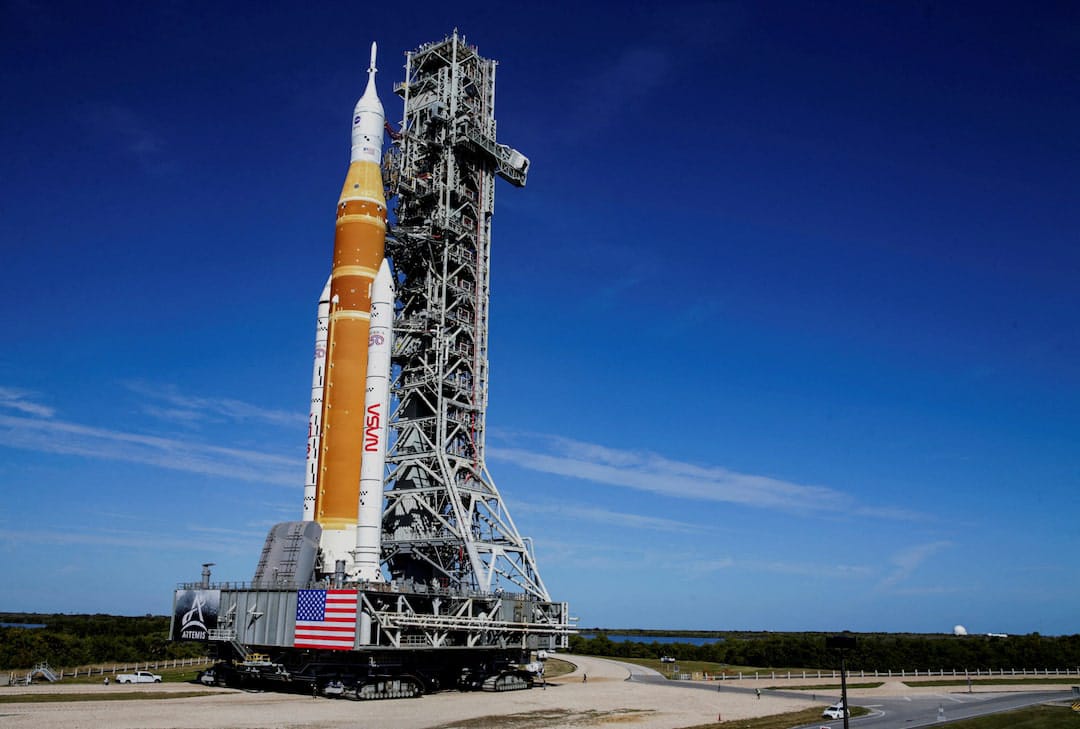
NASA has postponed the planned early March launch of its next lunar mission after engineers detected a technical issue during final preparations, delaying what would be the first crewed flight toward the Moon in half a century.
The U.S. space agency confirmed that a March 6 launch window for the Artemis II mission is no longer viable following routine preflight checks at the Kennedy Space Center in Florida.
The mission is designed to send four astronauts on a 10 day journey around the far side of the Moon and back to Earth, the deepest human flight into space since the Apollo era. Only a day earlier, officials had indicated the spacecraft could be ready within weeks after a lengthy rehearsal appeared to proceed without major faults.
NASA Administrator Jared Isaacman said the team initially believed the “wet dress rehearsal”, a full countdown simulation with propellant loading, had cleared the way for launch preparations.
Read also: Moon City Project Takes Priority Over Mars, Musk Announces
The outlook changed overnight when engineers observed an interruption in the helium flow needed for flight operations. Helium plays a critical role in the rocket’s functioning, maintaining pressure inside fuel tanks and stabilizing engine systems during ascent. NASA treats irregularities in that system as a high risk condition requiring inspection and repair.
The rehearsal had involved loading roughly 730,000 gallons of propellant into the rocket over several hours. It was the second full practice run after earlier attempts were halted because of hydrogen leaks linked to seals and filtration components.
Isaacman acknowledged the delay would be disappointing after the program appeared to be approaching a milestone. The crewed mission would mark humanity’s return to lunar travel for the first time since the early 1970s, though the astronauts will not land on the surface during this flight.
The crew includes U.S. astronauts Reid Wiseman, Victor Glover and Christina Koch, along with Canadian astronaut Jeremy Hansen. Their flight path is intended to loop around the far side of the Moon, allowing the team to conduct observations and systems testing before returning to Earth.
Read more: Hydrogen-Powered Hypersonic Jet Aims ‘Mach 12’ Flight Record
NASA officials said the postponement reflects the agency’s cautious approach to human spaceflight, where minor anomalies can lead to significant schedule changes. The administrator noted that historic missions have encountered similar setbacks, citing Neil Armstrong’s 1966 Gemini 8 flight, which ended early because of a technical malfunction prior to the later Apollo landing. Artemis II serves as a preparatory step for a future mission that would place astronauts on the lunar surface for the first time since 1972. That landing, planned under the Artemis III mission, is currently targeted for 2028, though NASA has previously indicated the timetable could shift depending on technical readiness.
Engineers will now inspect and repair the helium system before a new launch date is selected. NASA has not yet announced a revised timeline, but officials said another attempt will be scheduled once testing confirms the rocket meets flight safety requirements.