
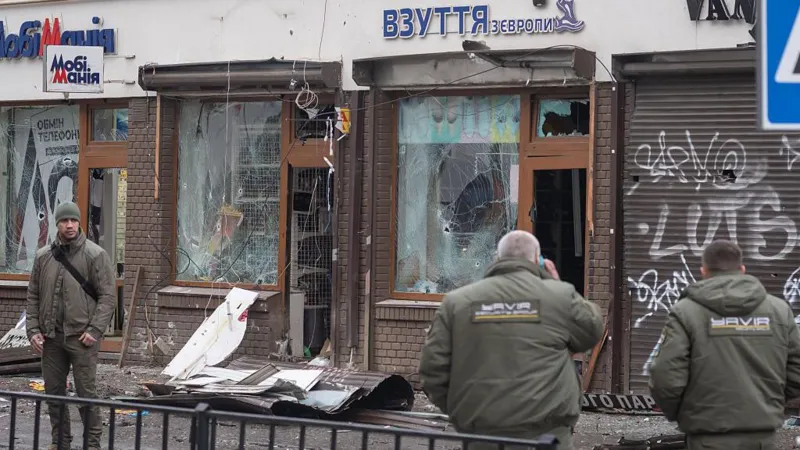
A Ukrainian woman has been arrested on suspicion of planting two homemade explosive devices in the centre of Lviv in the early hours of Sunday that killed a 23-year-old police officer and wounded 25 others, with Ukrainian Interior Minister Ihor Klymenko stating there was “every reason to believe that the crime was carried out on Russia’s orders,” in what would mark one of the most serious acts of Russian-directed sabotage inside western Ukraine since the full-scale invasion began four years ago this week.
A false emergency call was placed to Ukraine’s 102 police line shortly after midnight, reporting a break-in at a shop on Danylyshyna Street in the city centre. When the first patrol crew arrived and exited their vehicle to investigate, the first device detonated. A second device was placed nearby and exploded minutes later when a second patrol unit reached the scene, a double-blast sequencing that prosecutors described as deliberately designed to maximise casualties among first responders. Six law enforcement officers were among the eleven people admitted to hospital, several in serious condition.
The officer killed was Viktoriia Shpylka, a native of Volyn Oblast who had grown up in Kherson. She graduated from Lviv State University of Internal Affairs and began her service in the Kherson region at the start of the full-scale invasion in 2022, before transferring to the Lviv patrol service in 2023. She had married a fellow patrol officer the previous autumn.
“Her colleagues remember her as sensitive, bright and sincere. She knew how to support, listen and find a kind word even on the hardest of days,” the National Police wrote on Telegram. She was 23 years old.
The detained suspect is a 33-year-old Ukrainian citizen. Police said she was detained in Staryi Sambir, a town in Lviv Oblast near the Polish border, and is suspected of carrying out the attack on the instruction of a handler based in Russia. The Security Service of Ukraine and the National Police conducted the arrest jointly.
President Volodymyr Zelensky confirmed several persons had been detained and said investigative procedures involving the primary suspect were ongoing. Klymenko said authorities were “identifying other individuals involved in committing this crime.”
“Police officers respond to calls every day and night, never knowing what awaits them. But they rush to help because protecting people is their primary duty,” Klymenko wrote on Telegram. Lviv Mayor Andriy Sadovyi, who confirmed the incident as a terrorist attack within hours of the blasts, described the city as “under attack” and called on residents to support the investigation.
Read Also: Ukraine’s Zelenskiy To Unveil Election Blueprint Feb 24
The Lviv prosecutor’s office opened a formal criminal investigation under Ukraine’s terrorism statutes, classifying the offence as “a terrorist act that caused serious consequences.” Forensic teams were examining the debris near the Magnus shopping centre, where the blasts also caused a roof fire in an adjacent residential building and heavily damaged a patrol vehicle and a civilian car. The investigation was focused on establishing motive, confirming the chain of command leading to the attack, and determining whether the suspect had any prior involvement in other sabotage incidents.
The Lviv bombing fits a documented pattern. In December 2025, an IED detonated along a National Guard patrol route in Kyiv’s Darnytskyi district, killing one officer and injuring others, with a second device exploding during the response. In February 2026, a military-affiliated vehicle was blown up in the capital. Earlier this month, the SBU dismantled two FSB-linked networks that were assembling homemade bombs intended for deployment in crowded areas of Kyiv. The consistency of tactics, improvised devices, false calls designed to lure first responders, double detonations, suggests a coordinated, externally directed campaign rather than isolated domestic extremism.
The attack falls three days before the fourth anniversary of Russia’s full-scale invasion, which began on February 24, 2022. Its occurrence in Lviv, a city near the Polish border that has historically served as a relative sanctuary compared to the east and south of the country, and a major logistics and humanitarian hub, carries both symbolic and strategic significance. Striking a city associated in the Ukrainian and international public consciousness with safety and western connectivity is consistent with what Ukrainian security officials have described as a Russian effort to demonstrate reach across the entire territory of Ukraine, not merely the front-line regions.
The same night, Russia launched 50 missiles and 297 drones against Ukraine in one of the largest overnight barrages of the year. Seven regions were struck. One person was killed and eight others injured, including a child, in the Kyiv region alone. One Russian missile struck a factory in northern Ukraine owned by Mondelez International, the American multinational whose snack and confectionery brands include Oreo and Milka.
Read Also: Ukrainian Drone Attack Ignites Fire At Russian Black Sea Port
“This is not a military target, but a factory that has operated since the 1990s, producing globally known brands, employing Ukrainians, contributing to our and American economy,” Foreign Minister Andrii Sybiha said. Zelensky noted that Russia had launched more than 1,300 attack drones, over 1,400 guided aerial bombs, and 96 missiles of various types in the past week alone.
Lviv is hosting a ceremony on Tuesday to mark the invasion’s anniversary. Security measures in the city centre had already been elevated before Sunday’s attack. They were tightened further immediately after.