
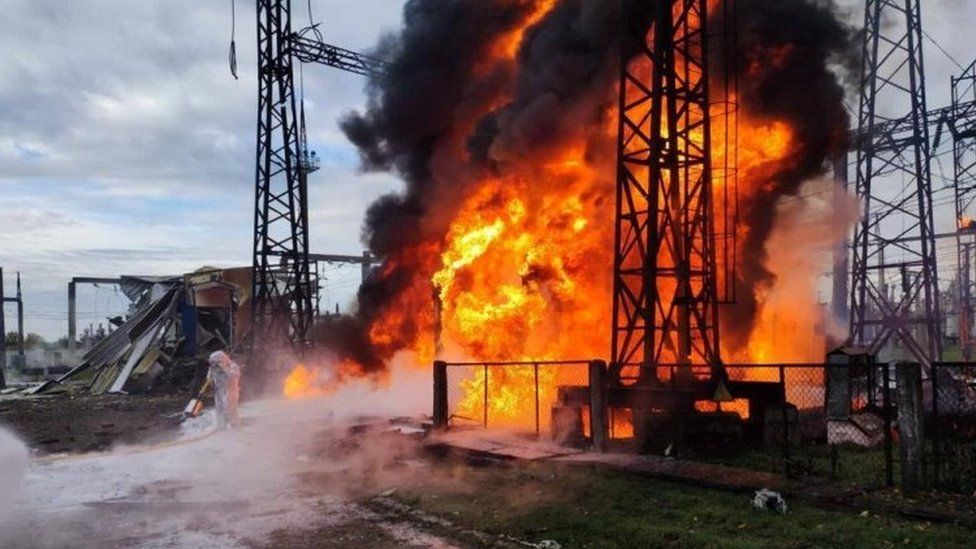
On the threshold of the fourth year of full-scale war, Russia intensified its aerial assault on Ukraine, killing at least four civilians and striking critical infrastructure across multiple regions. The attacks, unfolding just before the anniversary of Europe’s largest armed conflict since the Second World War, underscored the persistence of a war that has reshaped continental security and strained global political alignments.
In the southern region of Odesa, two people were killed late Monday after Russian drones targeted industrial, energy and civilian facilities, according to Governor Oleh Kiper. Writing on Telegram, Kiper detailed damage extending beyond immediate impact zones. Production and warehouse complexes were hit, as were administrative buildings and car dealership premises. Vehicles were destroyed. Fires broke out across affected sites before being extinguished by emergency crews.
One drone struck an apartment in a multistorey residential building but failed to detonate. Psychologists from Ukraine’s state emergency service were deployed to assist residents coping with the shock. Municipal and rescue teams remained on site into the early hours, working to contain damage and restore essential services.
Further east, in the Zaporizhia region, the scale of bombardment was even broader. Regional governor Ivan Fedorov reported that Russian forces carried out more than 750 attacks across 44 settlements. Two people were killed in the city of Zaporizhzhia itself. The barrage targeted a mix of civilian and infrastructure locations, reflecting a sustained campaign aimed at weakening Ukraine’s internal resilience as much as its military capacity.
To the north, in Kharkiv, a missile struck the Kholodnogirsky district, according to Mayor Ihor Terekhov. Casualty figures were not immediately available as emergency teams assessed the destruction. Kharkiv, which has endured repeated shelling since the early months of the invasion, remains within range of Russian artillery and missile systems positioned across the border.
The overnight exchange extended beyond Ukrainian territory. Kyiv reported that its air defences shot down 105 Russian drones. Moscow, for its part, said it intercepted 152 Ukrainian drones. Such reciprocal claims have become a routine feature of the conflict’s aerial dimension, illustrating the degree to which unmanned systems now define the operational tempo on both sides.
These latest fatalities come as Ukraine approaches four years since Russia launched its full-scale invasion in February 2022. What began as a rapid offensive intended to topple Kyiv’s government has hardened into a protracted war of attrition, reshaping alliances and compelling European states to recalibrate defence and energy policies.
The anniversary has also sharpened diplomatic activity in Brussels. European Union foreign ministers convened to consider a new financial package for Kyiv alongside a 20th round of sanctions against Moscow. The measures under discussion are designed to both sustain Ukraine’s fiscal capacity and constrain Russia’s revenue streams.
Read Also: El Mencho’s Death Sparks Cartel Violence Across Mexico
At the centre of deliberations is a €90 billion loan intended to support the Ukrainian government through the end of 2027. The package, initially agreed in December and subsequently approved by the European Parliament, aims to provide budgetary stability at a time when wartime expenditures continue to strain public finances.
The proposed sanctions would include a ban on maritime services connected to exports of Russian crude oil. The European Commission has also advanced additional financial restrictions to limit Russia’s ability to conduct international payments tied to economic activity. Together, these steps represent an incremental tightening of the economic pressure that the EU has sought to apply since 2022.
Yet unity within the bloc remains contested. Hungary’s Foreign Minister, Peter Szijjarto, announced that Budapest would block the loan unless oil exports to Hungary via the Druzhba pipeline resume. The pipeline, a legacy artery of Soviet-era energy integration, remains a critical supply route for Hungary and Slovakia.
Ukrainian officials contend that flows through the pipeline have been disrupted by Russian bombing since late January. Hungary and Slovakia, however, accuse Kyiv of deliberately preventing the restoration of deliveries. The dispute has injected tension into EU negotiations at a moment when collective resolve is being tested.
Poland’s foreign minister, Radoslaw Sikorski, described Hungary’s stance as “shocking” ahead of the Brussels meeting. Estonia’s Foreign Minister, Margus Tsahkna, argued there was no valid basis to block sanctions, attributing the pipeline closure to Russian actions rather than Ukrainian interference. “If we are not able to put the sanctions on Russia, then Russia will be happy,” he said, framing the issue as one of strategic coherence.
Germany’s Foreign Minister, Johann Wadephul, expressed astonishment at Budapest’s position while signalling confidence that consensus could ultimately be reached. “We will discuss this with our Hungarian colleagues,” he said, adding that he believed the bloc would prevail in maintaining its sanctions regime.
The debate over energy flows and financial assistance reveals the layered complexity of sustaining long-term support for Ukraine. While the battlefield remains active, economic endurance has become equally decisive. Ukraine’s ability to fund public services, pay salaries and maintain infrastructure is inseparable from its military resistance. For the EU, providing that support while managing domestic political pressures requires delicate negotiation.
Russia’s continued strikes on civilian and industrial targets serve not only a military purpose but a psychological one. By targeting energy facilities and residential areas, Moscow seeks to erode morale and strain Ukraine’s emergency response systems. At the same time, Kyiv’s expanding drone operations inside Russia signal its determination to impose costs beyond its own borders.
Read Also: Ukraine Signals Fresh Talks This Week As Peace Process Stalls
Four years into the war, neither side shows signs of strategic exhaustion. The conflict has entrenched itself as a defining feature of European geopolitics, influencing defence budgets, energy diversification strategies and transatlantic relations. It has also reverberated across Africa and the Global South, where disruptions to grain supplies and energy markets have carried economic consequences.
As ministers deliberate in Brussels and air raid sirens sound across Ukrainian cities, the war’s dual dimensions—military and diplomatic—remain tightly interwoven. The deaths reported in Odesa and Zaporizhia are the latest reminder that behind the language of sanctions and loans lies a daily reality of loss.
The approaching anniversary does not mark closure. It marks endurance. And as Europe recalibrates its collective response, the trajectory of the war will depend as much on sustained political cohesion as on developments at the front.