
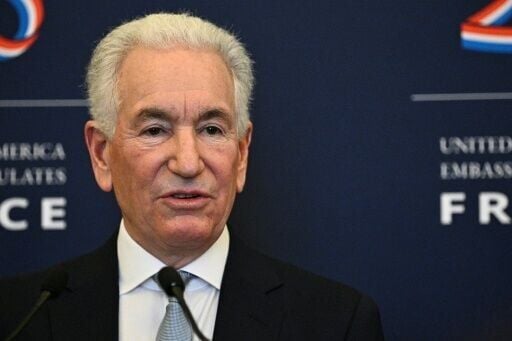
France has taken the unusual step of restricting contact between senior government officials and a United States diplomatic envoy after a dispute over comments made by the U.S. embassy regarding political violence, opening a fresh point of tension between two long standing allies.
The French foreign ministry said U.S. envoy Charles Kushner would no longer be granted direct access to ministers following his failure to attend a scheduled meeting requested by Foreign Minister Jean Noel Barrot. Kushner, the father of Jared Kushner, son in law of former U.S. president Donald Trump, had been summoned to provide clarification over statements issued by the embassy in Paris.
The meeting was set for Monday evening, but Kushner informed French authorities that he had a prior commitment and instead sent a deputy diplomat.
French officials interpreted the decision as a breach of diplomatic protocol and responded publicly.
In a sharply worded reaction, the ministry said the absence demonstrated what it described as an “apparent failure to grasp the basic requirements of the ambassadorial mission,” adding that Barrot had asked that Kushner no longer be received directly by members of the French government.
Read also: US Ambassador To France Blocked From Official Meetings
The dispute grew out of a message posted on social media by the U.S. embassy following the death of a French student, Quentin Deranque. The embassy statement warned that violent left wing extremism was increasing in France, a characterization that officials in Paris strongly rejected.
Deranque, 23, died in hospital on February 14, two days after he was assaulted by a group of masked attackers in Lyon.
The incident occurred near a gathering linked to a radical left political event and has become a subject of national debate. Members of France’s centre right governing camp attributed the attack to far left militants.
French authorities, however, criticized what they saw as political interpretation of an ongoing criminal investigation. Barrot said the killing should not be used to advance ideological narratives, describing the embassy’s comments as inappropriate intervention in domestic matters.
Read more: France Summons US Envoy Kushner Over Lyon Killing Remarks
“We reject any use of this tragedy, which has plunged a French family into mourning, for political ends,” he said over the weekend. He added that France would not accept external judgment on its internal security situation.
The U.S. embassy has not publicly elaborated on the post, and requests for comment have not produced an official response.
Meanwhile, the criminal investigation in France continues. Six suspects have been charged in connection with the fatal assault, while a parliamentary assistant linked to a deputy from the left wing France Unbowed party has been charged with complicity.
France Unbowed leader Jean Luc Mélenchon, widely seen as a potential candidate in next year’s presidential election, denied any connection between his party and the attack and condemned violence. He expressed sympathy for the victim’s relatives and said the party rejected political exploitation of the case.
The diplomatic friction comes at a sensitive political moment in France, where security and extremism have become major campaign themes ahead of national elections. Authorities appear particularly wary of foreign commentary that could influence domestic political debate.
Diplomatic analysts note that disagreements between allied countries are typically handled privately through formal channels. Public criticism, especially involving social media messaging by an embassy, is rare and often interpreted as political signaling rather than routine diplomacy.
France’s decision to limit the envoy’s access does not sever diplomatic relations but signals displeasure.
Embassies ordinarily maintain regular direct contact with senior government officials to manage cooperation on security, trade and international policy.
The episode also highlights how domestic incidents can quickly acquire international dimensions. Statements from foreign missions are closely watched in host countries, and governments generally expect embassies to avoid commentary that could be viewed as taking sides in internal political disputes.