
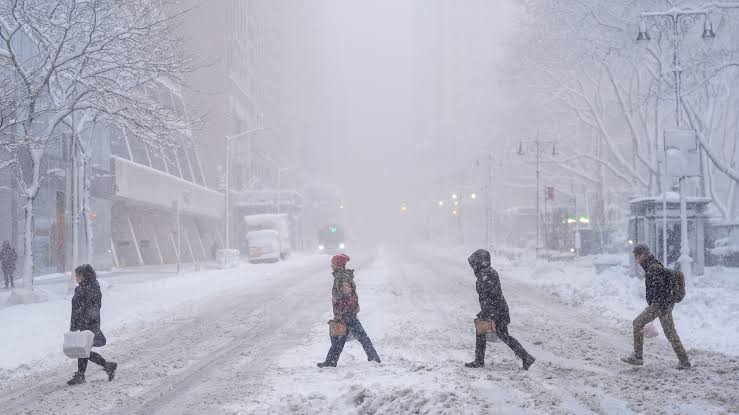
A historic winter system swept across the northeastern United States this week, immobilizing one of the world’s most densely connected economic corridors and exposing once again the vulnerability of advanced infrastructure to extreme weather shocks. From Washington, D.C. to northern Maine, a powerful nor’easter buried cities under record snow, disrupted air travel on a massive scale, and left hundreds of thousands without electricity.
By Monday night, more than 5,700 flights within, into, or out of the United States had been cancelled, according to FlightAware data, as major aviation hubs along the East Coast effectively shut down. Airports serving New York City—LaGuardia and John F. Kennedy International—recorded cancellation rates of 98% and 91% respectively. Boston, Newark, and Philadelphia faced similar paralysis. On Tuesday, disruptions continued, with more than 2,000 additional flights scrapped as airlines struggled to reposition aircraft and crews.
The storm’s defining feature, however, was not only its breadth but its intensity. Snowfall totals shattered long-standing records in parts of New England. In Rhode Island, the smallest US state, Providence received 36 inches (91 cm) of snow—surpassing the previous single-storm record of 28.6 inches set in February 1978. Local media described it as the most severe snowstorm in the state’s recorded history.
Meteorologists were equally stunned. Candice Hrencecin, a forecaster with the National Weather Service in Boston, told the New York Times that the accumulation “completely smashed” previous benchmarks. Nearly 37 inches (94 cm) fell in parts of Rhode Island and Massachusetts, while New York City’s Central Park measured over 19 inches. The National Weather Service had issued warnings spanning from North Carolina through Maine, with alerts extending into eastern Canada as the system moved northward.
Such snowfall would strain any urban system. In this case, it triggered cascading disruptions across energy, transport, and media operations. More than 600,000 properties along the East Coast experienced power outages. In Massachusetts alone, nearly 300,000 customers lost electricity. Barnstable County, which encompasses Cape Cod, saw outages affecting roughly 85% of customers at the storm’s peak.
Read Also: Trump’s 10% Global Tariff Takes Effect
The combination of heavy snow and sustained winds created white-out conditions—periods during which visibility is reduced to near zero—forcing authorities to take extraordinary measures. Rhode Island and neighbouring Connecticut imposed bans on non-essential travel. Massachusetts Governor Maura Healey later followed suit, warning residents that emergency responders might be unable to reach stranded motorists. “White-out conditions are making travel extremely dangerous,” she said in a public statement, urging residents to remain off the roads.
In New York City, a temporary travel ban effectively froze movement across a metropolitan area of more than eight million residents. Bridges, highways, and arterial roads were closed before authorities lifted restrictions at midday. Even then, mobility remained limited as snow removal operations continued. Long Island residents reported snow accumulations so deep that front doors were blocked. One resident, Sandra Wu, told Reuters her family had to attempt access through their garage, only to find digging efforts largely futile.
The scale of disruption extended beyond transport and utilities. In Boston, the storm halted the physical production of one of America’s most established newspapers. The Boston Globe announced that it would not print its Tuesday edition—the first such interruption in its 153-year history. Despite navigating wars, technological upheavals, and even the COVID-19 pandemic, the paper’s management said the sheer volume of snow made it impossible for staff to reach the printing facilities. Subscribers are expected to receive combined editions later in the week.
At a human level, the storm altered daily life in profound ways. Boston resident Bradley Jay described feeling confined, unable to resume his routine outdoor walks for what he estimated could be ten days. Across the region, families remained indoors as municipal crews worked to clear roadways and restore essential services.
Law enforcement agencies faced their own challenges. In New York City’s Washington Square Park, the police department began investigating footage showing officers being pelted with snowballs during the height of the storm. Police Commissioner Jessica Tisch publicly condemned the conduct as criminal and unacceptable, underscoring tensions that can surface even during weather emergencies.
The storm’s economic implications are difficult to quantify immediately but are likely substantial. The northeastern corridor is a critical artery for finance, manufacturing, trade, and higher education. Prolonged airport closures ripple through global supply chains, particularly for time-sensitive cargo. Rail services and trucking routes also experienced interruptions, compounding logistical bottlenecks.
For global observers—including policymakers in Africa increasingly focused on climate resilience—the episode offers a reminder that even advanced economies remain susceptible to extreme weather volatility. The United States possesses extensive snow-management infrastructure and sophisticated meteorological capabilities. Yet record-breaking events continue to test the limits of preparedness. As climate variability intensifies, questions surrounding urban design, grid resilience, and emergency coordination are likely to gain further urgency.
The nor’easter is forecast to track into eastern Canada, with strong winds persisting even as snowfall tapers off. Cleanup operations are expected to continue for several days, particularly in coastal communities where drifts remain high and downed trees pose additional hazards.
Read Also: Panama Seizes Canal Ports From CK Hutchison
What emerges from this episode is not merely a story of meteorological extremes, but one of systemic strain under climatic pressure. When a single weather system can suspend aviation networks, darken hundreds of thousands of homes, and interrupt a century-old newspaper’s press run, it underscores the fragility embedded within modern interdependence.
For residents of the northeastern United States, recovery will mean clearing streets, restoring power, and resuming routine. For policymakers—both domestically and globally—the storm stands as another data point in a broader pattern: infrastructure designed for historical norms must increasingly contend with record-breaking realities.