
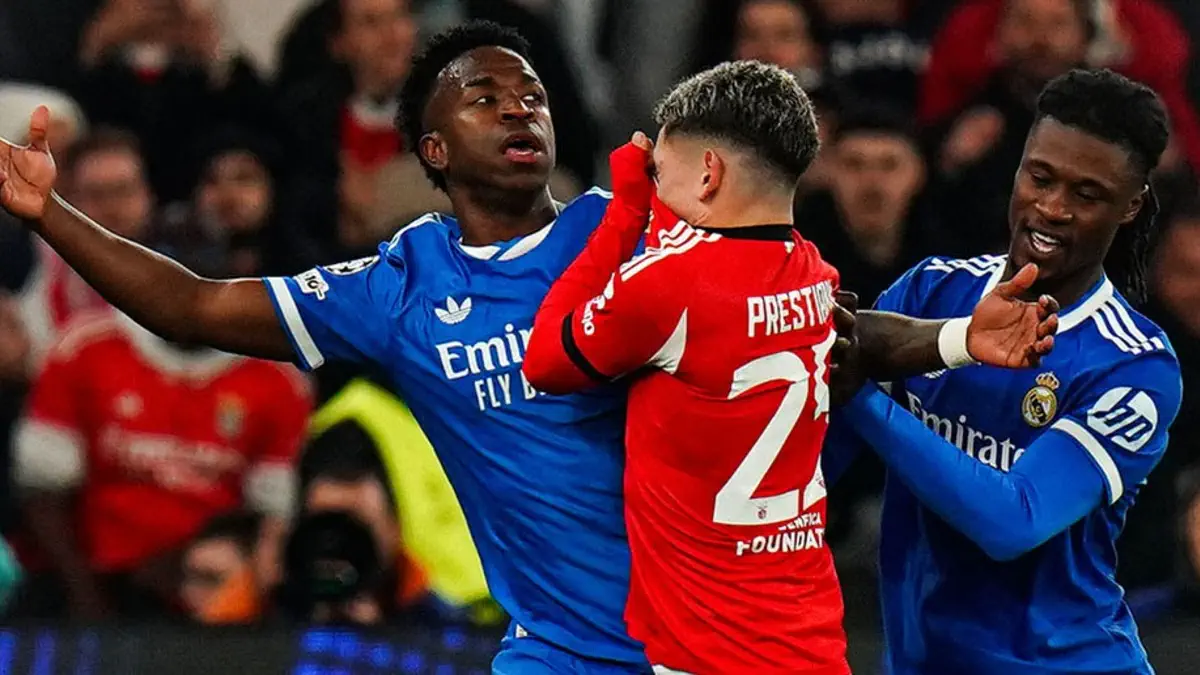
The decision by S.L. Benfica to include Gianluca Prestianni in its traveling delegation to Madrid—despite a temporary suspension issued by UEFA—signals more than a routine administrative gesture. It reflects the layered realities of elite European competition, where legal technicalities, squad management strategy, and symbolic messaging often intersect on the eve of decisive fixtures.
Prestianni, currently subject to a provisional ban that prevents him from taking the field in tomorrow’s match, will not feature in active competition. Yet his inclusion in the official squad list suggests that Benfica’s leadership is navigating the situation with calculated deliberation. In modern football governance, disciplinary measures do not automatically translate into physical exclusion from team operations. Clubs frequently choose to maintain a suspended player’s presence within the traveling group to reinforce unity, preserve morale, and demonstrate institutional backing while awaiting procedural resolution.
The immediate context is straightforward: UEFA’s suspension renders Prestianni ineligible for match participation. The sanction, temporary in nature, does not extend to restricting his physical movement with the squad. As such, Benfica remain within regulatory bounds by listing him among the traveling contingent. The move appears compliant rather than confrontational.
However, the broader optics merit attention. European competitions operate under intense scrutiny, where administrative decisions can be interpreted as subtle statements. By traveling with the team, Prestianni remains visibly integrated into Benfica’s competitive structure. He trains, prepares, and occupies the same operational environment as his teammates. This continuity mitigates the isolating effect that disciplinary rulings can impose, particularly on younger players navigating the pressures of continental football.
For Benfica, the stakes in Madrid are significant. Away fixtures in European tournaments demand cohesion and psychological steadiness. Disruptions—whether tactical, legal, or reputational—can ripple across a squad. The club’s choice to keep Prestianni embedded in the group may therefore be as much about maintaining internal equilibrium as about preserving external leverage.
From a governance perspective, UEFA’s temporary suspensions are procedural safeguards. They allow investigations or disciplinary reviews to proceed without prematurely imposing definitive sanctions. The framework balances due process with competitive integrity. In such circumstances, clubs often adopt a cautious stance: respecting the ruling while signaling confidence in eventual clarity.
Read Also: Digital Soccer Leagues Court US Market With $185m
Prestianni’s situation underscores the increasingly intricate relationship between regulatory oversight and sporting operations. Modern football clubs function as legal entities as much as athletic institutions. Compliance departments, legal advisers, and sporting directors collaborate to interpret regulations in real time. Travel lists, eligibility rosters, and official communications are drafted with precision, mindful of both technical adherence and public perception.
There is also a developmental dimension to consider. For emerging talents, continental exposure is formative. Even when barred from playing, remaining within the competitive setting sustains experiential growth. Tactical briefings, stadium preparation, and matchday routines provide continuity. Removing a player entirely from the traveling party can interrupt that progression. Benfica’s approach suggests an awareness of the long-term investment embodied in the player.
At the same time, UEFA’s authority remains central. European football’s governing body has, over the past decade, reinforced its disciplinary architecture to ensure uniform application of rules across member associations. Temporary suspensions are designed to be immediate yet measured. Clubs are expected to comply without resistance, and Benfica’s actions do not appear to challenge that expectation.
The episode also reflects the broader normalization of regulatory complexity in elite sport. Travel squads often exceed the number of players eligible for selection on matchday. Injured players, those serving domestic bans, or individuals under review may accompany the team for logistical or rehabilitative reasons. The distinction between presence and participation is increasingly operational rather than symbolic.
Still, optics matter. Publicly listing Prestianni communicates that the club does not consider the suspension an indictment of character or commitment. It frames the issue as procedural rather than punitive. Such messaging can be crucial in protecting both player reputation and market value—particularly in a transfer ecosystem where perception influences financial calculus.
Read Also: Trump’s 10% Global Tariff Takes Effect
For supporters and analysts, the immediate impact is limited to team selection. Benfica must adjust tactically without the option of deploying Prestianni. Strategic depth becomes critical. Coaches in European competition prepare contingency frameworks precisely for such eventualities, whether due to injury, suspension, or rotation.
Looking beyond tomorrow’s fixture, the key variable will be the duration and outcome of UEFA’s process. Should the suspension be lifted swiftly, Prestianni’s uninterrupted integration ensures a seamless return to eligibility. If extended, Benfica may face more substantive recalibration. For now, the club appears intent on minimizing disruption while respecting institutional boundaries.
In Madrid, the match itself will command attention. Yet the inclusion of a suspended player in the traveling squad serves as a reminder that contemporary football is governed as much by procedural nuance as by performance on the pitch. Decisions made in administrative offices can carry implications that ripple into locker rooms and beyond.
Benfica’s choice, restrained and calculated, reflects that reality. It neither defies UEFA nor distances the player. Instead, it occupies the narrow space between compliance and solidarity—a space increasingly familiar to clubs operating within Europe’s tightly regulated competitive framework.