
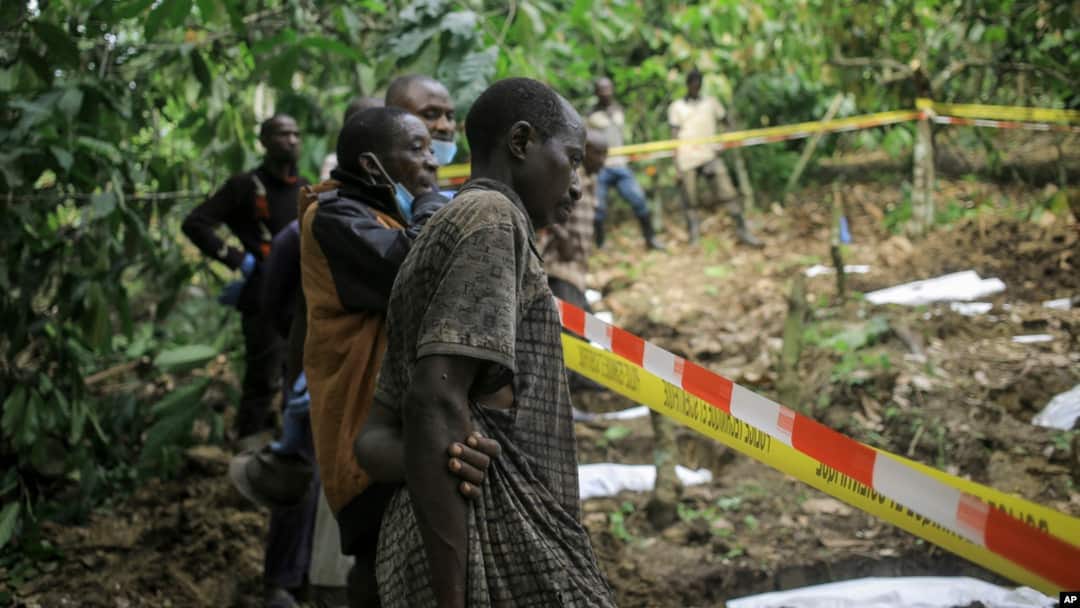
Authorities in eastern Democratic Republic of Congo say they have uncovered at least 172 bodies in mass graves in Uvira, a lakeside city that government forces recaptured last month after a brief occupation by the AFC/M23 rebel group.
Jean-Jacques Purusi, the Kinshasa-appointed governor of South Kivu province, said the graves were found in the Kilomoni and Kavimvira neighborhoods. One site contained 31 bodies, the other 141, he told local journalists on Tuesday in remarks recorded and broadcast across the country on Thursday.
A local human rights activist, Mashauri Mwindule, said additional graves had been discovered in Kabimba, a village eight kilometers from Uvira. The circumstances of the deaths could not be independently verified by Reuters.
M23 held Uvira for roughly a week in December after seizing the transit hub on Lake Tanganyika, near the border with Burundi. The rebels withdrew under pressure from the United States, and Congolese army units re-entered the city in January.
Lawrence Kanyuka, a spokesperson for AFC/M23, said the group had no knowledge of mass graves during its time in Uvira and accused the government of spreading propaganda to tarnish its reputation.
Read also: BREAKING: Rwanda Launches Suit Over UK’s Ditched Asylum Pact
Human Rights Watch reported in December that M23 fighters had carried out summary executions in Uvira, citing residents and a United Nations source. Bodies were found in several neighborhoods, including Kavimvira, according to the report.
AFC/M23 did not respond to those allegations at the time but has previously accused the organization of running a “disinformation campaign” against it.
Human Rights Watch also said the Congolese army and allied militia groups committed abuses both before M23 took the city and as they retreated from it.
The rebel group now controls large areas of North and South Kivu provinces after a rapid offensive last year in which it captured the strategic cities of Goma and Bukavu. The advance displaced hundreds of thousands of civilians and disrupted humanitarian operations across the mineral-rich region.
Congo, the United Nations and Western governments have accused Rwanda of backing M23 with arms and troops. Kigali denies the allegations.
Fighting has persisted on several fronts in eastern Congo in recent weeks despite mediation efforts by Qatar, the United States and other actors.
Read also: BREAKING: Rwanda Launches Suit Over UK’s Ditched Asylum Pact
Talks aimed at de-escalating the conflict have made little headway, with both sides accusing each other of violating ceasefires and blocking negotiations.
Uvira sits on a key supply route connecting Congo’s eastern highlands to Lake Tanganyika and serves as a crossing point for trade and refugees moving between Congo and Burundi.
Its capture by M23 in December raised concerns that the rebels were expanding their territorial control beyond their traditional strongholds further north.
The discovery of mass graves adds to a growing body of evidence documenting atrocities committed during the conflict. International humanitarian organizations have struggled to access affected areas due to ongoing violence and restrictions imposed by armed groups.
Congo’s government has called for stronger international action against Rwanda and has threatened to sever diplomatic ties if support for M23 continues. Rwanda maintains it has legitimate security concerns related to armed groups operating along its border with Congo.