
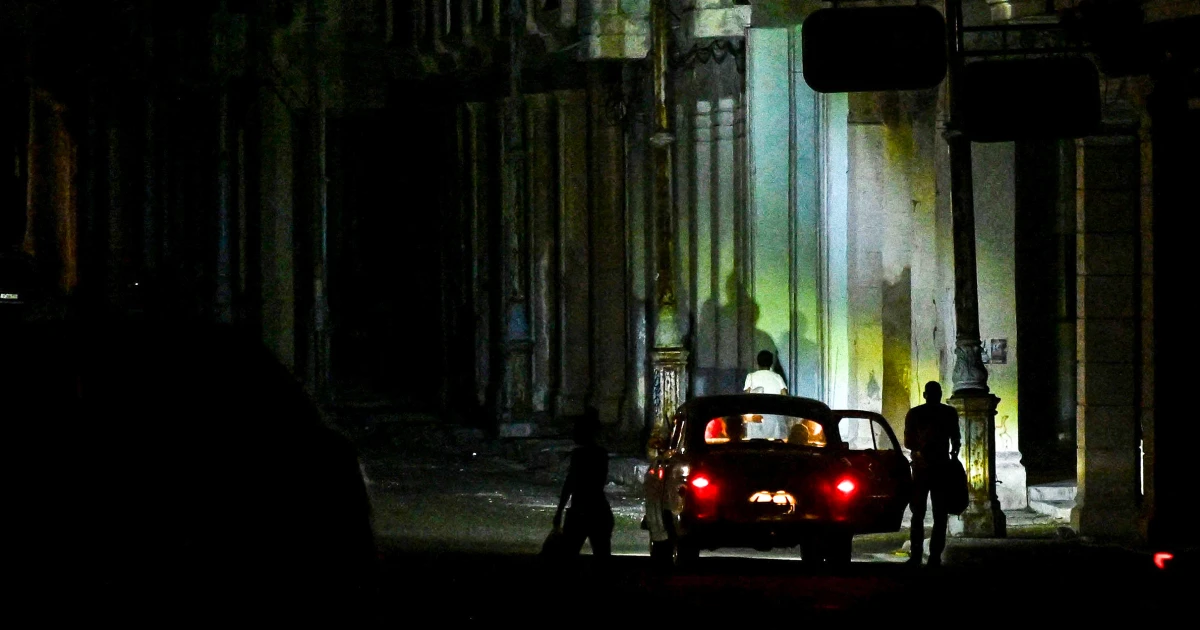
Pot-banging had barely started in Santa Fe on Tuesday night when the streetlights flickered on — and the same residents who’d stepped out in frustration turned straight back toward their doors, eager not to waste a minute of electricity that might vanish again by morning.
That small scene captured something larger playing out across Havana. Cuba’s grid had failed nationwide Monday for the third time this year, and by late Tuesday, engineers had clawed back power to most of the island while leaving Santiago de Cuba, the country’s second city, dark entirely. State grid operator UNE reported connections restored from Pinar del Rio in the west to Holguin in the east — a stretch covering most of Cuba’s geography, but not, notably, its second-largest population center.
Frustration spilled into the streets well before the lights returned anywhere.
Residents in Havana’s outer neighborhoods of Jaimanitas and Santa Fe banged pots, leaned on car horns and shouted demands into the dark, a form of protest that has become almost seasonal on an island now six months into a U.S. fuel blockade. What once might have counted as an outburst has hardened into something closer to ritual.
Hundreds simply sat it out instead — doorsteps and sidewalks doubling as living rooms, dominoes clicking under streetlights that weren’t working, mosquitoes doing what mosquitoes do in tropical heat with no fans running to keep them off. Outages now regularly stretch past 30 hours, a duration long enough that many residents have stopped guessing when relief might come and instead built the darkness into how they plan an evening.
Read also: Russian Oil Tanker Arrival Tests U.S. Pressure On Cuba
“Our power plants are obsolete and there’s no fuel,” said Amauri Gonzalez, who’d stepped outside for air rather than sit inside sweating. He doesn’t expect the problem to resolve quickly, he said — a diagnosis shared by nearly everyone else on his street.
He isn’t wrong about the fuel shortage. Washington severed Cuba’s fuel imports in January and has since layered on sanctions that pushed foreign businesses off the island and gutted a tourism industry that once supplied Cuba with badly needed hard currency. American officials describe the campaign’s goal plainly: pressure Havana’s government until it holds democratic elections and releases prisoners Washington considers political.
Havana rejects that framing outright, and so, notably, does the United Nations — both arguing the sanctions violate international law and strip ordinary Cubans of rights that have nothing to do with their government’s politics.
That disagreement played out publicly Tuesday at the UN General Assembly, where member states debated the sanctions regime in real time. U.S. Ambassador Michael Waltz placed blame squarely on Cuba’s leadership. “Change your ways and turn the lights back on for your people,” he told the chamber, framing the blackouts as a domestic failure rather than a consequence of cut fuel supplies.
Nearly every other delegation that spoke pushed back in the opposite direction, calling on Washington to lift the blockade and reverse sanctions they said had crippled an entire economy — leaving the United States conspicuously isolated in a debate about who bears responsibility for a Caribbean island’s failing grid.
Diplomatic movement has stalled entirely. Officials on both sides describe talks as going nowhere, with neither government showing signs of shifting position after six months of standoff.
None of that registered on a Santa Fe street corner Tuesday night, where the pot-banging simply stopped the instant the lights came back. Neighbors who’d been shouting into the dark minutes earlier went quiet, turned, and disappeared indoors — not because anything had been resolved, but because for now, at least, the power was on, and nobody wanted to be the one still outside when it went off again.