
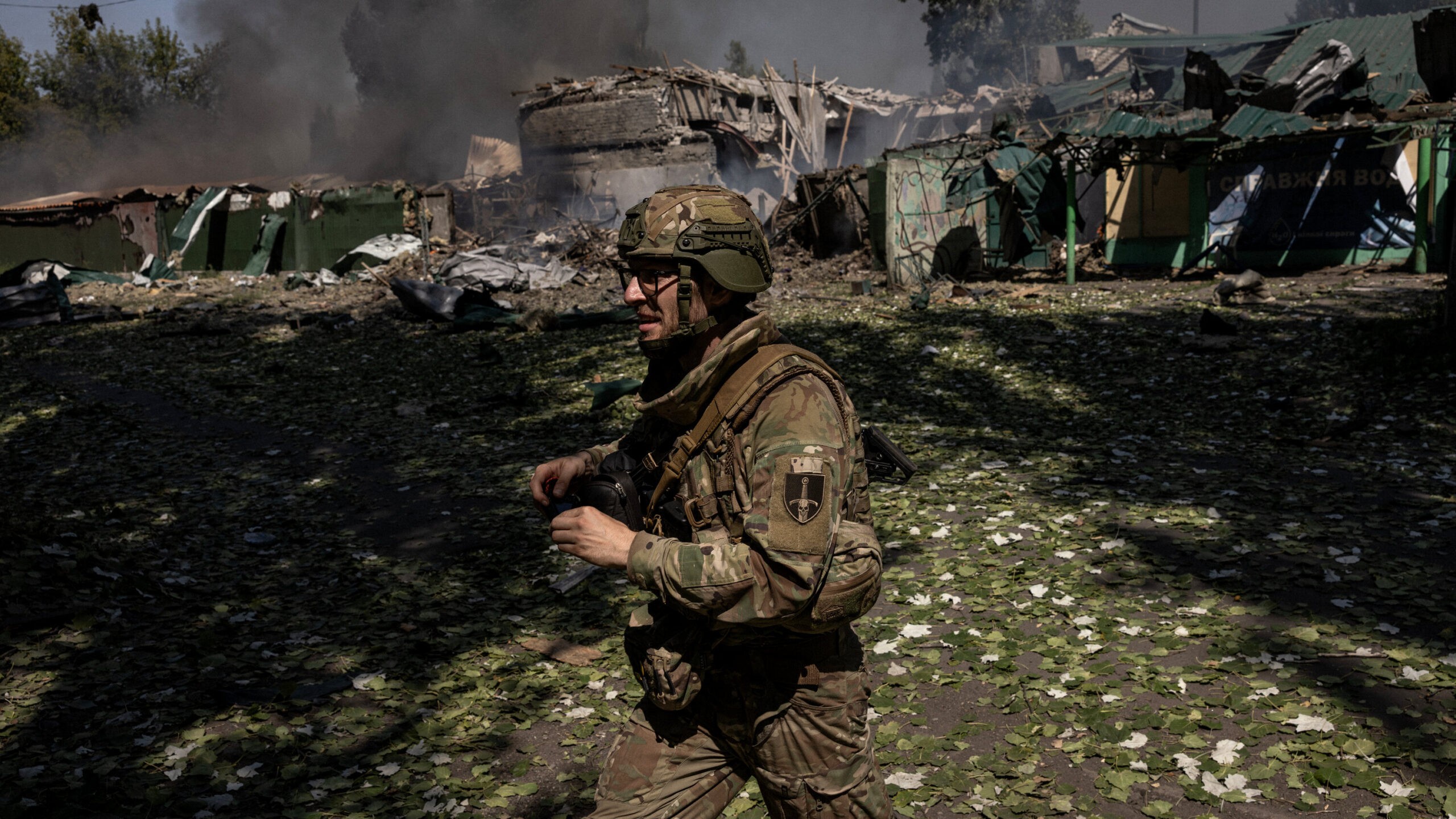
Ukraine demonstrated its expanding strike capabilities this week by hitting a missile factory 1,200 kilometers inside Russia, marking the first successful use of a new long-range weapon as the war entered its fifth year with neither side able to break a grinding stalemate.
The February 21 attack on the Votkinsk facility in Udmurtia used Ukraine’s domestically produced FP-5 “Flamingo” missile, which carries a 1,150-kilogram warhead and represents Kyiv’s most powerful long-range weapon to date. Satellite imagery confirmed damage to at least one machine-building plant at the complex, which produces Russia’s Oreshnik intermediate ballistic missile and other systems Moscow has threatened to use against European targets.
Missile expert Fabian Hoffman described the strike as the first time Ukraine had successfully hit a core Russian missile production site with a heavy missile capability.
Ukrainian drones also struck the Neftogorsk Gas Processing Plant in Samara on the same day, damaging two gas condensate stabilization units. The attacks formed part of a strategic campaign to disrupt Russian weapons and fuel supply chains.
President Volodymyr Zelenskyy said Saturday that Ukrainian forces had recaptured 300 square kilometers of territory in southern Ukraine, though he did not specify a timeframe. Commander-in-chief Oleksandr Syrskii put the figure at 400 square kilometers two days later, saying the gains had come since late January.
“You can’t say that we’re losing the war,” Zelenskyy said in an interview with AFP. “The question is whether we will win.”
The Institute for the Study of War, a Washington think tank, said Ukraine’s southern advances followed disruptions to Russian military communications after Starlink disconnected illegal Russian terminals in the area and Moscow partially disabled the Telegram messaging service. Both platforms had been essential for Russian forces coordinating operations.
Read also: U.S. Charges 30 More In Minnesota Anti-ICE Church Protest
The counterattacks, though limited in scale, may have disrupted Russian preparations for a spring offensive, the institute said.
Russia controls roughly 20 percent of Ukrainian territory four years after launching its invasion. Open source intelligence and European officials have noted that Moscow has seized 1.5 percent of Ukraine or less over the past three years at a cost of hundreds of thousands of casualties.
The eastern city of Pokrovsk appears to have fallen to Russian forces in recent weeks after a two-year campaign to capture a town with a pre-war population of 60,000. The Institute for the Study of War said the city, once an important logistics hub, had ceased to be operationally significant by the time Russia intensified its assault in winter.
“Russian strikes denied Ukrainian forces the ability to fully leverage the town for logistics as early as July 2025,” the institute said.
Russia launched more than 1,500 drones and at least 90 missiles against Ukraine during the week marking the invasion’s anniversary. The two largest barrages came days before and after the February 24 date.
On February 23, Russia fired 197 drones and 50 missiles. Ukraine intercepted all but 26 drones and 31 missiles.
On February 27, Russia launched 420 drones and 39 missiles. Ukrainian air defenses neutralized 90 percent of the drones and 30 missiles.
Read more: Ex-USAF Pilot Charged With Training Chinese Armed Forces
Zelenskyy said the improved interception rate reflected better performance by Ukraine’s air force. “We indeed managed to protect very important facilities,” he said. Kyiv’s power remained on despite the attacks.
Serhiy Beskrestnov, an adviser to Ukraine’s defense ministry, said all ballistic missiles fired at Ukraine were manufactured at the end of 2025 or beginning of 2026. “We are actually being attacked with missiles from the factory,” he said, suggesting Russia is using its full production capacity.
Ukraine’s air force said it had destroyed 3,855 long-range missiles and 67,000 drones since the war began.
Zelenskyy said Tuesday that Russian President Vladimir Putin “understands he is not capable of defeating Ukraine on the battlefield, and the ‘second army in the world’ is fighting against apartment buildings and power plants.” The comment referred to Russia’s aerial campaign targeting infrastructure across the four-fifths of Ukraine that remains unoccupied.
The Flamingo missile, which entered production in the second half of last year, has been plagued by accuracy problems. Hoffman said the Votkinsk strike marked the first confirmed successful use against a high-value target.
Ukraine has sought to expand its ability to strike deep inside Russia as a way to offset Moscow’s advantages in manpower and artillery. Western allies have provided some long-range weapons but placed restrictions on their use against targets inside Russia, leaving Ukraine reliant on domestically produced systems for strikes far from the border.
Russia has stationed Oreshnik missiles in Belarus and repeatedly threatened to use them against European countries supporting Ukraine. The missile system, which Putin has described as “unstoppable,” uses technology developed at facilities like Votkinsk.
The front line has shifted slowly over the past year despite intense fighting. Ukrainian forces have held defensive positions in much of the east while making incremental gains in the south. Neither side has achieved a breakthrough that would significantly alter the war’s trajectory.