
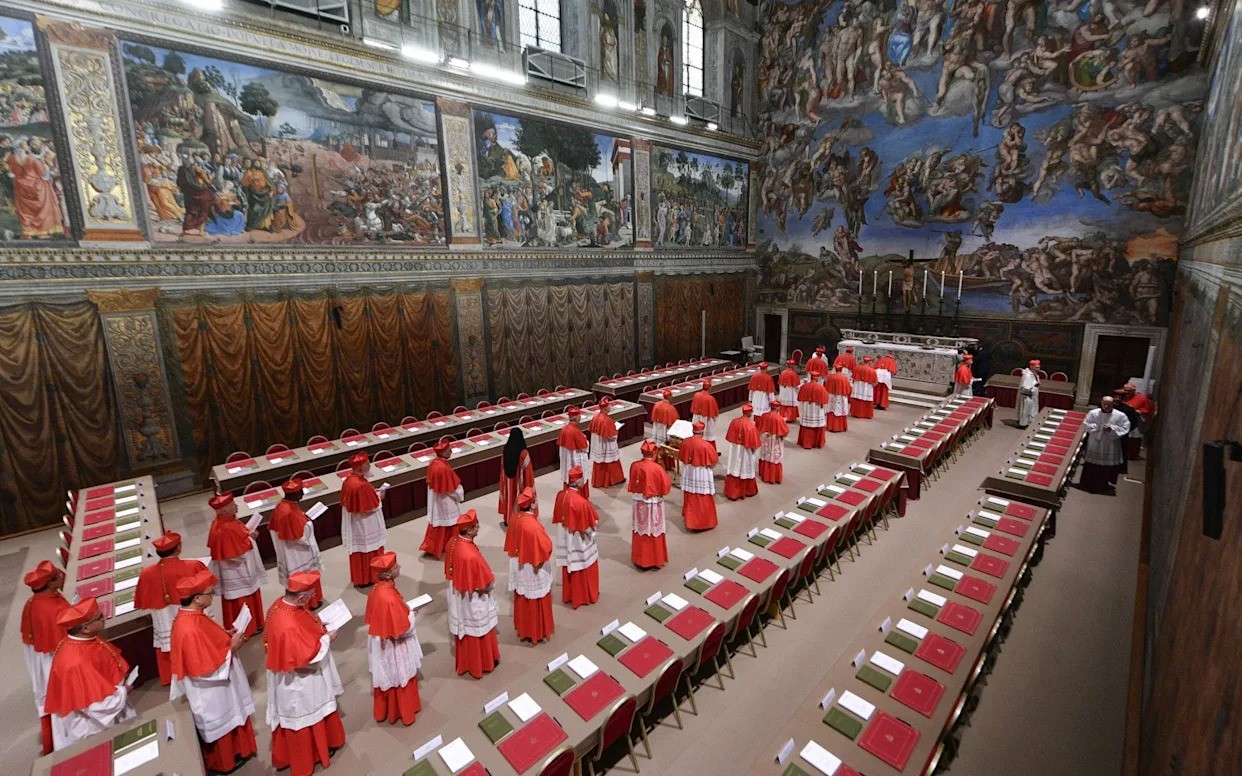
A previously unknown security breach occurred during the papal conclave that resulted in the election of Pope Leo XIV last May after one of the 133 cardinals participating in the secret meeting was found to be carrying a mobile phone, according to a new book by two veteran Vatican journalists.
According to the book, “The Election of Pope Leo XIV,” as the cardinals began to assemble in the Sistine Chapel to commence the first round of voting, security personnel detected a mobile phone signal, despite the fact that the chapel was equipped with phone jamming technology.
An older cardinal soon realized he was carrying a phone in his pocket, which he turned over to the authorities, leaving the gathered clerics “disoriented and distressed,” the authors of the book revealed, without disclosing the identity of the errant prelate or the reason behind his actions.
“The scene was unimaginable even for a film and never before seen in the history of modern conclaves,” wrote Gerard O’Connell and Elisabetta Piqué, who based their account on interviews with the participating cardinals.
According to O’Connell, the incident, which took place in reality, was “better than fiction,” referring to the 2024 feature film Conclave, which narrates the papal conclave in a fictional way.
Read Also: Pope Leo Closes Holy Year With Call for Compassion
Clerics participating in the conclave must take a vow of non-communication with the outside world and give up all their electronic devices during the conclave, which may take several days to be concluded.
The Vatican press office was not available to comment on the book.
On May 7-8, the conclave was held following the death of Pope Francis in April, who had ruled the 1.4 billion-member Catholic Church for 12 years.
The two-day-long conclave was the most diverse ever, with cardinals from 70 countries participating in the voting.
As the book reveals, the majority of the public speculation before the voting was focused on the probability of a pope from Asia or Africa.
Nevertheless, none of the candidates from these parts of the world managed to accumulate significant votes.
Two candidates were the leading contenders: Italian Cardinal Pietro Parolin, who had been working in the Vatican for a long time, and his American counterpart, Robert Prevost, who was unknown to the public but would eventually be chosen to become the new Pope Leo XIV.
Cardinal Prevost of the United States managed to accumulate between 20 and 30 votes on the first ballot held on the evening of the 7th of May, which was a surprisingly high number of votes, the book reveals.
At the same time, the popular Philippine Cardinal Luis Antonio Tagle, who was considered a potential candidate, managed to collect fewer than 10 votes during the conclave.
On the fourth ballot on the 8th of May, Prevost managed to accumulate 108 votes to be chosen on the final ballot. According to the book, the Philippine Cardinal, who was sitting next to Prevost on the final tally, offered him a cough drop.
While the cardinals are strictly forbidden to disclose the results of the secret ballot without the express permission of the newly elected pope, journalists have managed to get information on the process in the following years through interviews with the participants.
The research carried out by O’Connell and Piqué can be seen as one of the first attempts to analyze the voting process and the internal workings of a modern-day conclave.
Further information on the process can be found in the book regarding the technical details surrounding the process.
Read Also: Pope Leo Urges Ukraine–Russia Talks In Christmas Message
The Sistine Chapel is equipped with technical devices to block any form of communication, and the votes are recorded on paper ballots that are then burned after the counting process.
This process has a symbolic meaning depending on the color of the smoke produced.
The voting patterns of the 2025 conclave, as mentioned in the book, reveal the change in the voting patterns of the College of Cardinals.
The book indicates that the diversity of the cardinals, as well as their experience, was an essential factor in the voting patterns of the cardinals, although the actual voting patterns of the cardinals remain a secret.
The ascension of Pope Leo XIV was the first time a U.S. cardinal became the Pope of the Catholic Church.
His ascension to the papacy was a result of his experience in the Vatican’s structures, as mentioned in the book.
The book indicates that the relatively unknown status of Prevost, as far as the Catholic Church’s hierarchy was concerned, was an essential factor in his ascension to the papacy as a unifying candidate among the factions of the Catholic Church.
The text also puts the conclave into a broader historical context. O’Connell and Piqué explain that, while mobile phones and other devices are not allowed, the 2025 breach is the first recorded case of a cardinals’ device being discovered during an active vote in the modern era.
There have been no indications from the Vatican on further actions regarding the phone incident.