
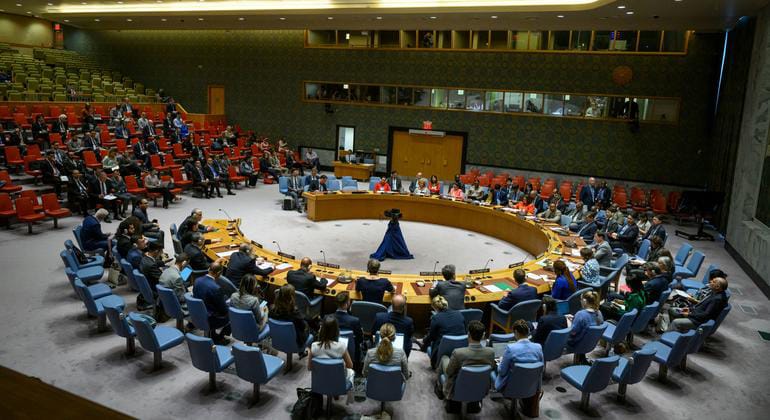
The UN Security Council will convene an emergency session Saturday afternoon following US and Israeli airstrikes on Iran and Tehran’s retaliatory missile attacks across the Middle East, with multiple governments demanding immediate steps to halt what they described as illegal aggression.
France, China, Russia, Bahrain and Colombia each pushed for the extraordinary weekend meeting, according to a diplomatic source.
The session is scheduled for 4:00 pm in New York, where Secretary-General Antonio Guterres is expected to address the body.
Russia’s UN mission said it requested the gathering over “the unprovoked act of armed aggression by the United States and Israel against the Islamic Republic of Iran.” Moscow said it would demand both countries immediately cease their actions and pursue a political settlement.
Iranian Foreign Minister Abbas Araghchi sent a letter to the council calling for “immediate” measures to stop what Tehran characterized as unlawful use of force by Washington and Tel Aviv. He said the council must address the strikes and take necessary steps to halt the attacks.
“The United States and the Israeli regime shall bear full and direct responsibility for all ensuing consequences, including any escalation arising from their unlawful actions,” Araghchi wrote.
Guterres issued a statement condemning the escalation before the scheduled session, saying the strikes and Iran’s retaliation undermine international peace and security.
He called for an immediate cessation of hostilities and de-escalation but offered no specific proposals for achieving either.
The United States and Israel launched the attacks Saturday, citing what they described as threats from Iran. Tehran responded with missile volleys aimed at Gulf states hosting US military installations and at Israeli territory.
Read also: Iran Announces Khamenei Killed In Joint US-Israel Strike
European Commission President Ursula von der Leyen warned that the situation had become “perilous” and urged all parties to exercise restraint. She said protecting civilians in any ensuing conflict was critical.
Von der Leyen also stressed the importance of ensuring nuclear safety after American officials indicated Iranian nuclear facilities were potential targets. The European Union has long expressed concern that military action against Iran’s atomic program could scatter radioactive material or provoke Tehran to weaponize its enrichment capabilities.
Countries across the Middle East and beyond voiced alarm that the exchange could spiral into a broader regional war. The Gulf states, caught between their security partnerships with Washington and their geographic proximity to Iran, face particular pressure as the confrontation intensifies. The Security Council meeting comes at a moment when the body’s five permanent members—the United States, Russia, China, France and Britain—are deeply divided over Middle East policy. Russia and China have grown closer to Iran in recent years, while the US maintains its decades-old alliance with Israel.
That split could prevent the council from issuing any unified statement or resolution in response to the crisis. Previous attempts to address conflicts involving Iran have collapsed over vetoes and procedural disputes.
Read also: Pakistan Claims 331 Taliban Dead As “Open War” Enters Day Three
Saturday’s strikes marked the most direct military confrontation between the US and Iran since the two countries have been adversaries for more than four decades. While they have clashed through proxies across the region, large-scale airstrikes represent a significant escalation.
Iran’s nuclear program has been a flashpoint for years. Tehran insists its activities are for peaceful energy production, while Western governments and Israel have accused it of pursuing weapons capability. International inspectors have documented Iran’s accumulation of highly enriched uranium and its failure to fully cooperate with monitoring efforts.
The 2015 nuclear agreement, which placed limits on Iran’s enrichment in exchange for sanctions relief, collapsed after the US withdrew in 2018. Efforts to revive that accord have stalled, and Iran has since expanded its program beyond the deal’s restrictions.
Whether the Security Council session produces any concrete action remains uncertain. The body has struggled to address escalating tensions in the region, with competing interests among its members often resulting in diplomatic gridlock.