
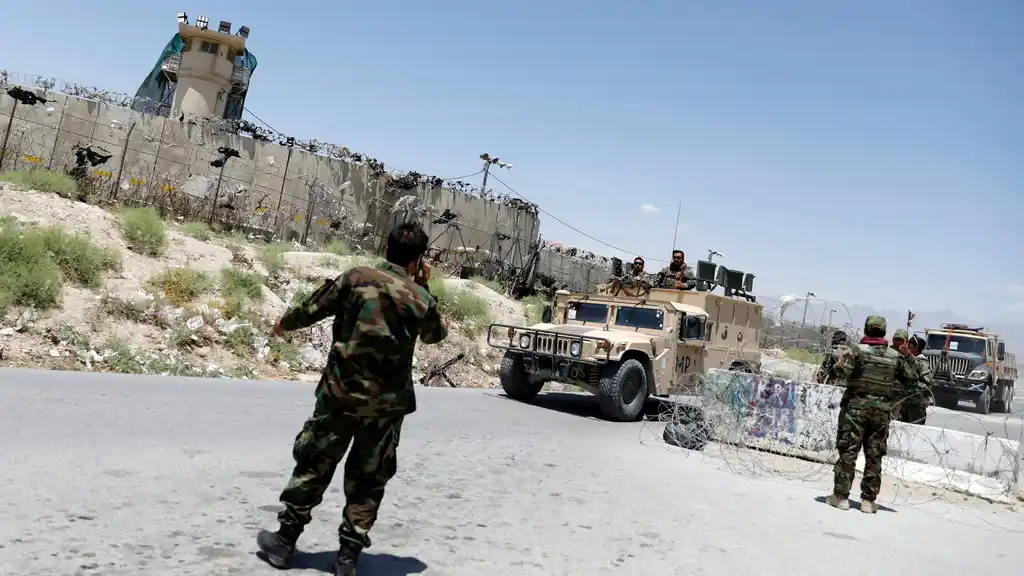
Pakistani air and ground forces struck Bagram Airbase north of Kabul on Tuesday and clashed with Taliban fighters at more than two dozen points along the 2,600-kilometre frontier as the six-day conflict between the two nuclear-armed neighbours deepened, while Afghanistan launched its own retaliatory air force strikes on military installations inside Pakistan and the United Nations reported that 42 civilians had been killed in the fighting, with more than 16,000 households displaced across five Afghan provinces.
Pakistan’s Information Minister Attaullah Tarar confirmed the Bagram strike in his first official acknowledgement of the operation against the former American command centre, which served as the United States military’s largest base in Afghanistan throughout the 20-year war before the Taliban takeover in 2021. “We had intelligence that there was ammunition and critical equipment being used by terrorists to fight the Pakistan army along the border as well as by Afghan Taliban troops,” Tarar told Reuters. Afghanistan’s Parwan provincial authorities initially claimed their anti-aircraft guns had repelled the assault. Satellite imagery subsequently published by the New York Times showed multiple blast craters and destroyed buildings at the facility, contradicting the Afghan account and confirming that Pakistani strikes had found their targets despite the defensive response.
Afghanistan’s Ministry of National Defence announced it had conducted retaliatory air force strikes on Pakistani military installations, naming Nur Khan Airbase in Rawalpindi, a key facility near the Pakistani capital, the 12th Division headquarters in Quetta in Balochistan province, and the Khwazai Camp in Mohmand Agency in Khyber Pakhtunkhwa.
“These operations were carried out in response to the recent aerial incursions by the Pakistani military, which struck Kabul, Bagram, and several other regions,” the ministry said in a statement. Pakistan’s military did not immediately comment on the claims. The strikes on Rawalpindi, if confirmed at scale, would represent a significant escalation, bringing the conflict from the frontier and the Afghan interior into the Pakistani heartland.
Pakistan’s overall tally of operations since the start of Operation Ghazab Lil Haq stood at 46 strike locations across Afghanistan as of Tuesday. Islamabad claimed to have killed 415 Afghan fighters for the loss of 12 Pakistani soldiers.
Read Also: Security Council Convenes As UN Boss Slams Mideast Crisis
Pakistani security forces also claimed to have seized 32 square kilometres of Afghan territory in the Ghudwana enclave south of the Zhob sector, a strategically located area near Kandahar province. Afghan officials said Taliban forces had captured a Pakistani military post in the Kandahar region and killed 80 Pakistani soldiers. Reuters could not independently verify the competing claims. Taliban intelligence simultaneously ordered Afghan domestic media not to cover areas targeted in recent Pakistani strikes, with intelligence personnel stationed at media offices to enforce the blackout and journalists warned against defiance, a censorship effort that complicated independent assessment of damage inside Afghanistan.
UNAMA’s statement, issued Tuesday and covering the period from February 26 to March 2, recorded 42 civilian deaths and 104 injuries across five Afghan provinces: Paktya, Paktika, Nangarhar, Kunar, and Khost.
The figures included casualties from both indirect fire in cross-border clashes that struck residential areas and from direct Pakistani airstrikes in Paktika and Nangarhar provinces. The mission described the numbers as preliminary and subject to upward revision. Minister Tarar rejected the figures, arguing that militant fighters in civilian attire were being counted among the dead and that UNAMA depended on Taliban authorities, whom he characterised as a party to the conflict, as its primary source of information.
“Pakistan has been precise in targeting terrorists and their supporters, including Afghan Taliban military installations that support terrorists,” he said.
UNAMA called for an immediate halt to hostilities. The mission warned that the conflict was compounding an already fragile humanitarian situation in a country still recovering from earthquakes in August and September 2025 that killed more than 1,400 people. Border movement restrictions were limiting humanitarian agencies’ ability to reach the most affected areas. Approximately 16,400 households had been displaced across the five affected provinces, according to preliminary data compiled by the UN Office for the Coordination of Humanitarian Affairs.
Read Also: Pakistan Claims 331 Taliban Dead As “Open War” Enters Day Three
A senior Pakistani security source told Reuters that air strikes would continue until Afghanistan took concrete steps to expel or neutralise militant groups operating from its territory. If no such steps were taken, the source said, Pakistan reserved the option of targeting the Taliban’s senior leadership, a threat that, if carried out, would represent an unprecedented direct assault on the governing authority of a neighbouring state.
Pakistani President Asif Ali Zardari, addressing a joint session of parliament on Monday, restated Islamabad’s position in terms that allowed no ambiguity: “We will not allow any entity, domestic or foreign, to use neighbouring territory to destabilise our peace.”
The conflict is unfolding simultaneously with the US-Israeli military campaign against Iran and the resulting regional instability, stretching Pakistan’s security establishment across two active fronts, its western border with Afghanistan and the domestic unrest that followed Ayatollah Ali Khamenei’s death in cities including Karachi, Islamabad, and Peshawar.
Pakistan’s military resources and diplomatic attention are being stretched at precisely the moment when both are most needed. Saudi Arabia and Qatar have been engaged in mediation efforts, though no ceasefire framework had materialised. No resumption of the Qatar-mediated talks that produced the collapsed October 2025 agreement had been announced as of Tuesday.