
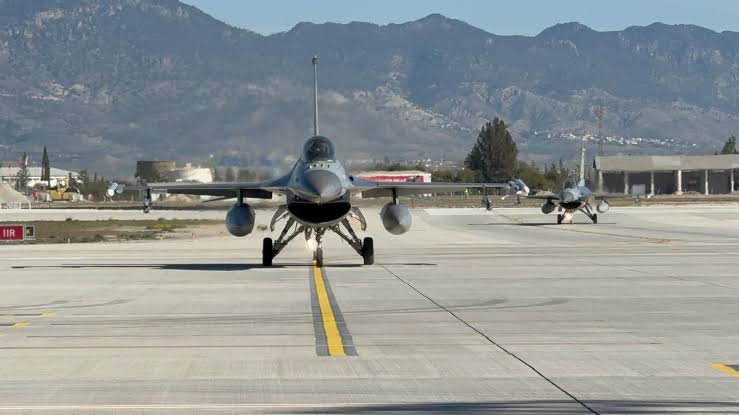
Turkey said on Monday it had dispatched six F-16 fighter jets and deployed air defence systems to northern Cyprus, citing concerns over regional security amid the ongoing U.S.-Israeli military operations against Iran.
The move, the Turkish Defence Ministry said, was aimed at protecting the Turkish Cypriot community and could be followed by additional measures depending on evolving threats.
“In the context of the latest developments in our region, six F-16 fighter jets and air defence systems have been deployed to the Turkish Republic of Northern Cyprus as of today,” the ministry said in a statement.
“As a result of the evaluations to be made depending on the developments, additional measures will continue to be taken if necessary.”
Turkey is the only country that recognises the self-declared Turkish Republic of Northern Cyprus, declared in 1983 after the Turkish military intervention on the island in response to the Greek Cypriot-backed coup.
The southern part of Cyprus, ruled by the internationally recognised Republic of Cyprus, is part of the European Union. Ankara does not recognise the Greek Cypriot administration.
The latest Turkish deployments are part of an increased level of regional tensions that followed the drone strike on the British Royal Air Force’s Akrotiri base in southern Cyprus last week.
Security officials from the European Union have blamed the attack on the Lebanese militant group Hezbollah, backed by Iran.
Read Also: Turkey Iran Espionage Arrests Shake Regional Security
The attack prompted the deployment of the military from the European powers on the island, which has been ethnically divided since the Turkish intervention in 1974.
The Greek Cypriot president, Nikos Christodoulides, said that the Turkish presence is a “reaction” to the declarations of the European Union that the security of Cyprus is under the EU’s responsibility.
In his interview with the Greek newspaper Kathimerini, Nikos Christodoulides referred to Turkey as the “occupying power” in the north of Cyprus, which has long been a point of contention between the two sides.
The remarks of the Greek Cypriot president have not gone unnoticed by the Turkish side.
The leader of the Turkish Cypriot side, Tufan Erhurman, said that attention should be paid to the security of all Cypriots, including the people in the north and the south of the island.
However, Omer Celik, an official from the ruling AK Party and an ally of President Tayyip Erdogan, reiterated that the move was taken for defense purposes.
While speaking to the broadcaster NTV, Omer stated that the move was not intended to target any particular entity but was focused on enhancing the security structure and “consolidating the power balance in Cyprus.”
Greece, which has a security alliance with the Republic of Cyprus, has not yet commented on the Turkish move.
The absence of an official response from Greece is an indication that the country is still sensitive about the militarization of northern Cyprus.
These movements come in the wake of a separate regional security incident last week in which NATO forces intercepted a ballistic missile launched by Iran that entered Turkish airspace.
Read Also: Turkey Thwarts ISIS Holiday Plot With 115 Arrests Nationwide
Ankara has since issued a warning to Tehran against launching further missiles into Turkish territory.
There has been concern in Turkey that European military movements in Cyprus might inadvertently drag the country into further regional conflicts.
Northern Cyprus is home to various Turkish military installations, and the latest movements of F-16s into the region mark an important boost in military reinforcement in the current environment.
It has been argued that the reinforcement of air defense systems with fighter jets is an important move in the region, especially in the wake of rising drone activity.
The European Union and NATO have closely observed the escalation of the situation, with EU countries expressing concern over the spillover of the Middle East conflict into the eastern Mediterranean.
Though the involvement of NATO has only been in the security of the airspace and the coordination of missile defense with Turkey, the need for the escalation of the conflict and the resolution of the situation through diplomacy have been highlighted by the alliance in the context of the island conflict.
Along with the military actions, the officials in Turkey have highlighted the continuation of regional intelligence and surveillance operations in the region.
Celik has highlighted the fact that these actions are being taken in the context of the overall strategy of dealing with the threats without targeting any other countries, with the focus being the security of the Turkish Cypriots.
These developments in Cyprus serve to highlight the fragility of the security situation in the island nation even years after the conflict that led to the division in 1974.
Both sides rely on the support of external forces for their security, with Turkey providing security in the north and Greece/EU forces providing security in the south.