
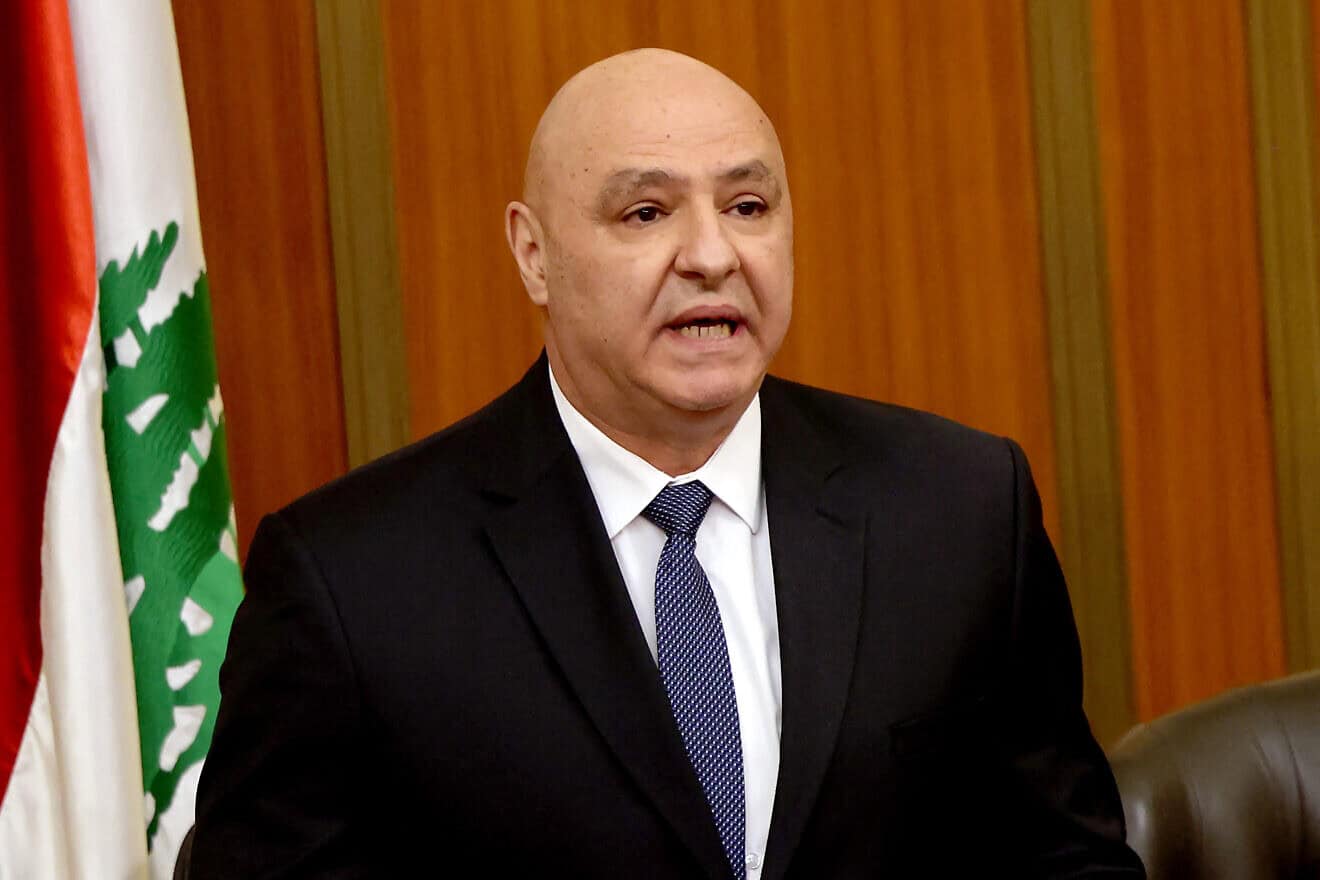
Lebanese President Joseph Aoun publicly accused Hezbollah on Monday of deliberately dragging Lebanon into Iran’s war and working toward the “collapse of the Lebanese state,” while simultaneously proposing a four-point peace initiative that would include direct negotiations with Israel for the first time in the country’s history, a dual move that exposed the depth of Beirut’s fury at the group and the desperation of a government watching its country burn for a war it did not choose.
Aoun detailed his plan during a virtual meeting with European Union officials, leveling sharp criticism at both Hezbollah and Israel for what he called “an attempt to corner my country.”
He accused Israel of showing “no respect for the laws of war, nor for international laws,” while describing Hezbollah as “an armed faction that places no value on Lebanon’s interest nor on the life of its people.” The statement was the most explicit public condemnation of Hezbollah ever issued by a sitting Lebanese president, breaking a decades-long convention by which Lebanese heads of state preserved studied ambiguity about the group’s role inside the country’s political and military architecture.
Aoun’s initiative included a comprehensive ceasefire, logistical support for the Lebanese Armed Forces, the disarmament of Hezbollah, and direct negotiations between Lebanon and Israel under international auspices. Under the proposal, Israel would halt all land, air, and sea operations against Lebanon, after which the Lebanese army would move to disarm Hezbollah and confiscate its weaponry with international assistance. Israel would then gradually withdraw from Lebanese territory it currently occupies, with Lebanese Armed Forces replacing Israeli troops in the south.
“And simultaneously, Lebanon and Israel begin direct negotiations under international sponsorship, in order to execute the aforementioned plan,” Aoun said. A Lebanese government spokesperson told the BBC that Beirut was ready to negotiate, but not while the country remained under Israeli fire, a sequencing demand that Israel showed no sign of accepting.
The Israeli response was cold. Israeli Defense Minister Israel Katz said: “From this point on, we must not only avoid retreating but seize the opportunity to strike Hezbollah.” Israel’s ambassador to France Joshua Zarka said Tel Aviv was not aware of any decision to enter negotiations to end the war.
“What would end it is the disarmament of Hezbollah, and that is a choice for the Lebanese government,” he said. The Carnegie Endowment for International Peace assessed that Israel’s actual goal went beyond mere disarmament, that a more plausible interpretation of its principal objective was to engineer Hezbollah’s complete outlawing and dissolution, with the evacuation orders and buffer zone threats designed to dismantle the civilian population base in which Hezbollah operates.
Read Also: Tensions Increase In Cyprus After Drone Strikes British Base
The Trump administration’s response was equally skeptical. According to Axios, which cited five sources with knowledge of the matter, both the US and Israeli responses to Lebanon’s diplomatic approach were “cool and deeply skeptical.”
The US diplomat most recently handling Lebanon, Morgan Ortagus, left the government in January. The Lebanon portfolio currently has no clear owner in Washington at a moment of acute crisis. Lebanese President Aoun, Prime Minister Nawaf Salam, and Parliament Speaker Nabih Berri were furious when Hezbollah joined the war, having received assurances from the group’s political leadership for weeks that it would stay out of any conflict between Israel and Iran. That betrayal, confirmed across multiple Lebanese official sources, was the direct context for Aoun’s unusually blunt public condemnation.
The structural obstacle to Aoun’s plan was not diplomatic but military. Lebanese Army commander General Rodolphe Haykal had resisted the government’s push to deploy troops against Hezbollah, refusing to act while active fighting continued. His stance had fueled tensions with Prime Minister Salam and drawn pressure from both Democrats and Republicans in Washington on Aoun to fire him. Without the army’s willingness to enforce the government’s March 2 declaration that Hezbollah’s military activities were illegal, Aoun’s four-point plan rested on a premise, Lebanese state capacity to disarm the group, that his own military commander had declined to deliver. Tel Aviv University Middle Eastern history professor Eyal Zisser called Aoun’s statement “a cry of help from a country, a president and a prime minister who have lost control of their territory,” while assessing the initiative as unlikely to lead anywhere under current circumstances.
Read Also: Israel Bombs Hezbollah’s Bank Network Across Beirut
The humanitarian toll underpinning the diplomatic emergency was staggering. More than 600,000 people had been displaced since Hezbollah entered the conflict nine days earlier, approximately ten percent of Lebanon’s total population.
At least 486 people had been killed and more than 1,300 wounded according to the Lebanese Ministry of Public Health. Ahmed al-Halabi, a father of two from south Beirut’s Dahieh district, fled with his extended family in the middle of the night as missiles struck nearby.
“We were running away from the bombing! There’s no safety! This is the second time my kids have experienced this and they have developed psychological trauma. The adults can live with this. The kids cannot,” he told the BBC from a school in central Beirut converted into a shelter.