
China set its weakest economic growth target in nearly three decades Thursday, signaling that leaders expect years of subdued expansion as they wrestle with a collapsed property market, deflation and consumer confidence that has yet to recover from pandemic-era shocks.
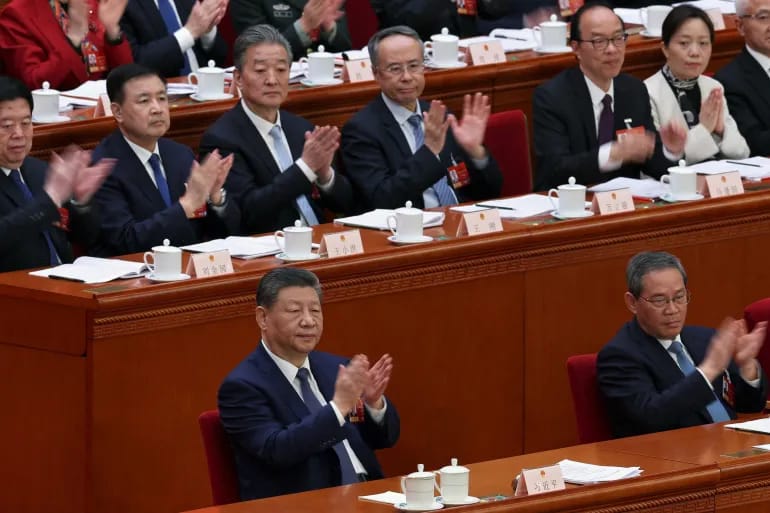
Nearly 3,000 delegates to the National People’s Congress formally approved a target of 4.5 to 5 percent annual growth through 2030, figures embedded in the government’s 15th five-year plan that also sets goals for inflation, fiscal deficits and urban unemployment.
The range marks the lowest ambition Beijing has stated since the late 1990s, excluding the COVID-19 period when the economy contracted.
Planners face the challenge of reaching what they describe as “moderately developed” status by 2035 while GDP per capita sits at $13,303—well short of the $20,000 threshold officials have identified as the benchmark. That gap would require sustained growth above what the new targets project, suggesting either revisions ahead or acceptance that timelines may slip.
The five-year blueprint emphasizes industrial self-reliance and state support for sectors including artificial intelligence, aerospace, biomedicine and integrated circuits. Future energy systems, quantum technology, embodied AI, brain-computer interfaces and 6G networks also feature as priorities, according to Xinhua, the state news agency.
Beijing plans to expand use of the digital yuan, known as e-CNY, particularly for cross-border payments, Reuters reported. The People’s Bank of China has been developing the digital currency for years but deployment remains limited compared to private payment platforms that dominate domestic transactions.
Anticorruption enforcement is accelerating under measures the legislature will soon formalize as law. The NPC Standing Committee’s work report indicated that legislation targeting cross-border corruption will pass in coming months, extending President Xi Jinping’s long-running campaign across government, military and private sectors.
China’s Supreme Court reported a 22.4 percent increase in corruption cases last year involving 36,000 individuals. Authorities recovered 18.14 billion yuan—roughly $2.63 billion—through enforcement actions in 2025, Xinhua said.
The military identified corruption as a priority in its annual work report alongside ensuring political loyalty to Xi and the Communist Party.
How those twin objectives interact—rooting out graft while demanding allegiance—has shaped internal disciplinary processes that have removed senior officers and defense industry executives over the past two years.
Read also: US Navy P-8A Transits Taiwan Strait Ahead of Trump China Trip
The NPC runs concurrently with the Chinese People’s Political Consultative Conference, an advisory body. Together they form the “Two Sessions,” a week-long gathering that brings thousands of delegates to Beijing to approve policy directions and budgets.
Work reports released by government ministries during the sessions offer glimpses into progress on existing goals and hints about future priorities. This year’s reports reflected persistent economic headwinds that have complicated efforts to stimulate growth without triggering debt risks or asset bubbles.
Consumer spending remains weak despite government attempts to boost household income and encourage retail activity. Deflation has persisted longer than officials anticipated, eroding corporate profits and household wealth while complicating debt servicing for companies and local governments.
The property sector, which once accounted for roughly one-quarter of economic activity, has contracted sharply since 2021 when regulators cracked down on developer borrowing. Unsold inventory sits in cities across the country, construction has slowed dramatically, and land sales that local governments depend on for revenue have collapsed.
Beijing has responded with measures to support developers, ease purchase restrictions and encourage banks to lend for real estate projects. But demand has not recovered to levels seen before the downturn, and prices in many cities continue falling.
Whether the 4.5 to 5 percent target proves achievable depends partly on external factors including global trade conditions and geopolitical tensions. China’s export machine faces tariff threats from the United States and Europe while domestic manufacturers contend with overcapacity in sectors like electric vehicles and solar panels.
The emphasis on technological self-reliance reflects lessons learned from US restrictions on semiconductor exports and other measures designed to limit China’s access to advanced components and manufacturing equipment. Beijing has poured resources into domestic chip production, software development and research aimed at reducing dependence on foreign suppliers.
Read more: Oil Field-Bound Drones Intercepted By Saudi Defense Forces
Progress has been uneven. Some areas like commercial drones and solar manufacturing have seen Chinese companies dominate global markets.
Others, particularly advanced semiconductors and aircraft engines, remain heavily reliant on imports or foreign technology despite years of investment.
The digital yuan project aims to modernize payment infrastructure and potentially create an alternative to dollar-based settlement systems for international trade. Adoption has been slow domestically, where Alipay and WeChat Pay already provide convenient digital payment options.
Cross-border applications face additional hurdles including regulatory coordination with other countries and reluctance by trading partners to adopt systems that could give Beijing visibility into transactions. Pilot programs in several cities have demonstrated technical feasibility but widespread use remains distant.
The legislative session concluded after a week of speeches, committee meetings and votes that followed scripts prepared months in advance. Delegates approved budgets, personnel appointments and policy frameworks with overwhelming margins that reflected the body’s function as a ratifying mechanism rather than a deliberative parliament.