
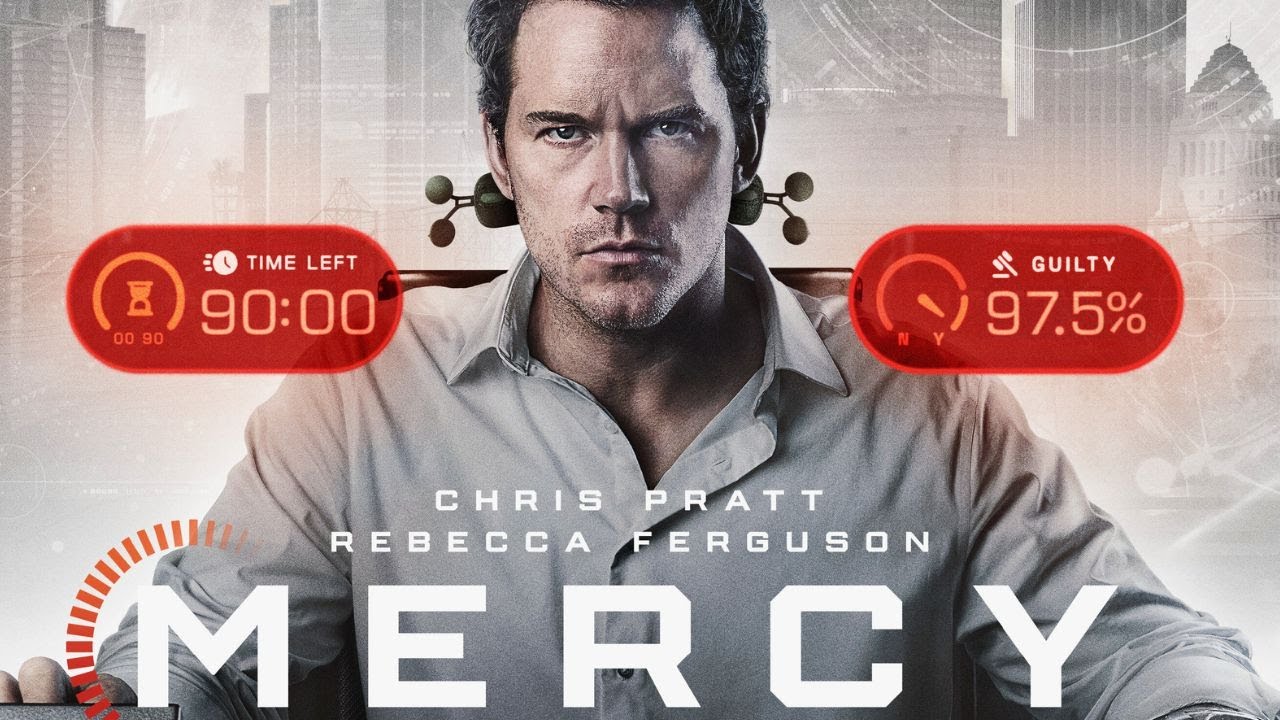
Official Trailer:
The idea that technology might one day take over the most sensitive decisions of human society has long fascinated filmmakers. Few institutions carry as much moral weight as the justice system, and the possibility of replacing human judges with artificial intelligence raises difficult questions about fairness, accountability, and the limits of machine logic. The science-fiction thriller Mercy places those questions at the center of its narrative, imagining a near future where criminal verdicts are no longer decided by people but by algorithms.
Set in a technologically advanced society that has embraced automation in its legal process, the film follows a man accused of murder who becomes the subject of a controversial AI-driven justice program. In this system, suspects are placed inside a high-tech interrogation environment where a powerful artificial intelligence analyzes their statements, reactions, and psychological responses. The system promises perfect objectivity, claiming that human bias and emotional interference have finally been removed from criminal judgment.
But the promise of technological perfection comes with a chilling condition: the accused has only ninety minutes to prove his innocence.
From the moment the interrogation begins, Mercy frames its story as both a race against time and a philosophical confrontation between human instinct and machine calculation. The protagonist sits restrained within a futuristic examination chair while the AI system—operated and monitored by technicians outside the room—subjects him to an escalating series of psychological tests. Every response is recorded, analyzed, and converted into statistical probabilities of guilt.
Read Also: Before “I Do”: When Love Faces The Truth
As the countdown clock continues to tick, the film’s tension builds not through explosive action but through mounting psychological pressure. The protagonist must not only defend himself against accusations but also navigate the cold logic of a system that believes it is incapable of error.
Leading the film is Chris Pratt, whose performance anchors the story’s emotional core. Known for blockbuster roles that often emphasize charm and humor, Pratt adopts a more restrained and serious tone here. His character is placed in a situation where control is constantly slipping away, and much of the performance revolves around subtle shifts in expression and tone as the interrogation intensifies.
Opposite him is Rebecca Ferguson, whose role within the narrative adds an important dimension to the film’s ethical conflict. Ferguson’s character represents the human presence behind the technological system—a reminder that even the most advanced machines still operate within frameworks designed by people. Her performance introduces moments of doubt and moral reflection that challenge the apparent certainty of the AI’s conclusions.
Together, their performances create a dynamic that keeps the film grounded despite its futuristic premise. The story may revolve around advanced technology, but its emotional power comes from the human reactions to that technology.
Visually, Mercy adopts a sleek and minimalist design that reinforces its themes of technological control. The interrogation chamber is sterile and controlled, filled with glowing interfaces, surveillance displays, and digital readouts that constantly update the suspect’s probability of guilt. This environment emphasizes the sense that the protagonist has entered a world governed entirely by data.
Cinematography plays a crucial role in maintaining the film’s atmosphere. Tight framing keeps the audience close to the protagonist’s face, capturing every flicker of anxiety or defiance as the system evaluates his responses. Meanwhile, the digital overlays—timers, percentages, and analytical graphics—remind viewers that the machine is watching, calculating, and judging at every moment.
Read Also: Her Turning Point: A Nollywood Drama Of Love And Choice
The pacing of the film mirrors the structure of the interrogation itself. As the ninety-minute deadline approaches, each new revelation and line of questioning pushes the story toward a more intense psychological confrontation. Rather than relying on traditional action sequences, the film derives suspense from the growing possibility that the system’s verdict may already be predetermined.
What makes Mercy particularly interesting is its exploration of the ethical implications of artificial intelligence within criminal justice. The film raises a critical question: can a machine truly deliver fair judgment if it lacks the human capacity for empathy, context, and moral uncertainty?
Supporters of the AI system within the story argue that technology eliminates the biases that have historically plagued courts. Without human prejudice or emotional influence, the algorithm claims to deliver the most rational outcome possible. Yet the film quietly challenges that assumption by exposing how even the most advanced systems depend on data, programming, and interpretations created by human designers.
In this sense, Mercy reflects a broader cultural conversation about the role of artificial intelligence in modern society. As algorithms increasingly shape decisions in areas ranging from finance to law enforcement, the film’s premise feels less like distant science fiction and more like a speculative extension of current technological debates.
Within the wider landscape of science-fiction cinema, the film aligns with stories that examine technology not as a spectacle but as a moral dilemma. Rather than focusing on futuristic gadgets or elaborate world-building, Mercy narrows its attention to a single, intense scenario where technology’s promise of efficiency collides with the messy realities of human life.
Watch the Full Movie Here: Movie Hub
By the time the narrative approaches its final moments, the film leaves audiences with an unsettling thought. A system designed to remove human error may also remove human compassion. And in a justice system where every decision is reduced to probabilities, the margin for doubt—the very space where mercy traditionally lives—may disappear entirely.
In exploring that possibility, Mercy delivers a tense and thought-provoking reflection on the future of justice. It asks viewers to consider whether society truly wants a system that can calculate guilt with near-perfect accuracy, or whether justice, at its core, requires something machines may never fully understand: the fragile, complicated humanity behind every decision.