
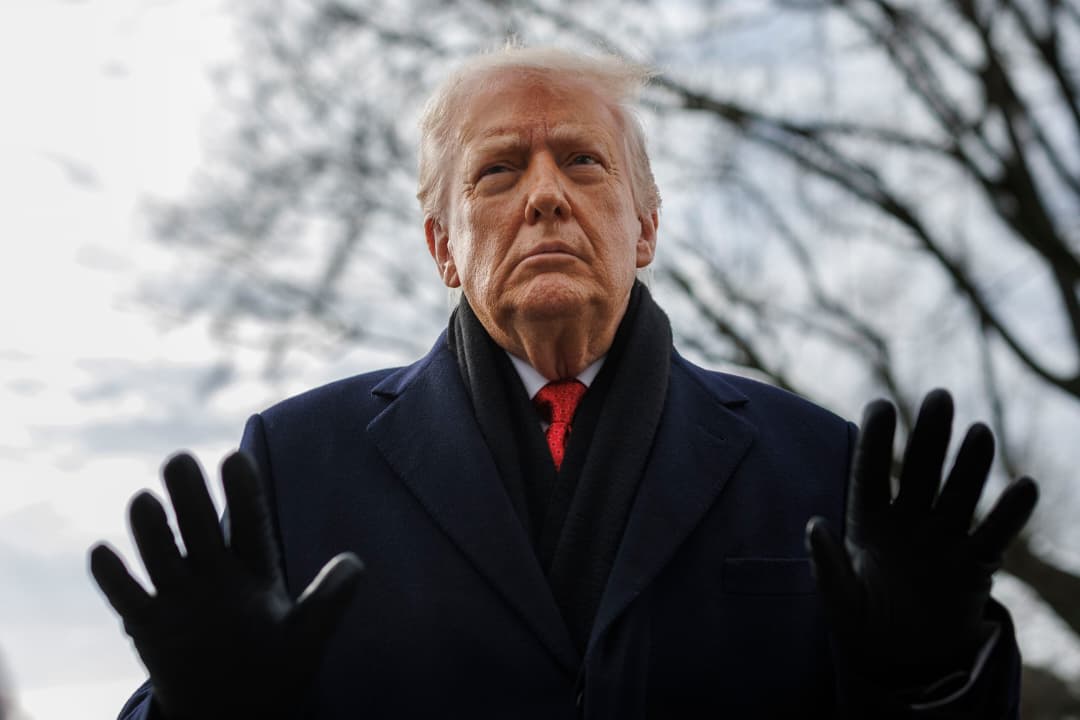
Donald Trump threatened Wednesday to obliterate Iran’s South Pars gas field — one of the world’s largest energy reserves — if Tehran strikes Qatar again, as the war in the Middle East lurched toward a full-scale assault on the Persian Gulf’s energy infrastructure that sent oil prices surging past $110 a barrel.
The threat came hours after Israel struck South Pars in an attack Trump publicly distanced the United States from, even as American and Israeli officials told reporters the operation had been coordinated with and approved by the White House. Iran responded by hitting a major Qatari natural gas facility and launching ballistic missiles at targets in Saudi Arabia and the United Arab Emirates, declaring that Gulf energy sites had become “direct and legitimate targets.”
Trump, posting on social media, warned Iran in capital letters: “NO MORE ATTACKS WILL BE MADE BY ISRAEL pertaining to this extremely important and valuable South Pars Field.” But he reserved his most explosive language for a direct American threat. Should Iran strike Qatar again, he wrote, “The United States of America, with or without the help or consent of Israel, will massively blow up the entirety of the South Pars Gas Field at an amount of strength and power that Iran has never seen or witnessed before.”
“I do not want to authorize this level of violence and destruction because of the long term implications that it will have on the future of Iran,” Trump added. Then: “I will not hesitate to do so.”
The scale of what that threat implies is difficult to overstate. South Pars is the world’s largest natural gas field, shared between Iran and Qatar across the Persian Gulf. Natural gas powers roughly 80 percent of all electricity generated in Iran, according to the International Energy Agency. Destroying the field entirely would not merely damage the Iranian economy — it would collapse the country’s energy system at a moment when its population is already enduring sustained bombardment.
Read also: White House Terror Chief Quits Over Iran War, Urges U-Turn
Markets absorbed the day’s developments with visible alarm. Oil prices jumped five percent Wednesday, extending a surge that has now pushed crude above $110 a barrel since the war began. Asian shares fell sharply in early trading. US stocks also retreated, compounding losses driven by a separate inflation report that suggested price pressures were building even before the conflict sent energy costs spiking. Federal Reserve Chair Jerome Powell’s comments, which dampened investor hopes for near-term interest rate cuts, pushed Treasury yields higher and sent the dollar climbing against major currencies.
An Iranian regional governor gave the economic dimension of the conflict its sharpest formulation yet. “The pendulum of war has swung to a full-scale economic war,” said Eskandar Pasalar.
Saudi Arabia emerged from Wednesday’s attacks with its own warning. Foreign Minister Prince Faisal bin Farhan, speaking after senior Gulf diplomats convened in Riyadh, said Iranian ballistic missile strikes had shattered whatever trust remained between Riyadh and Tehran. “This pressure from Iran will backfire politically and morally,” he said, adding that the kingdom reserved the right to take military action if deemed necessary. The statement marked a significant hardening from a government that has carefully managed its public posture since the war began.
Trump’s claim that Washington had no advance knowledge of the Israeli strike on South Pars ran into immediate contradiction. The Associated Press reported that US officials had been informed of Israel’s plans before the attack. Axios went further, citing both American and Israeli officials who said the operation was coordinated with and explicitly approved by the White House. The discrepancy — between Trump’s public posture of surprise and the reported reality of prior approval — echoes the pattern of studied ambiguity the administration has maintained throughout the conflict, appearing to distance itself publicly from the most provocative Israeli actions while privately enabling them.
Read also: Cuban Govt Beckons Exiles With Investment ‘Open Door’ Pledge
Trump’s framing of the Israeli attack reflected that ambiguity. “Israel, out of anger for what has taken place in the Middle East, has violently lashed out at a major facility known as South Pars Gas Field in Iran,” he wrote — language that cast Israel as an emotional actor operating independently, rather than a partner executing a jointly approved strike. He was equally careful to insulate Qatar, whose Al Udeid air base hosts the largest American military presence in the Middle East. “The country of Qatar was in no way, shape, or form, involved with it, nor did it have any idea that it was going to happen,” he said.
The strike on South Pars is the first reported attack on Iranian energy infrastructure since the US-Israeli campaign began at the end of February. Until Wednesday, strikes had focused primarily on military installations, nuclear-adjacent facilities, and command infrastructure. Hitting South Pars crosses into a different category — economic warfare aimed at the resource that keeps Iranian lights on and factories running.
Iran’s declaration that Gulf energy sites are now legitimate targets suggests it intends to respond in kind, extending the conflict’s reach to the oil and gas infrastructure of states that have not directly participated in the fighting. Whether Trump’s threat deters further Iranian strikes on Qatar — or accelerates the cycle of escalation it was designed to interrupt — is the question every energy market in the world is now pricing in real time.