
Official Trailer:
There is a quiet irony at the heart of many modern relationships: two people can share a life together and still fail to truly understand each other. It is within this emotional gap that the Nollywood drama Love Language finds its voice. Rather than presenting love as a seamless connection, the film examines what happens when affection is present but communication is broken—when the language of love itself becomes a source of conflict rather than comfort.
Set within the intimate space of a marriage, the story unfolds with a focus on a couple whose relationship is gradually strained by emotional disconnect. What initially appears to be a stable union begins to unravel under the weight of unspoken expectations, unmet needs, and differing expressions of care. The film does not rush into dramatic collapse; instead, it allows tension to build slowly, reflecting the way real relationships often deteriorate—not through a single moment, but through a series of small misunderstandings left unresolved.
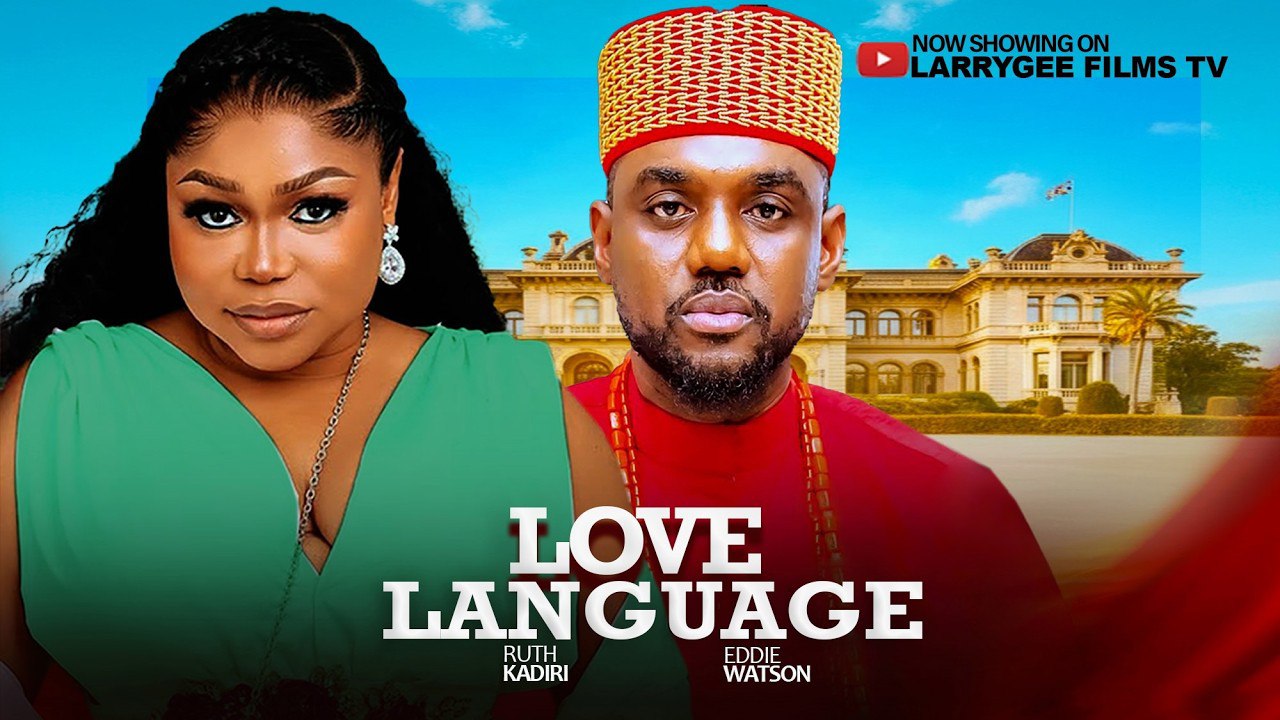
At the center of this narrative is Ruth Kadiri, whose performance anchors the film’s emotional depth. Kadiri portrays a woman navigating the delicate balance between love and frustration, capturing the internal struggle of someone who feels unseen despite giving so much of herself. Her portrayal is layered with restraint, relying less on overt dramatics and more on subtle emotional shifts. In moments of silence, her expressions convey the exhaustion of trying to hold a relationship together when communication begins to fail.
Opposite her, Eddie Watson delivers a performance that complements and challenges Kadiri’s character. His role reflects a man who believes he is fulfilling his responsibilities, yet remains unaware of the emotional distance growing between them. Watson’s interpretation avoids reducing the character to a simple antagonist; instead, he presents a figure shaped by perspective and misunderstanding. This nuanced portrayal allows the audience to see both sides of the conflict, reinforcing the film’s central idea that relationship struggles are rarely one-sided.
What makes Love Language particularly engaging is its commitment to emotional realism. The film resists the temptation to simplify its conflict into clear right and wrong positions. Instead, it presents love as something that requires constant effort, adaptation, and, most importantly, understanding. The concept of “love language” becomes more than a thematic label—it evolves into the central question of the film: how do people express love, and what happens when those expressions go unrecognized?
Read Also: Fast Money Girls: The Price Of A Life Built On Speed
From a directorial standpoint, the film embraces an intimate storytelling style. Much of the narrative unfolds within domestic settings—living rooms, bedrooms, and quiet corners of shared spaces. These environments are not merely backdrops; they reflect the emotional state of the characters. Familiar spaces begin to feel tense and uncomfortable as communication breaks down, reinforcing the sense that the conflict is deeply personal rather than external.
The cinematography supports this intimacy through close framing and warm lighting, drawing the audience into the characters’ emotional world. The camera often lingers just long enough to capture reactions that words fail to express. This approach allows viewers to engage with the story on a more personal level, as though witnessing private moments rather than staged drama.
Watch the Full Movie Here: Movie Hub
Pacing plays a crucial role in shaping the film’s impact. Love Language unfolds with deliberate patience, allowing conversations to develop naturally and conflicts to simmer before reaching their peak. While some may find the tempo reflective rather than urgent, it ultimately serves the narrative’s authenticity. Real emotional conflicts do not resolve quickly, and the film’s willingness to embrace this reality strengthens its credibility.
Beyond its central relationship, the film also touches on broader social themes. It reflects the pressures placed on modern couples—balancing career ambitions, societal expectations, and personal fulfillment. In doing so, it subtly critiques the assumption that love alone is enough to sustain a relationship. The film suggests that without communication, even the strongest emotional bonds can weaken over time.
Read Also: Married To A Star: When Fame Enters The Heart Of A Marriage
Within the wider context of Nollywood cinema, Love Language represents a continued shift toward more introspective storytelling. While the industry has long been celebrated for its vibrant narratives, there is a growing emphasis on character-driven dramas that explore the complexities of human relationships. This film fits comfortably within that evolution, offering a story that prioritizes emotional truth over spectacle.
What ultimately sets Love Language apart is its refusal to provide easy answers. It does not present a perfect formula for fixing relationships, nor does it guarantee reconciliation. Instead, it leaves viewers with a more thought-provoking message: understanding is not automatic—it must be learned, practiced, and nurtured over time.
By the time the film reaches its conclusion, what lingers is not just the outcome of the relationship, but the questions it raises. How often do people assume they are expressing love clearly, only to discover they are speaking a language their partner does not understand? And how many relationships falter not because love is absent, but because it is miscommunicated?
In exploring these questions, Love Language offers more than just a romantic drama. It becomes a quiet reflection on the fragile nature of connection—reminding audiences that love, in its truest form, is not just something to be felt, but something to be understood.