
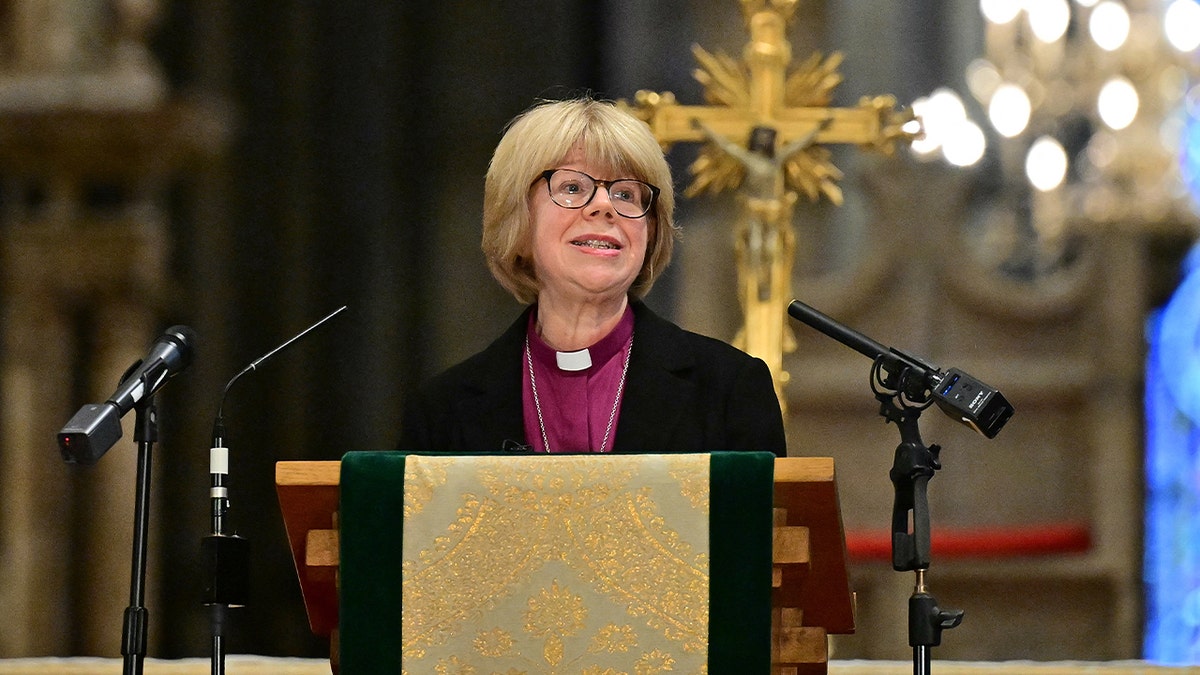
Dame Sarah Mullally will be formally installed as the 106th Archbishop of Canterbury at Canterbury Cathedral on Wednesday, becoming the first woman to hold the office in its 1,400-year history at a ceremony on the Feast of the Annunciation chosen deliberately for its resonance with a calling faithfully accepted, as she arrives in the role carrying both a historic mandate and an Anglican Communion whose structural unity is under the most sustained challenge it has faced in living memory.
The installation takes place at 11 a.m. local time before a congregation of 2,000 guests. The Prince and Princess of Wales will attend on behalf of King Charles III, who serves as Supreme Governor of the Church of England. Prime Minister Sir Keir Starmer and Conservative leader Kemi Badenoch are also expected to attend, alongside faith leaders, healthcare workers personally invited by Mullally, and more than two dozen primates from Anglican Communion churches across the globe.
The Vatican will send a representative from the Holy See, and the Archbishop of Westminster will deliver an Old Testament reading, reflecting Mullally’s commitment to ecumenical engagement as a defining element of her archiepiscopate.
Mullally arrived at Canterbury Cathedral on Sunday afternoon, completing a six-day, 140-kilometer walking pilgrimage along the Becket Camino route from St Paul’s Cathedral in London — the first Archbishop of Canterbury in modern history to undertake the journey. Around 100 people accompanied her for the final stretch through Canterbury’s streets to the cathedral, where she was received by the city’s mayor, the Bishop of Dover Rose Hudson-Wilkin, and the Dean of Canterbury David Monteith. “It’s been a real joy, it’s also a joy to know that we’re done,” she told reporters.
The ceremony follows a liturgical sequence rooted in centuries of tradition. Mullally will approach the cathedral’s west door and formally seek admission, greeted by children. She will preach her first sermon in the role, deliver declarations affirming her responsibilities, and be formally enthroned in two separate chairs: first in the Cathedral Chair as Diocesan Bishop of Canterbury, then in the Chair of St Augustine — carved from Purbeck marble in the early 13th century — as Primate of All England and symbolic leader of the Anglican Communion.
The ancient Canterbury Gospels, which tradition holds St Augustine of Canterbury brought to England in 597 and which are normally kept at Corpus Christi College, Cambridge, will be brought to the cathedral for the installation. Prayers and readings in multiple languages, including Urdu, and African choruses will reflect the Communion’s geographic breadth.
Mullally, 63, was born in Woking and trained as a nurse at St Thomas’ Hospital in London, treating cancer patients for years before beginning study for ordained ministry in the late 1990s. She was ordained to the priesthood in 2001 and served in South London parish ministry before becoming Chief Nursing Officer for England in 1999 — a position she left in 2004 to pursue full-time ministry. She was consecrated as Bishop of Crediton in 2015, becoming one of the Church of England’s first female bishops. In 2018, she was installed as Bishop of London, the third most senior episcopal position in the Church of England.
Read Also: Archbishop Of Westminster Appointment Marks Vatican Shift
Her election as Archbishop was confirmed legally at St Paul’s Cathedral on January 28, 2026, at which point she legally succeeded Justin Welby, who resigned in November 2024 following criticism over his handling of allegations against a church-affiliated volunteer abuser.
The Communion she inherits is fractured along lines that have been deepening for more than a decade. Gafcon, the Global Fellowship of Confessing Anglicans — a conservative bloc whose membership is concentrated in African and Asian provinces — has declared that Mullally “cannot provide leadership to the Anglican Communion” because of her support for the blessing of same-sex marriages and her status as a woman bishop, which the majority of Gafcon member churches do not recognize as valid. This month, Gafcon established a new council of primates in a direct institutional challenge to Mullally’s authority. The Archbishop of Uganda, the Archbishop of Nigeria, and several other African primates have declined to attend the installation.
The Anglican Consultative Council, which Mullally is scheduled to convene for its first meeting under her leadership this summer in Belfast, is itself expected to debate possible revisions to the leadership structure of the Communion — including the role of the Archbishop of Canterbury — when it meets June 27 to July 5. Those discussions could produce formal changes to the way the Communion’s global institutions are organized, potentially reducing the Archbishop’s formal authority beyond its current moral rather than juridical basis.
Read Also: Church Abuse Complaint Sparks Review Of Incoming Archbishop
Those in the majority who welcome her appointment have placed significant emphasis on what her selection represents beyond the doctrinal disputes. Emily Onyango, the first female Anglican bishop in Kenya, said Mullally’s election indicated that “things will be done differently.” Thabo Makgoba, the Archbishop of Cape Town, called it a “thrilling development.” Several pioneering female Anglican bishops from across Africa will participate in Wednesday’s cathedral procession — a visual argument that the global South’s relationship with Mullally’s leadership is more complex than Gafcon’s opposition suggests.
The installation ceremony, Mullally has said, represents not an end but a beginning. Her priorities include the healing of the Communion’s internal divisions where possible, a commitment to climate and creation care as a theological and political imperative, and the renewal of the Church of England’s public credibility at a moment when institutional trust has been significantly damaged by successive child safeguarding scandals. As a former nurse and NHS official, she has also said she intends to amplify the Church’s witness on poverty, healthcare access, and social care — themes that connect her pre-ordination career to her episcopal ministry.
The ceremony proceeds against the background of a meningitis outbreak in Kent. Officials confirmed the service would go ahead without additional precautionary measures, while remaining in contact with local health authorities. Mullally addressed the deaths of two young people earlier in the week, saying: “My heart goes out to them in their devastating loss.”