
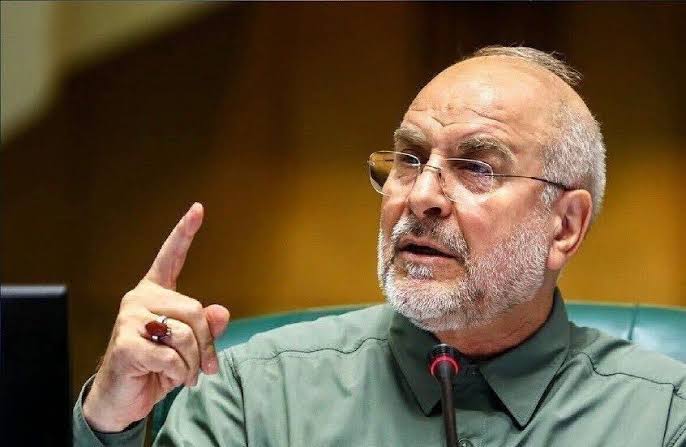
Iran’s parliament speaker threatened Sunday to incinerate American ground troops if they set foot on Iranian soil, as diplomats from three Muslim-majority nations gathered in Pakistan to piece together a channel for direct US-Iran talks — two tracks of the same conflict running simultaneously in opposite directions, one toward escalation, the other toward an exit neither side has yet agreed to use.
Mohammad Bagher Qalibaf told Iranian state media that his country’s forces were “waiting for the arrival of American troops on the ground to set them on fire and punish their regional partners forever.” The statement came as approximately 2,500 US Marines trained in amphibious landings arrived in the Middle East, a deployment whose purpose Washington has not officially characterised but which analysts read as preparation for a potential assault on Iranian islands along the Strait of Hormuz. Qalibaf dismissed the Pakistani diplomatic initiative as cover — a negotiating facade erected while the real preparation was military.
In Islamabad, the foreign ministers of Saudi Arabia, Turkey and Egypt met without American or Israeli participation, seeking to build a bridge between two governments that have communicated almost entirely through intermediaries since the war began on February 28. Egypt’s foreign minister, Badr Abdelatty, said the meetings were aimed at opening direct dialogue — the first such channel, if established, between Washington and Tehran in the current conflict. The ministers were expected to reconvene Monday.
Read also: Zelenskyy’s Gulf Trip Yields Defence Pacts With UAE, Qatar
The diplomatic effort is threading a narrow passage. Iran has publicly rejected the 15-point framework the United States offered as a basis for a ceasefire, and Iranian officials have consistently framed any negotiation conducted under military pressure as a capitulation they will not accept. Yet Press TV, the English-language arm of Iranian state broadcasting, reported last week that Tehran had drafted its own five-point counter-proposal — calling for a halt to killings of Iranian officials, guarantees against future attacks, reparations, and what it described as Iran’s exercise of sovereignty over the Strait of Hormuz. The gap between the two frameworks is vast. The existence of both suggests that somewhere beneath the public posturing, channels are open.
Iran offered a small but pointed gesture toward selective normalcy on Saturday, agreeing to allow 20 additional Pakistani-flagged commercial vessels through the strait. Pakistan’s former ambassador to Iran, Asif Durrani, described the move as a signal that Tehran “remains open for business with the world, provided the United States abandons coercion” — diplomatic language that simultaneously holds out an olive branch and names its price.
The Revolutionary Guard issued a threat of a different and alarming category on Sunday, warning that Israeli universities and branches of American universities operating in the Gulf region would be considered legitimate military targets unless Iran received safety guarantees for its own academic institutions by midday Monday. Israeli airstrikes had hit several Iranian universities, including facilities Israel claimed were used for nuclear research and development. Iran’s foreign ministry said dozens of universities and research centres had been struck, among them the Iran University of Science and Technology and Isfahan University of Technology. American universities with Gulf campuses — Georgetown, New York University and Northwestern among them operate in Qatar and the UAE — were named explicitly in the Guard’s warning.
Read also: Iran Warns U.S. Against Ground Invasion As Talks Open
Both sides have now threatened to attack civilian infrastructure the other considers protected, a pattern that legal scholars and human rights organisations have warned constitutes the architecture of war crimes regardless of which actor is responsible.
The war has killed more than 3,000 people across the region in one month. Iranian authorities report more than 1,900 dead inside the country. Israel has recorded 19 deaths. Lebanon, where Israel has invaded while pursuing Hezbollah, has lost more than 1,100 people. Eighty Iraqi security forces members have died as Iranian-backed militia groups entered the conflict from Iraqi territory. Twenty people have been killed in Gulf states. Four have died in the occupied West Bank.
The Houthi movement in Yemen has joined the conflict, raising the spectre of a second maritime chokepoint falling under threat. The Bab el-Mandeb strait connecting the Red Sea to the Gulf of Aden carries a substantial portion of global seaborne trade; Houthi interdiction there, combined with Iran’s grip on Hormuz, would place two of the world’s most critical waterways simultaneously under pressure. Global oil, gas and fertiliser supplies are already severely disrupted. Air travel across the region has been upended.
From Iraq, where Iranians have been crossing the border to urge an end to the war, the view from ground level was offered by Razzak Saghir al-Mousawi, a 71-year-old man describing the relentless air strikes. “We don’t know at what moment our homes could be targeted,” he said. “I am definitely afraid.”
The UAE’s Anwar Gargash called Sunday for any settlement to include “clear guarantees” against future Iranian attacks on Gulf neighbours and compensation for damage to civilian infrastructure, describing Iran’s government as “the main threat” to Persian Gulf security. The demand for guarantees is the Gulf states’ non-negotiable floor — a recognition that a ceasefire which leaves Iran’s capacity and appetite for regional disruption intact would simply be the prelude to the next crisis.
The Marines are in the region. The diplomats are in Islamabad. The parliament speaker is promising fire. Somewhere between those three facts lies whatever happens next.