
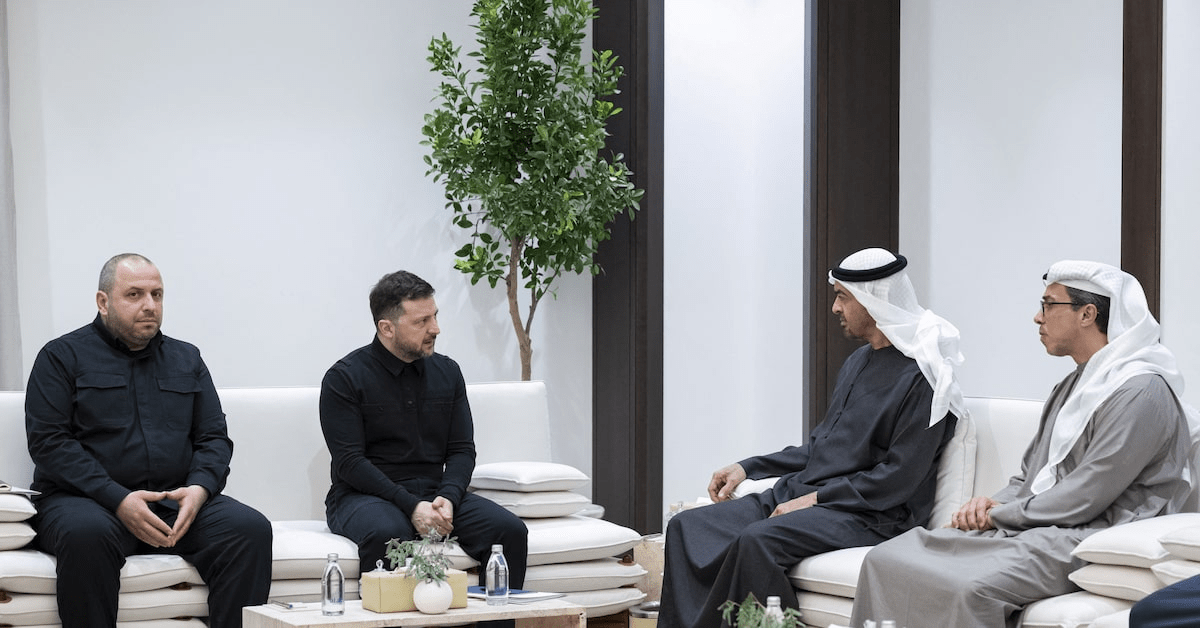
Volodymyr Zelenskyy completed a three-country Gulf tour on Saturday by signing a defence agreement with Qatar in Doha, capping a diplomatic sprint that has repositioned Ukraine as a serious security partner for Gulf states absorbing Iranian drone and missile strikes — and opened a new front in Kyiv’s long campaign to convert battlefield experience into international leverage.
The Qatar deal, signed during Zelenskyy’s visit to Doha after an earlier stop in the UAE, covers collaboration in technological development, joint investment and the exchange of expertise in countering missiles and unmanned aerial systems. It follows a deal with Saudi Arabia signed Thursday and a separate defence cooperation agreement with the UAE earlier the same day. In the space of 72 hours, Ukraine has formalised security relationships with three of the Gulf’s wealthiest states — all of them currently absorbing the spillover from the US-Israeli war on Iran that Tehran insists is targeted only at American assets, even as Gulf nations say their civilian populations are being put at risk.
The architecture of what Ukraine is offering is straightforward and the economics are striking. Gulf states have been relying primarily on Patriot and THAAD interceptor missiles to down Iranian drones and ballistic missiles — systems that work, but at a cost that becomes difficult to sustain at scale. A single Patriot missile runs to approximately $4 million. Ukraine has spent three and a half years developing methods to intercept Russian Shahed drones — Iranian-designed and Iranian-supplied — at a cost of around $2,000 per drone killed, using a combination of electronic warfare, specialised interceptors and accumulated tactical knowledge that no classroom can replicate.
“Ukraine is offering a cheap way of countering Iranian drones,” Al Jazeera’s Dmitry Medvedenko reported from Doha. The proposition is not complicated: Gulf states have the expensive solution. Ukraine has the affordable one, proven against the same weapons systems now being fired into the same skies.
Read also: Turkey Shuttles Messages Between U.S. & Iran To End War
Two hundred and one Ukrainian anti-drone experts were deployed to the Middle East as of March 18, Zelenskyy announced. They are already operating in the three countries he visited — a boots-on-the-ground presence that preceded the formal agreements and gave Gulf military commanders something more useful than a diplomatic communiqué to evaluate before deciding whether to sign one.
But Ukraine’s interest in the arrangement runs deeper than reputation or solidarity. Kyiv needs Patriot missiles. Russia’s near-daily attacks on Ukrainian cities have consumed stocks of the interceptors that are vastly better suited to countering ballistic missiles than anything Ukraine produces domestically. The Gulf states, meanwhile, are burning through Patriots at an accelerated rate to counter the Iranian barrage. Ukraine has proposed a swap: its drone interception expertise and technology in exchange for the higher-end air defence missiles the Gulf is using but Ukraine cannot produce.
The US-Israeli war on Iran is, from Kyiv’s perspective, consuming a resource it urgently needs. “The US-Israeli war on Iran is costing so many Patriot missiles, which concerns Ukraine as its stocks will decline,” Medvedenko noted. Every Patriot fired over Riyadh or Doha is a Patriot that is not heading to the production queue that replenishes Ukraine’s depleted inventory. The Gulf tour is, in part, an attempt to ensure that if those missiles are being spent in the Middle East, Ukraine at least receives something in return — whether financial compensation, technology transfer or direct missile supply through alternative channels.
Qatar’s defence agreement was signed by Qatari Armed Forces Lieutenant General Jassim bin Mohammed Al Mannai and Ukrainian Chief of Staff Andrii Hnatov, in the presence of Deputy Prime Minister Sheikh Saoud bin Abdulrahman and Ukrainian National Security Council Secretary Rustem Umerov. The level of seniority on both sides signals that this is not a memorandum of understanding designed to be filed and forgotten, but an operational framework with near-term implementation in mind.
Ukraine’s emergence as a drone warfare authority is one of the more unexpected strategic developments of the past three years. When Russia began deploying Iranian Shahed drones against Ukrainian cities in September 2022, Kyiv had no established playbook for intercepting them at volume. What followed was an improvised, iterative, often lethal education that produced some of the world’s most battle-tested anti-drone doctrine. The irony that this expertise is now being sold back into the same Middle Eastern theatre that supplied the weapons which generated it — Iranian drones refined through Russian use, now being countered by Ukrainian methods developed against Russian use — is the kind of circularity that wars tend to produce.
Read more: Oil Plunges As Trump Pauses Iran Power Plant Strikes
Tehran’s insistence that its strikes target only American military infrastructure has not been accepted by Riyadh, Abu Dhabi or Doha, whose territory and populations have absorbed sufficient damage to make the distinction academic. The Gulf states’ decision to formalise security ties with Kyiv — a country fighting its own war against a Russian government that maintains publicly warm relations with Iran — carries its own diplomatic weight, signalling that the Iran conflict has reshuffled regional alignments in ways that will outlast the immediate crisis.
Zelenskyy returns from the Gulf having converted battlefield misery into diplomatic currency. Whether the deals deliver what Ukraine actually needs — the missiles, the money, the sustained partnership — will be tested in the months ahead.