
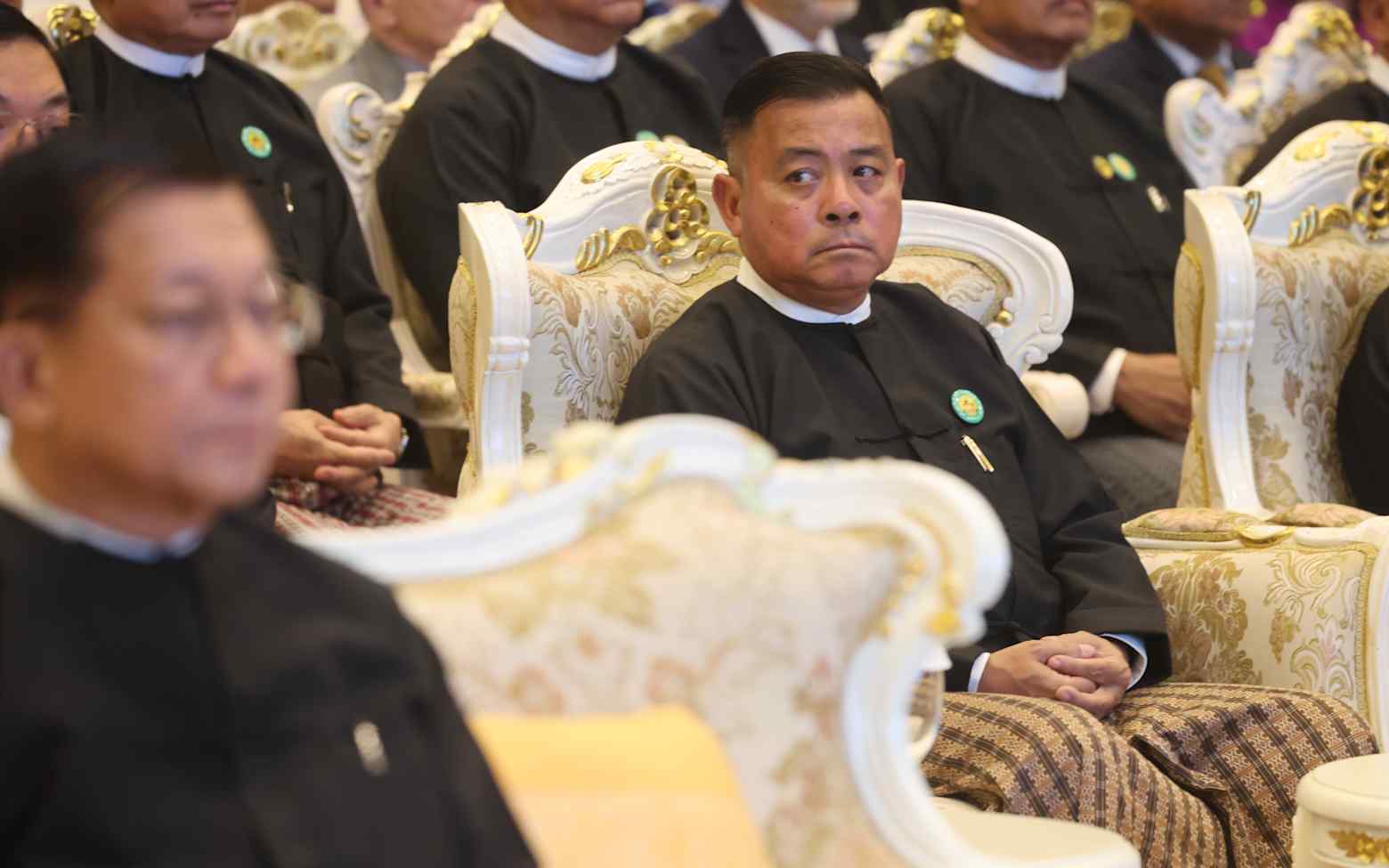
Myanmar’s military chief Min Aung Hlaing formally relinquished command of the armed forces he has led since 2011 on Monday, stepping down to pursue the country’s presidency through a parliamentary process set in motion by a stage-managed election widely condemned as illegitimate, completing a transformation analysts describe as a shift from military uniform to civilian guise with no change in the underlying concentration of power.
Min Aung Hlaing, 69, was nominated as a vice-presidential candidate by a lawmaker from a military-aligned party during a session of the newly convened lower house of parliament in Naypyitaw, broadcast live on state media.
“Senior General Min Aung Hlaing is proposed as a vice-presidential candidate,” Kyaw Kyaw Htay told the chamber. Under the constitutional framework Myanmar’s military wrote in 2008, the lower house, the upper house, and the military each nominate one candidate for the presidency. After a vetting period, parliament elects one of the three as president; the remaining two serve as vice presidents. A date for the presidential vote had not been announced as of Monday.
At a separate ceremony in the capital, Min Aung Hlaing handed command of the Tatmadaw to General Ye Win Oo, who was appointed intelligence chief in 2020 and promoted to army commander earlier this month.
Read Also: Myanmar Expels Timor-Leste Rep Over War Crimes Dispute
“I will continue to serve the interests of the people, the military, and the national interests of the country,” Min Aung Hlaing said in remarks broadcast by military-owned media. Ye Win Oo is a graduate of the Officer Training School rather than the elite Defence Services Academy that has traditionally produced Myanmar’s senior officer corps. He previously commanded an infantry division and the Southwestern Command in the Ayeyarwady delta. “The fact that he received two major promotions within two months clearly demonstrates that he is one of Min Aung Hlaing’s most trusted loyalists,” said independent analyst Aung Kyaw Soe.
Min Aung Hlaing was born in the south of the country, studied law before entering military service, and rose through the ranks steadily before being hand-picked by former military ruler Than Shwe to become commander-in-chief on March 30, 2011, exactly 15 years before Monday’s transition.
His tenure has been defined internationally by two episodes above all others: the 2021 coup that ousted the democratically elected government of Nobel Peace Prize laureate Aung San Suu Kyi, who remains in detention, and the military campaign against the Rohingya in Rakhine State between 2016 and 2018 that the International Criminal Court’s prosecutor designated as genocide, resulting in an ICC arrest warrant against him in 2024. Suu Kyi had refused at a crucial juncture to concede to Min Aung Hlaing’s demand that he be named president in exchange for dropping the military’s fraud claims against her party’s 2020 election landslide. The coup followed shortly afterward.
Read Also: Myanmar Hospital Air Strikes Kill At Least 34
The election that underpins Monday’s political transition was conducted in three phases between December 28, 2025 and January 25, 2026. The USDP secured 193 of 209 seats in the lower house and 52 of 78 seats in the upper house, meaning the party and the military’s 166 constitutionally guaranteed parliamentary seats together comfortably surpass the 294 needed to govern.
The UN described the poll as illegitimate. ASEAN said it would not certify the vote. Multiple powerful ethnic armed organizations prevented elections from being held in territories they control. The National Unity Government, which represents the country’s exiled and underground democratic opposition, urged voters to boycott. At least 7,705 people have been killed in the civil war since the 2021 coup, while 22,745 remain detained, according to the Assistance Association for Political Prisoners.
“This is not a transition to democracy, but rather a transformation from a military-clad dictatorship to a civilian-clothed one,” said one Thailand-based analyst.
“This has been Min Aung Hlaing’s goal all along,” said independent analyst Htin Kyaw Aye. “It’s just a shift from ruling as a military leader to ruling as president.” Whether his formal departure from the uniform changes anything on the country’s battlefields is doubtful. Before stepping down, Min Aung Hlaing had reportedly reached out to various ethnic armed groups, urging them to participate in peace talks. Those outreach efforts have so far produced no substantive agreement.
The new government is expected to be formally constituted in April, once the presidential vote is completed and a cabinet is assembled. The opposition National Unity Government and ethnic armed organizations have not indicated any intention to recognize the incoming administration.