
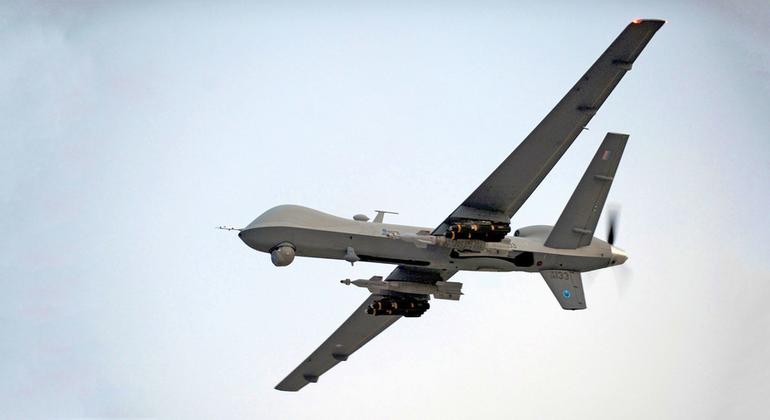
Satellite images have revealed what appear to be Chinese and Turkish combat drones at a Libyan military airbase in the east of the country, suggesting that Khalifa Haftar’s forces have acquired significant new air power in violation of a United Nations weapons embargo that has been routinely flouted since it was imposed in 2011.
Commercial satellite imagery reviewed by three independent weapons experts shows at least three drones at Al Khadim airbase, located roughly 100 kilometres east of Benghazi in the desert interior, appearing between late April and December. Ground control equipment associated with the aircraft remained visible in images taken this year. Reuters could not establish who supplied the drones, when they arrived, or whether any UN embargo exemption was sought or granted. The Libyan National Army, the governments of China and Turkey, and the drones’ manufacturers did not respond to detailed questions.
The experts who examined the images reached consistent conclusions about what they were looking at. One drone appears most likely to be a Chinese-made Feilong-1, an advanced surveillance and attack platform produced by Xi’an-based Zhongtian Feilong. The others appear to be Turkish-made Bayraktar TB2s, the same model that proved decisive in multiple recent conflicts including Libya’s own 2014-2020 civil war. The experts said they could not entirely rule out alternative models but were largely in agreement on the identification.
Read also: Gulf War Pummels India’s Glass Hub, Tests Factory Push
The significance of the acquisition extends beyond the hardware. Haftar’s LNA is not known to possess the technical expertise required to operate drones of this sophistication, raising a question that Anas El Gomati, director of the Sadeq Institute think tank, posed directly: “Who’s operating them?” The answer matters as much as the question of who supplied the aircraft, because external operators would represent a deeper foreign military entanglement than a simple arms transfer.
El Gomati described the drones’ arrival at Al Khadim as “a huge symbolic win” for Haftar, one that reinforces his control over eastern and much of southern Libya — including the major oilfields whose revenues underwrite his administration — and strengthens his negotiating position in ongoing discussions about forming a unified Libyan government. The weapons could also, he said, be used to defend supply lines to Sudan’s Rapid Support Forces paramilitary group, which Haftar has denied supporting.
The drone arrivals fit within a broader pattern of rearmament that analysts and UN investigators say is accelerating on both sides of Libya’s east-west divide. In December, the LNA signed a reported $4 billion deal with Pakistan to purchase military equipment including JF-17 fighter jets developed jointly with China. Pakistani officials maintained at the time that the deal did not violate the embargo; UN sanctions officials and Pakistan’s relevant ministries did not respond to questions about that assertion. Meanwhile, the Tripoli-based government signed an agreement with Turkey in October 2022 to procure Bayraktar Akinci drones — a more advanced model than the TB2, capable of carrying nearly three times the payload and operating at higher altitudes.
Read also: Tiger Woods Says No To Ryder Cup Captain Job, Eyes Therapy
The embargo itself has a history that renders each new violation significant without making it surprising. Imposed in 2011 following the NATO-backed uprising that toppled Muammar Gaddafi, it was comprehensively ignored during the subsequent civil war, when the UAE supplied and likely operated Chinese Wing Loong II drones on Haftar’s behalf while Turkey provided TB2s and air defence systems to the Tripoli government. The UN panel of experts monitoring the embargo documented these violations repeatedly. Abu Dhabi denied them repeatedly. The drones flew regardless.
The Wing Loongs that had been based at Al Khadim departed in 2020 following the ceasefire. The new drone activity documented by satellite imagery suggests their replacements have now arrived — an upgrade in some respects, a continuation of the same dynamic in all others.
The Security Council committee that handles embargo exemption requests did not respond to Reuters’ questions about the drones. A UN department referred the news agency to a Security Council resolution from last year expressing “grave concern” over continued embargo violations — language that accurately describes the situation without doing anything to change it.