
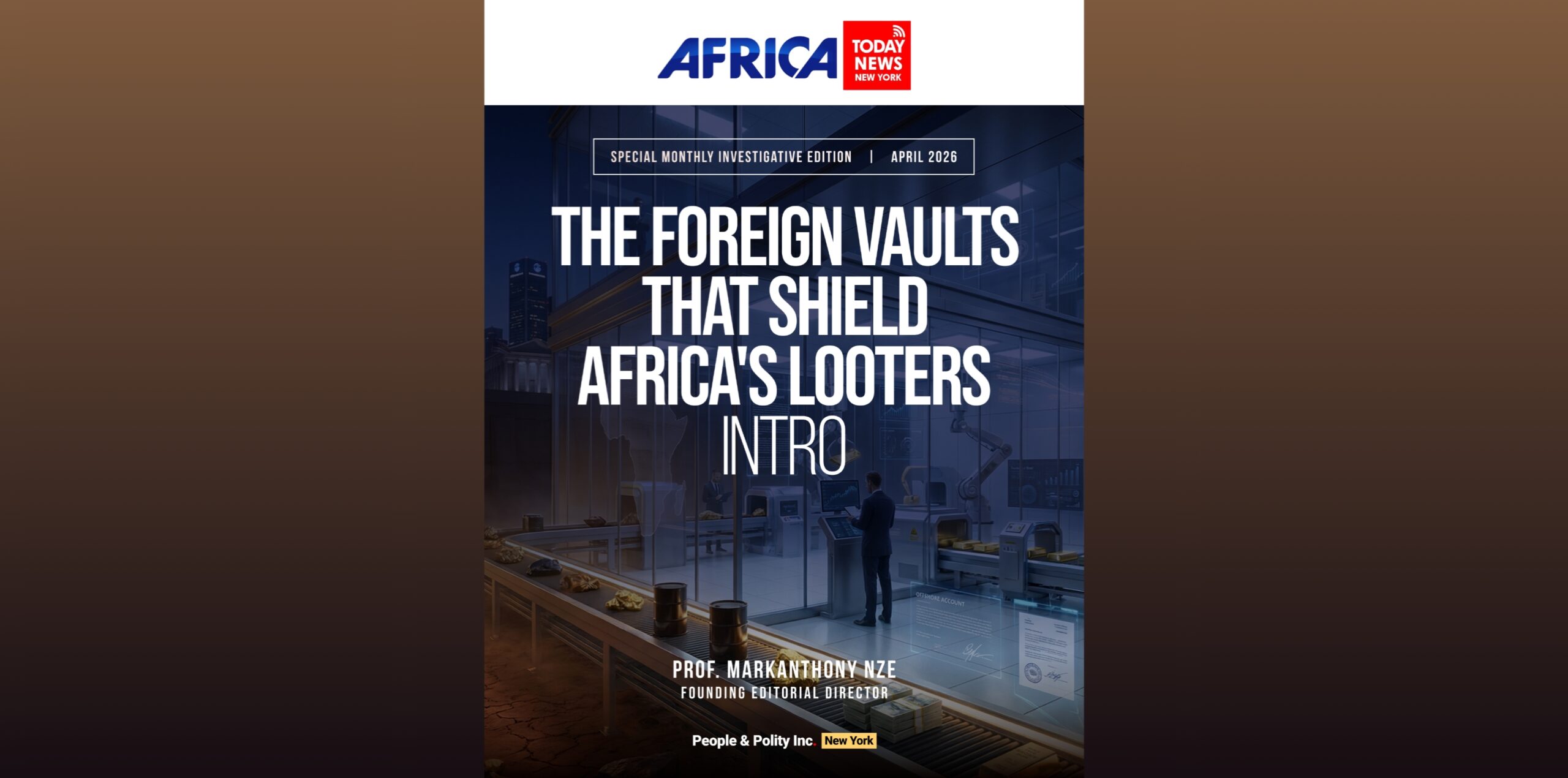
They Did Not Just Steal From Africa. They Engineered Its Disappearance.
The looting was local. The protection was foreign.
Africa’s stolen wealth did not merely leave. It was prepared for departure, disguised for survival, and received abroad by systems that knew how to turn public plunder into protected private wealth.
That is the first lie this investigation rejects.
For too long, the story of African looting has been told in a way that flatters the foreign world. It begins with the corrupt leader, the minister, the procurement baron, the presidential circle, the military ruler, the party fixer, the banker’s favored client. It names the greed, the betrayal, the swollen account, the missing funds. Then, just as the money crosses into the truly decisive phase of its life, the story goes quiet. The silence begins when the money leaves Africa and enters the foreign world of legal masks, secrecy shelters, private banking, prestige assets, offshore entities, and respectable institutions that know how to make theft look less like theft and more like wealth. That silence has protected the wrong people for decades.
Read also: The Foreign Vaults That Shield Africa’s Looters
The truth is harsher. Africa was not only looted by those who ruled it badly. It was helped into loss by a foreign system fluent in concealment, rewarded by silence, and skilled in converting the proceeds of public suffering into assets that could sleep peacefully behind powerful names, foreign flags, and expensive paperwork.
That is the crime inside the crime.
What vanished from African treasuries, oil revenues, procurement systems, central accounts, and public budgets did not simply evaporate into some mysterious global mist. It moved. It was routed. It was split into layers. It was cleaned up on paper. It was put under corporate wrappers, placed inside nominee arrangements, buried in secrecy jurisdictions, passed through banks, and, in many cases, transformed into holdings respectable enough to be defended as ordinary wealth. The money did not disappear because it was untraceable by nature. It disappeared because an entire foreign world exists to help difficult money travel with dignity.
That world is the subject of this series.
UNCTAD has estimated that Africa loses 88.6 billion dollars every year through illicit financial flows, roughly 3.7 percent of the continent’s GDP. That figure is not just an
economic statistic. It is a map of absence. It is the measure of roads not completed, hospitals not built, schools not equipped, currencies weakened, public trust destroyed, and futures repeatedly mortgaged to fund private escape. It is the annual invoice for a system in which the powerful steal once and societies pay for years.
Read more: The Foreign Vaults That Shield Africa’s Looters—Part II
But even that number does not capture the full obscenity. The real scandal is not only that money was taken. It is that stolen African wealth often entered foreign systems that knew how to preserve it. Wealth does not need to remain in a hidden account forever to survive. It only needs to be given safe passage, legal cover, and enough time to outlast outrage. That is where the foreign shield comes in. One part of the shield drafts the structures. Another part buries ownership. Another part moves the funds. Another part turns the proceeds into prestige. Another part explains everything away when the trail starts to surface.
So when people speak lazily about African corruption, they are usually telling a half-truth that serves the second half of the crime. They condemn the thief and overlook the vault. They denounce the official who signed the theft but speak too softly about the legal and financial systems that helped the proceeds survive. They treat the looting as though it ended at the point of extraction, when in fact the theft became stronger once it crossed a border. What was stolen at home was often protected abroad. What was looted in public was often stabilized in private. What began as a national injury was turned into internationally sheltered wealth.
That is why this cannot be written as a simple morality tale about bad African leaders. The deeper story is one of global institutional logistics. Before the public fully grasps that money has gone, someone may already have prepared the route. The shell company is ready. The trust structure is available. The nominee name is waiting. The offshore filing is in order. The property market is open. The bank can move the funds. The secrecy jurisdiction can absorb the ownership trail. The compliance language is standing by for later use. The theft is not improvised. It is often helped into safety by people whose professional specialty is to make wealth harder to question.
And once the money is safely outside, a second injustice begins. The proceeds of African plunder do not just rest abroad. They enter systems of value. They can be parked in luxury property, dressed up as investment, circulated through markets, integrated into credit, and, in some cases, returned toward Africa in forms that deepen dependency. This is the bitterest turn of all: a continent stripped by looting can find itself borrowing back versions of its own stolen future while the foreign system that helped the theft survive continues to speak the language of development, reform, partnership, and good governance.
That hypocrisy is not a side note. It is central to the story.
This investigation therefore follows the full foreign life of African plunder. It begins with the planners and legal coders who help shape the escape route. It moves through the devices that give theft a lawful face. It enters the secrecy havens that bury ownership and the banks that give stolen wealth passage. It examines the luxury markets that polish dirty money into status. It studies the institutional defenses that soften scandal into procedural language. And it ends where the system reveals its final cruelty: the point at which wealth taken from Africa strengthens foreign systems and returns, in one form or another, as leverage over the continent it helped impoverish.
Nothing in this story requires melodrama. The public record is devastating enough. Senate inquiries, asset-recovery actions, financial transparency reports, anti-money-laundering guidance, leak-based investigations, and government enforcement material have already exposed fragments of the route. What this series does is force those fragments into the same field of vision. When that is done honestly, the pattern becomes impossible to ignore. Africa’s looters were not solitary predators operating in a vacuum. They were joined, protected, serviced, or outlasted by a foreign order that knew how to keep stolen wealth alive.
This is not merely a story of greed. It is a story of reception.
A treasury is looted in Africa. Somewhere else, the money is welcomed. A public budget is stripped in Africa. Somewhere else, the proceeds are structured. A state is weakened in Africa. Somewhere else, the extracted wealth is defended as an asset.
That is the wound this series opens.
What follows is not rumor dressed up as indignation. It is a forensic account of how foreign systems received what should have triggered alarm, disguised what should have remained scandal, and protected what should never have been allowed to settle into safety.
Africa’s stolen wealth did not vanish.
It was helped to survive.
Special Section
What the World Did With Africa’s Stolen Wealth
How the loot was protected, profited from, and returned as pressure.
There is a stage in this story that deserves more outrage than it has received. It comes after the signatures, after the transfers, after the money has slipped out of ministries, procurement systems, oil accounts, sovereign institutions, and public budgets. It begins when the proceeds leave Africa and enter the foreign world that has spent decades presenting itself as cleaner, more lawful, more mature, and more disciplined than the political environments it often condemns. That is the moment when the crime becomes larger than the thief.
Because what happens next is not simple concealment. It is reception. Africa’s stolen wealth is not merely hidden abroad. It is received, processed, structured, defended, and made productive elsewhere. What begins as public loss in Abuja, Luanda, Kinshasa, Nairobi, or Johannesburg can end its first journey as a stable asset in an opacity-friendly jurisdiction, a property title in a prestige market, a layered holding vehicle, or a pool of defended capital sitting safely behind procedure and paperwork. This is where the story stops being only about corruption and becomes a story about international complicity.
When Theft Became Reception
The most cited figure in this debate remains devastating because it describes loss on a civilizational scale. UNCTAD estimated in its 2020 report that Africa loses 88.6 billion dollars every year through illicit financial flows, roughly 3.7 percent of the continent’s GDP at the time. The same report said that curbing those losses could nearly halve Africa’s annual financing gap for achieving the Sustainable Development Goals, which it placed at about 200 billion dollars. Those are not decorative numbers. They tell us that the outflow is not marginal leakage. It is development-scale money. It is enough to shape whether roads are built, whether hospitals function, whether schools expand, whether laboratories are equipped, whether industrial corridors are financed, whether energy systems stabilize, and whether public institutions become trustworthy.
Now place beside that another figure. OECD preliminary data show that net bilateral official development assistance from DAC members to Africa stood at 42 billion dollars in 2023, with 36 billion dollars of that going to sub-Saharan Africa. The comparison is not perfect, and serious analysis should not pretend otherwise. But it is still morally revealing. The annual illicit outflow estimate identified by UNCTAD is more than double net bilateral ODA to Africa from DAC donors in 2023. That means a continent can lose, in hidden capital flight, far more than it later receives in bilateral development assistance. The language of benevolence begins to sound thin once that reality is allowed into the room.
The Men Who Drew the Map
To understand how such a system survives, one must look not only at the rulers, ministers, procurement fixers, and politically exposed insiders who steal. One must also look at the class of professionals who help theft outlive scandal. Too much public anger begins at the bank and ends there. That is understandable, but it is not enough. By the time suspicious wealth reaches a major financial institution, someone may already have created the shell company, layered the holding vehicle, inserted the nominee, drafted the trust relationship, chosen the jurisdiction, and written the transaction into a form that appears orderly on paper. The foreign bank may move the money, but someone often drew the map first.
That earlier class deserves much greater scrutiny than it usually receives. The global accounting-and-advisory complex, including the major multinational firms whose tax, audit, compliance, and cross-border structuring arms command extraordinary prestige, should carry the same forensic weight as the banks that later handle the proceeds. This is not a careless accusation against every accountant, lawyer, or adviser. It is a recognition that complexity itself becomes a service when sold into environments of weak accountability and extreme public consequence. A system that knows how to turn ownership into distance, control into layers, and suspicion into technical process is not morally neutral simply because it speaks in polished language.
That is where the so-called respectability of international finance begins to look less like innocence and more like insulation. The structuring class rarely appears at the scene of the original theft. It is rarely the face on the campaign poster, the official on television, or the insider defending missing funds. Its members are usually farther away, better dressed, and safer from public shame. They speak in memoranda, advisories, filings, tax opinions, and legal distinctions. But they matter because they help transform a public crime into a private problem of documentation. They do not merely assist movement. They assist survival.
Interest on Stolen Principal
Once the money is outside Africa and wrapped in lawful-looking form, it enters a second life. It can be parked in property, embedded in markets, invested through funds, circulated through institutions, and defended as capital. This is the stage at which theft stops looking like theft and starts looking, from a comfortable distance, like wealth. The public injury that produced it is pushed to the margins. The person who should be seen as the beneficiary of plunder can now appear as an investor, a principal, a buyer, a client, or a participant in global finance. The dirtiest achievement of the foreign system is not only that it hides the money. It teaches the money how to behave respectably.
And then comes the final insult. Africa is left to cope with the shortage. World Bank debt statistics show that external debt stocks for sub-Saharan Africa stood at about 516.9 billion dollars in 2023. That burden has many causes, and no serious writer should reduce it to one factor. But it exists in the same landscape as the illicit outflows. Governments facing infrastructure gaps, educational deficits, health burdens, weak industry, and fragile currencies are expected to borrow, refinance, restructure, and submit to fiscal discipline in a world where enormous quantities of wealth that should have strengthened domestic capacity were already permitted to leave. The theft happens first. The adjustment arrives later. The public pays twice.
That is why the phrase interest on stolen principal matters. The principal is the wealth that should have remained available for African public use. It should have financed roads, hospitals, schools, research centers, industrial plants, energy systems, and state resilience. Instead, a portion of that principal leaves through illicit channels, is protected abroad, and becomes useful elsewhere. Later, the same broad global order returns to Africa with aid programs, development partnerships, debt frameworks, technical assistance, fiscal advice, and managed concern. The original capital is gone. The shortage remains. What follows is presented not as partial compensation for tolerated extraction, but as generosity. That is not generosity. It is a cycle in which value leaves and authority returns.
What Africa Must Now Name Clearly
This is why Africa needs a harder vocabulary. For too long, the continent has described secrecy jurisdictions, opacity-friendly dependencies, and non-cooperative financial shelters in bloodless language, as if they were simply alternative market environments. But any jurisdiction that repeatedly profits from hidden ownership, resists meaningful transparency, frustrates asset tracing, or shelters suspicious public wealth should no longer be treated as morally neutral. It should be called what it is: a hostile economic actor.
That phrase is not rhetorical excess. It is descriptive clarity. A jurisdiction becomes hostile when its laws, tolerated practices, or institutional behavior help convert looted public wealth into defended private capital. It becomes hostile when it systematically offers opacity as a commercial advantage. It becomes hostile when African investigators, courts, or recovery efforts meet delay, obstruction, selective cooperation, or procedural evasion in the pursuit of stolen assets. It becomes hostile when it benefits economically from the secrecy that leaves another society weaker, poorer, and more indebted.
Naming matters because naming is part of the struggle. If Africa continues to describe every financial shelter as a neutral participant in innocent commerce, it helps preserve the fiction that underdevelopment is merely local mismanagement. It is not. It is also the story of what happened after the money left. It is the story of the places that received it, the professions that disguised it, the institutions that processed it, the markets that normalized it, and the jurisdictions that made accountability harder. So the deeper question is no longer only who stole. The deeper question is what the world did next. It gave the money safe passage. It gave the money legal cover. It gave the money professional handlers. It gave the money prestige. It gave the money time. It gave the money silence. And then, with an air of reason, it returned to the wounded continent carrying loans, advice, and managed concern. Until that second truth is spoken with the force it deserves, the first truth will never be enough.