
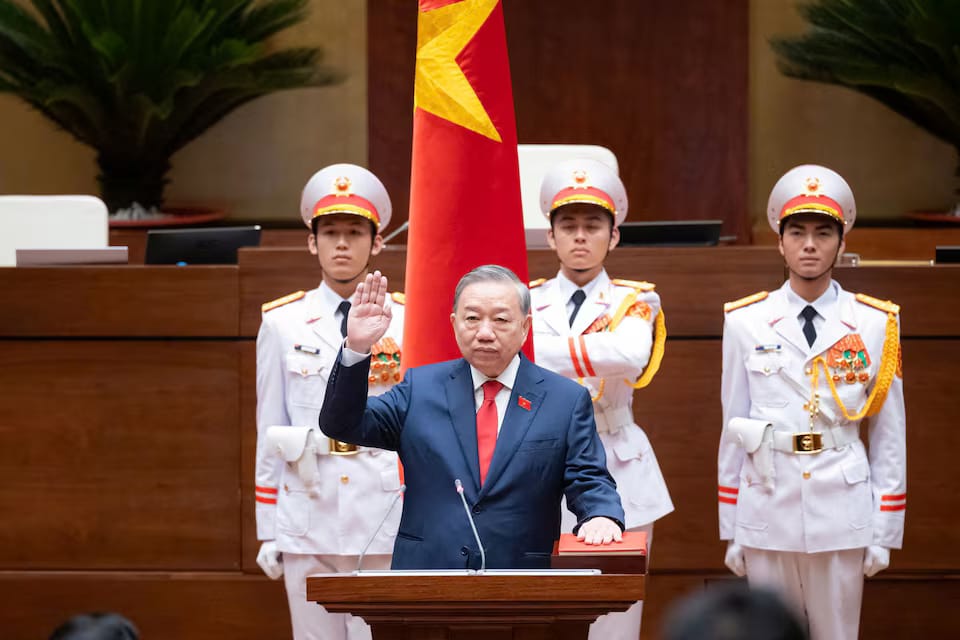
Vietnam’s parliament voted unanimously Tuesday to make To Lam state president, handing the 68-year-old Communist Party chief a double mandate that consolidates more personal authority in a single Vietnamese leader than the country has seen in decades — and signals a deliberate break from the collective leadership model that has governed the one-party state since the Soviet era.
All 495 deputies present at the National Assembly session endorsed Lam’s nomination without a dissenting vote. Five lawmakers were absent. The result was not a surprise — in Vietnam’s political system, the party decides and the parliament confirms — but the institutional significance of what was confirmed matters considerably. Lam already secured a second term as party general secretary in January. He now simultaneously holds the state presidency, a combination of roles that mirrors the structure of power in neighbouring China under Xi Jinping and that analysts say fundamentally rewrites the assumptions underpinning Vietnamese politics.
Read also: Power Plant Attacks Will Trigger Retaliation, Iran Warns
“The combination of the two roles will shift Vietnam’s domestic politics to a new normal where most of the old assumptions about Vietnam’s politics, including those about collective leadership, are no longer valid,” said Alexander Vuving of the Asia-Pacific Center for Security Studies.
Lam had briefly held both positions before — in the months following the death of longtime party general secretary Nguyen Phu Trong in 2024 — before relinquishing the presidency to army general Luong Cuong. During that interlude and afterward, observers noted that Lam continued to operate as though he had retained the presidential role, travelling internationally and representing Vietnam in meetings with foreign heads of state. Tuesday’s vote formalised what his behaviour had already suggested.
In a televised address to deputies after the vote, Lam pledged to pursue “a new growth model with science, technology, innovation, and digital transformation as the primary driving forces.” He said his priorities were stability, rapid and sustainable development, and improving living standards across Vietnamese society. He also said self-reliance in defence would be a priority — a framing that carries particular resonance for a country that shares a long border with China and has spent centuries calibrating its relationship with its giant neighbour.
Read also: UK Minister Says No Assessment Iran Could Strike London
The economic ambitions Lam has staked out are substantial. He has pledged double-digit growth through a development model deliberately designed to move Vietnam beyond its dependence on low-cost manufacturing dominated by foreign multinationals — the engine that powered the country’s rise as an export hub but which Lam regards as insufficient for the next stage of Vietnamese development. He has backed the expansion of private conglomerates while simultaneously issuing directives affirming the leading role of state-owned enterprises, a balancing act between reformist momentum and reassurance for party traditionalists that has characterised his first stint as general secretary.
Foreign investors, who have long regarded Vietnam’s political stability as one of its primary attractions, have generally viewed Lam as a pro-business leader. But his push for national champions and his appetite for rapid growth have raised concerns among some about the risks of favouritism, asset bubbles and corruption — the familiar shadow side of state-directed economic acceleration.
In foreign policy, Lam has maintained what Vietnamese leaders call “Bamboo Diplomacy” — flexible, pragmatic, bending without breaking, cultivating relationships with major powers including both the United States and China while preserving strategic autonomy. The approach has served Vietnam well through successive geopolitical storms and shows no sign of being abandoned under the consolidated leadership structure Lam now commands.
The parliament was scheduled to elect a new prime minister Tuesday to replace the outgoing Pham Minh Chinh, completing a leadership transition whose contours had been settled in a party meeting in late March.
The key analytical question surrounding Lam’s consolidation is whether the efficiency gains of concentrated authority outweigh the systemic risks of diminished internal checks. Le Hong Hiep of the ISEAS Yusof Ishak Institute in Singapore put both sides plainly: concentrating power in Lam “could pose risks to Vietnam’s political system, such as increased authoritarianism,” but could also “enable Vietnam to formulate and implement policies more quickly and effectively,” supporting the growth agenda Lam has made central to his leadership.
Vietnam has arrived at a crossroads that other one-party states in Asia have navigated in different ways, with different outcomes. To Lam has now been handed the institutional authority to determine which path his country takes. Tuesday’s unanimous vote ensured that determination will be his alone to make.