
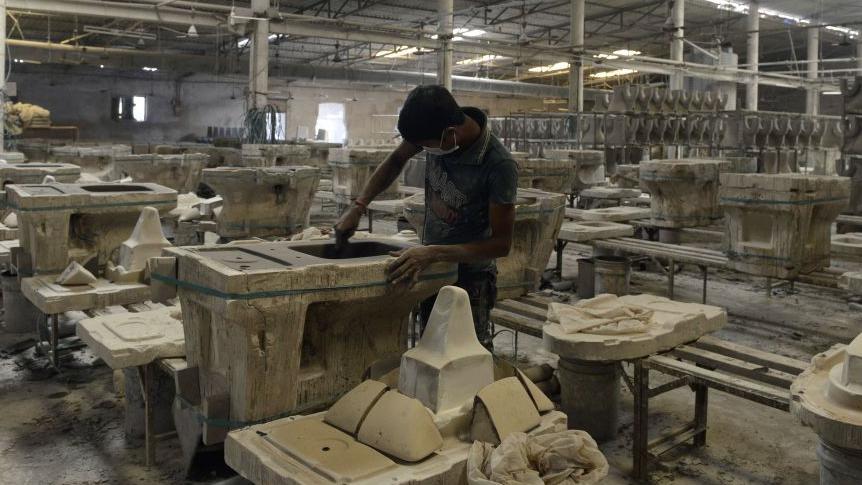
Pradeep Kumar spent seven years loading clay, quartz and sand into ceramic kilns in Morbi, Gujarat, working through summer heat without protective gear, earning enough to keep his wife and three children fed. On March 15, a war he had nothing to do with ended all of it.
Two weeks after the United States and Israel attacked Iran, the ceramics company where Kumar worked shut its doors. The propane and natural gas that fire the kilns at the temperatures ceramic production requires had become too scarce and too expensive to sustain operations. Five days later, the 29-year-old packed his family into whatever transport was available and headed back to Hardoi district in Uttar Pradesh, one of hundreds of thousands of migrant workers that the Iran war — fought thousands of kilometres away over a waterway he had probably never heard of — had displaced from their livelihoods.
“We don’t want to suffer like dogs, like we did during the COVID-19 pandemic,” Kumar told Al Jazeera, the memory of 2020’s mass exodus of migrant workers — millions walking on foot for days and weeks to reach home during the coronavirus lockdown — still fresh enough to shape how he talked about what was happening now.
Read also: Gulf War Pummels India’s Glass Hub, Tests Factory Push
Morbi is where India makes its ceramics. More than 600 companies operating in this Gujarat city produce roughly 80 percent of the country’s tiles, toilets, bathtubs and wash basins, generating a $6 billion industry that employs over 400,000 people. More than half those workers are migrants from poorer states — Uttar Pradesh, Bihar — who came west for wages their home districts could not offer. At least 450 of those 600 companies have now shut down. Around 200,000 workers have been affected, with more than a quarter forced to return home.
The mechanism connecting a naval blockade of the Strait of Hormuz to a shuttered tile factory in Gujarat is straightforward and devastating. India sources a significant share of its gas imports through the strait. Morbi’s ceramics factories rely on propane and natural gas to fire kilns at the temperatures ceramic production demands — around 60 percent of manufacturers use propane because it is cheaper than the state-supplied natural gas. When Hormuz traffic seized up, propane supplies dried out. Factories that could not switch to natural gas had no choice but to close.
“All manufacturing units in Morbi rely on propane and natural gas to fire kilns at high temperatures,” said Siddharth Bopaliya, a 27-year-old third-generation manufacturer and trader. New natural gas connections are being offered at 93 rupees per kilogram while existing users pay around 70 — a pricing gap wide enough that many factory owners are choosing to wait rather than absorb the transition cost.
Read also: Seven Injured After Car Ploughs Into Crowd In Derby
Manoj Arvadiya, president of the Morbi Ceramic Manufacturers Association, said the industry had initially shut down hoping the Middle East crisis would resolve by April 15. It has not. Only around 100 of the 600-plus companies have reopened, and most have not resumed actual manufacturing. “For at least another 15 days, it is likely to remain the same,” he said. Exports to the Middle East, Africa and Europe — worth $1.5 billion annually and accounting for about 25 percent of Morbi’s output — are delayed or halted entirely.
The shutdown has also exposed what was already wrong in Morbi before the war made it worse. Among the workers who left last month is Ankur Singh, 27, who returned to his hometown near Patna in Bihar carrying what he now knows is silicosis — an incurable lung disease caused by inhaling the silica dust that ceramic production generates in abundance. He had been experiencing fever and coughing for months but kept working. “The shutdown of my company did not send me back alone, but with a Morbi disease,” he said.
Labour rights activist Chirag Chavda said silicosis is widespread in Morbi because workers are routinely exposed to fine silica particles with inadequate ventilation and no protective equipment. “Even those not directly involved in moulding or kiln work often inhale the particles due to poor ventilation and prolonged exposure across factory spaces,” he said, adding that most companies do not follow government safety regulations.
Harish Zala, 40, worked in Morbi’s ceramics industry for two decades before silicosis forced him to stop two years ago. He received nothing from his employer — who he said threatened his father when the family sought assistance after the diagnosis. Zala described a system designed to deny workers the evidence of their own employment: no appointment letters, no salary slips, no identity cards. “This is done so that if a worker later demands labour rights or legal entitlements, they have no concrete evidence to prove that they were employed,” he said.
Not everyone has left. Sushma Devi, 56, stayed in Morbi with her husband and son because the company her son works for is providing shelter and food while it waits for manufacturing to resume. Every day she walks out to collect dry wood and discarded plywood to cook their meals. “I hope the kilns and manufacturing resume soon,” she said. “But I also hope they don’t stop giving us rice and potatoes even if the kilns don’t start running anytime soon.”
Kumar is running out of savings in Hardoi. The house needed repair. The family has borrowed 20,000 rupees — $214 — from a relative, with no clear plan for repayment. He is looking for daily wage work wherever he can find it, waiting for word that Morbi is open again, watching a debt he did not ask for grow from a war he did not start.