
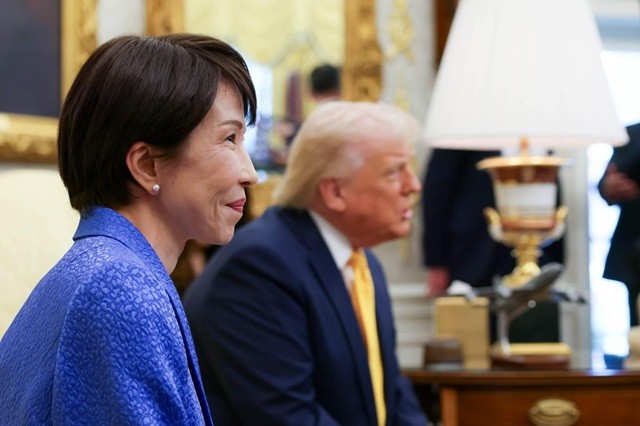
Japan crossed a threshold on Tuesday that its post-war constitution was specifically written to prevent it from crossing — announcing that it would lift the ban on exporting lethal weapons including fighter jets, missiles and warships, in the most significant dismantling of the country’s pacifist defence posture since the Second World War ended eight decades ago.
Prime Minister Sanae Takaichi announced the cabinet decision on X without specifying which weapons would now be eligible for overseas sale, but Japanese newspapers filled in what her post left out. Fighter jets, missiles and warships are all encompassed by the changes, according to reporting by Chunichi and Asahi newspapers. At least 17 countries will be eligible to purchase Japanese-manufactured weapons under the new framework, with that list potentially expanding as Japan enters additional bilateral defence agreements.
Takaichi framed the shift in the language of multilateral necessity rather than nationalist ambition. “With this amendment, transfers of all defence equipment will in principle become possible,” she said, adding that recipients would be limited to countries committed to operating within the UN Charter. “In an increasingly severe security environment, no single country can now protect its own peace and security alone.”
The rules being dismantled stretch back to 1967, when Japan first restricted military exports, and were codified further in 1976 into a framework that confined Japanese arms sales to non-lethal equipment — surveillance systems, minesweeping technology and similar defensive hardware. What Takaichi’s cabinet has done is not a refinement of that framework but its fundamental reversal.
Read also: Fuel Crunch Looms As Grounding Threat Grows For Airlines
Japan will retain restrictions on selling weapons to countries where active fighting is underway, though the policy carves out exemptions under what it terms “special circumstances” where Japanese national security interests are determined to be at stake. The breadth of that exemption, and who decides when it applies, will be among the most consequential details of implementation.
Countries already identified as prospective buyers include Australia, New Zealand, the Philippines and Indonesia, the last of which recently signed a major defence pact with the United States. The Australia connection is not hypothetical — Tokyo and Canberra signed a $7 billion deal under which Mitsubishi Heavy Industries will build the first three of 11 warships for the Australian navy, a transaction that both preceded and helped precipitate Tuesday’s formal policy change.
China did not wait long to respond. Foreign Ministry spokesman Guo Jiakun told a news conference that Beijing and the broader international community would “remain highly vigilant” and would “firmly resist Japan’s reckless new-style militarisation.” The word choice — reckless, militarisation — signals how Beijing intends to frame a policy shift it regards as a direct challenge to the regional balance of power it has been constructing.
Read more: Chinese Telecom Companies Face Potential US Crackdown
The announcement arrived on the same day that Takaichi was reported to have sent a ritual offering to the Yasukuni Shrine in Tokyo for its spring festival. Built in the 19th century to honour Japan’s war dead, the shrine carries the names of more than 1,000 convicted Japanese war criminals, including 14 found guilty of Class A offences — the most serious category of war crimes prosecuted by the post-war international tribunal. Visits or offerings by Japanese officials to Yasukuni have been a source of sustained diplomatic tension with China, South Korea and other nations whose populations suffered under Japanese imperial expansion, and the combination of the shrine offering and the weapons export announcement in a single day gave Tuesday a particular charge that neither act alone would have produced.
Takaichi is described as a China hawk and has been called Japan’s Iron Lady in some quarters, and she sits within a line of recent Japanese leaders who have incrementally pushed back against the constitutional pacifism that the country adopted after Hiroshima and Nagasaki. Each step has been justified on security grounds, and each has moved Japan further from the country it declared it would become in 1945.
The question that Tuesday’s announcement does not answer is where the line now sits — or whether, in the security environment Takaichi described, a line still exists at all.