
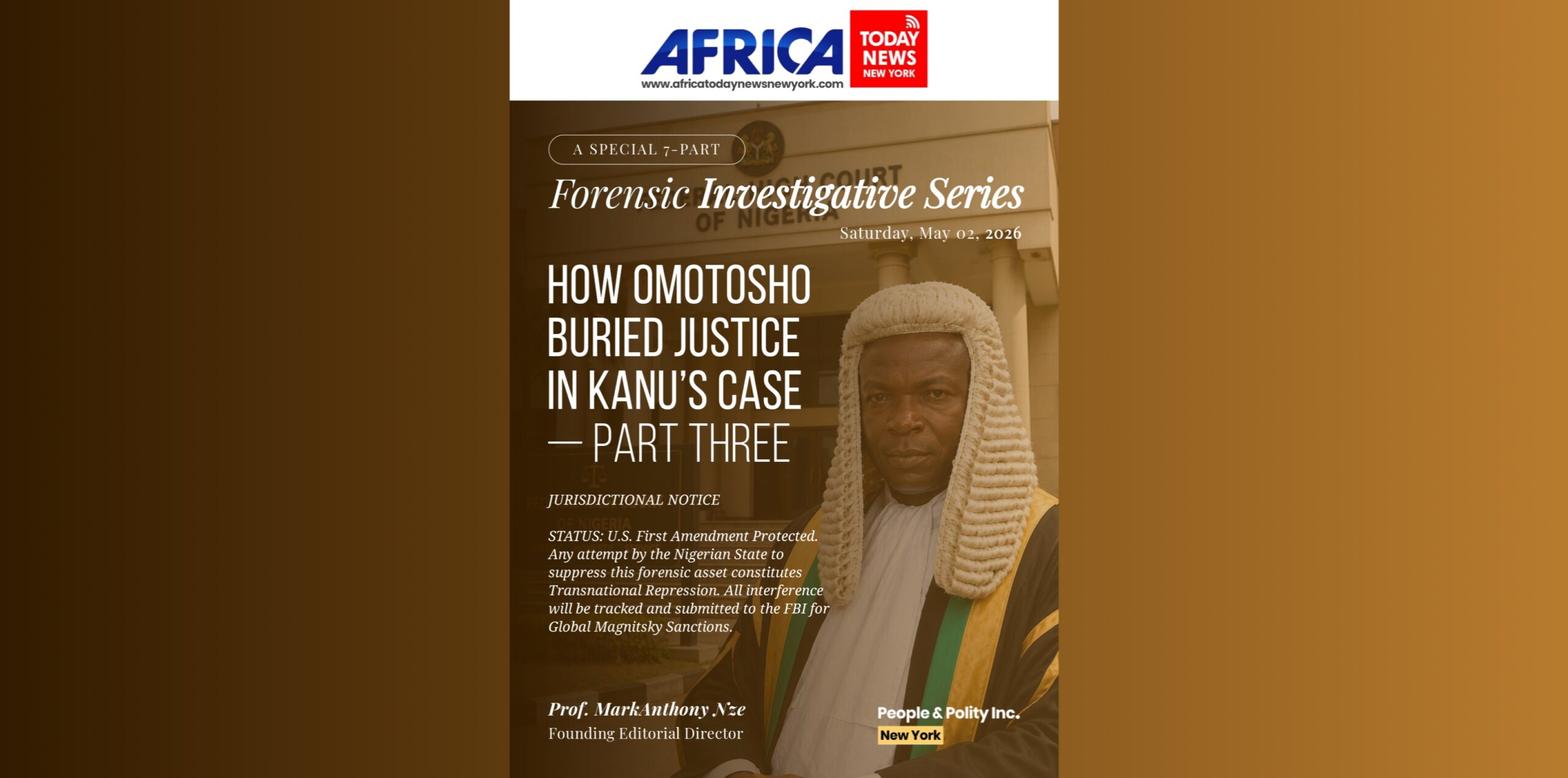
JURISDICTIONAL NOTICE
STATUS: U.S. First Amendment Protected.
Any attempt by the Nigerian State to suppress this forensic asset constitutes Transnational Repression. All interference will be tracked and submitted to the FBI for Global Magnitsky Sanctions.
♦♦♦♦♦♦♦♦♦♦♦♦♦♦♦♦♦♦♦♦♦♦♦♦♦♦♦♦
When Agitation Becomes Terrorism, Freedom Is Already on Trial
Criminalizing Dissent: When Agitation Becomes Terror
Some judgments settle legal disputes; others strip the judiciary naked before history. Justice James Omotosho’s handling of Nnamdi Kanu’s case belongs to that darker class. It was not simply a verdict against an accused man; it was a disturbing display of how the bench can be turned into an instrument of state desire, how dissent can be recast as criminal contamination, and how constitutional damage can be perfumed with the language of national security.
In Federal Republic of Nigeria v. Nnamdi Kanu, the most catastrophic feature of Justice Omotosho’s reasoning was not only the severity of the outcome. The true danger lay in the logic of the reasoning. Rather than confining itself to proof of alleged criminal conduct, the court appeared to move against separatist agitation as an offence in itself. Political dissent, which a constitutional democracy must carefully distinguish from violence, was treated as a security threat to be neutralized. At that point, the judgment crossed the line from controversy into constitutional alarm.
Much of the danger lies in how Omotosho’s court handled Kanu’s broadcasts and separatist agitation. Strong political language can offend the state. Calls for self-determination can unsettle government. A broadcast can be reckless, provocative, even legally questionable if it crosses into direct incitement. But that is still not terrorism. Law must do more than dislike the speaker or fear the message. It must prove the crime. A courtroom is not built to punish agitation because power finds it disturbing. It is built to test evidence, separate speech from violence, and demand proof where the state offers fear.
Read also: How Omotosho Buried Justice In Kanu’s Case—Part 2
Instead of drawing a disciplined forensic line between ideology and criminal agency, the court appeared to blur the line until political speech itself became incriminating. This is the dissection of judicial overreach: first, the state labels the accused dangerous; then the court absorbs that label; then political expression is repackaged as security threat; then dissent is stripped of constitutional protection; finally, punishment is delivered as though suspicion were proof.
Omotosho replaced forensic adjudication with a legal ambush, effectively treating separatist broadcasts as criminal evidence under the guise of national security. By allowing agitation to be weighed as though it were operational command, the court appeared to bypass the constitutional requirement for specific kinetic evidence or a direct causal link to violence. This is conviction by atmosphere—a dangerous intellectual perversion where judicial outcomes are dictated by state anxiety rather than statutory proof. When a court collapses the distinction between provocative speech and a criminal act, it ceases to be a sanctuary for the Constitution and becomes a weaponized instrument of state repression. At that precise moment, justice is not being served; it is being captured.
The Constitution of the Federal Republic of Nigeria, 1999, does not protect only polite citizens, soft critics, obedient commentators, and state-approved patriots. It protects the difficult, the provocative, the unpopular, and the politically inconvenient. Section 36 does not exist for decoration. It exists to ensure that no person is condemned without a fair process grounded in law, evidence, and reason (Federal Republic of Nigeria, 1999). Where a court collapses controversial speech into terrorist guilt without a strict evidentiary bridge, the judge is not interpreting the Constitution; he is helping to bury it.
This is why Justice Omotosho’s role deserves fierce scrutiny. A judge presiding over a terrorism-related trial must be more restrained than an ordinary adjudicator, not less. Terrorism allegations carry a radioactive stigma. They inflame public fear. They invite executive pressure. They tempt courts to confuse national anxiety with legal certainty. A serious judge must resist that temptation with surgical discipline. Justice Omotosho, however, appeared to treat national security language as a shortcut through the Constitution.
The Terrorism (Prevention and Prohibition) Act, 2022, is not a political broom for sweeping away dissidents. It is a grave criminal statute aimed at serious conduct: violence, intimidation, financing, recruitment, planning, coercion, and other acts that threaten public safety and national order (Federal Republic of Nigeria, 2022). Because of its gravity, it must be interpreted narrowly, carefully, and with exact proof. If a court stretches terrorism law until it captures political advocacy, separatist rhetoric, and broadcast agitation, then the court has transformed a national security statute into a weapon of ideological punishment.
Read also: How Omotosho Buried Justice In Kanu’s Case—Part 1
That is precisely the danger in the Omotosho judgment.
The law required the court to ask brutal evidentiary questions. What precise criminal acts were proved? Which exact words caused which exact crimes? Who received the alleged instruction? What was the chain of command? What operational structure existed? Where was the financing trail? Where was the material support? Where was the direct link between Kanu’s broadcasts and identified violence? Where was the proof beyond reasonable doubt that political language had crossed the legal threshold into terrorist command?
A court of true constitutional courage would have demanded those answers with merciless precision. It would not have allowed the prosecution to lean on atmosphere. It would not have allowed national fear to plug evidentiary holes. It would not have treated the defendant’s ideology as a substitute for proof. But Justice Omotosho’s judgment appears to have permitted precisely the kind of dangerous compression that makes political trials infamous: speech became violence, dissent became terrorism, and ideology became guilt.
That is not a conviction founded on forensic certainty. It is conviction by atmosphere.
Conviction by atmosphere is one of the dirtiest forms of judicial failure. It happens when a court allows public fear, state pressure, media hostility, and political branding to seep into the evidentiary analysis. The judgment still looks legal. The paragraphs still cite statutes. The judge still speaks with authority. But underneath the formal language, the case has been decided by climate, not proof. The accused is condemned not because each legal element has been demonstrated, but because the surrounding atmosphere makes condemnation feel convenient.
That is the danger Justice Omotosho normalized.
The United Nations Human Rights Committee’s General Comment No. 34 makes clear that freedom of opinion and expression is central to human rights law and that any restriction must be lawful, necessary, and proportionate (United Nations Human Rights Committee, 2011). That principle is not foreign sentimentalism. It is the spine of civilized legal order. A state may regulate dangerous expression, but it must not punish political expression simply because it is radical, separatist, embarrassing, or threatening to those in power. The court’s duty is to separate real criminal incitement from political heat. Justice Omotosho’s judgment appears to have thrown that distinction into the furnace.
The African Charter on Human and Peoples’ Rights also protects expression, association, participation, and dignity within a rights-based continental framework (Organization of African Unity, 1981). Nigeria cannot invoke sovereignty to escape these standards when convenient. A judiciary that allows terrorism law to swallow dissent is not defending sovereignty. It is weakening the moral claim of the state itself. Sovereignty without rights is merely power with a flag.
Justice Omotosho should have understood this.
A judge does not become patriotic by helping the state win. A judge becomes patriotic by forcing the state to obey the law even when the state is angry, embarrassed, or afraid. That is the whole point of constitutional adjudication. The judiciary is not the prosecution’s senior partner. It is not the security agency’s final clerk. It is not an office for laundering executive conclusions into judicial language. Its duty is to stand between the citizen and the state, especially when the citizen is controversial and the state is powerful.
In this case, the bench appeared to stand too close to power.
That closeness is what makes the judgment so terrible. It did not only punish a man. It created a template. Under that template, separatist speech can be recast as terrorist instruction. Political agitation can be described as destabilization. Regional advocacy can be branded separatist infrastructure. Harsh broadcasts can be treated as commands. Any angry movement can be pulled into terrorism law. Once that door opens, no activist, journalist, scholar, opposition politician, labor leader, or regional rights advocate is truly safe.
This is how authoritarian legality grows. It does not always abolish courts. It captures their reasoning.
The United Nations Office on Drugs and Crime has emphasized the evidentiary complexities in terrorism prosecutions, especially where internet activity, speech, ideological material, and alleged radicalization are involved (United Nations Office on Drugs and Crime, 2010, 2012). These are not cases for lazy inference. They require proof of intent, causation, material contribution, operational linkages, and statutory fit. Speech may be evidence in some cases, but it cannot be magically converted into proof of every crime the state attributes to a movement. A broadcast is not automatically a bomb. A slogan is not automatically a command. A political statement is not automatically a terrorist cell.
The judge’s duty was to make those distinctions. Justice Omotosho’s judgment appears to have failed at the very place where the law demanded the greatest care.
The UN Working Group on Arbitrary Detention’s Opinion No. 25/2022 had already placed Kanu’s treatment within a serious international human rights context (United Nations Working Group on Arbitrary Detention, 2022). That context should have placed the court on high alert. The trial was not unfolding in ordinary conditions. It was already haunted by allegations of extraordinary rendition, arbitrary detention, and state overreach. A judge handling such a case had to bend over backwards to show neutrality. He had to prove, by the quality of his reasoning, that the court was not completing a political operation. He had to write with restraint, exactness, and constitutional humility.
Instead, the judgment appears to have deepened the suspicion that the judiciary had become the final instrument in a chain of state coercion.
The Supreme Court record in Federal Republic of Nigeria v. Nnamdi Kanu had already made clear that this prosecution existed within a contested constitutional and procedural history (Supreme Court of Nigeria, 2023). By the time Justice Omotosho dealt with the matter, he was not entering a clean legal field. He was stepping into a battlefield of jurisdiction, rights, rendition, detention, due process, and political consequence. In such circumstances, the court’s obligation was not to accelerate toward condemnation. Its obligation was to slow down, interrogate every premise, and protect the integrity of justice from the smell of state desperation.
That did not happen.
Instead, the judgment has the terrifying appearance of a court converting political disagreement into criminal architecture. Broadcast agitation became more than speech. It became a judicial weapon. It allowed the court to depict separatist expression itself as evidence of terrorist intent. That is a dangerous move because political movements often communicate through speeches, broadcasts, slogans, committees, diaspora platforms, and ideological messaging. Not all such speech is lawful in every context, but neither is it automatically terrorist. The law must ask what the speech did, not merely how offensive it sounded.
A court that cannot make that distinction is not doing forensic adjudication. It is doing political translation for the state.
Justice Omotosho’s treatment of the issue risks telling future prosecutors exactly how to destroy dissent: find a controversial movement, isolate its most inflammatory broadcasts, connect them broadly to insecurity, avoid strict causation, invoke terrorism, and ask the court to complete the equation. If judges accept that formula, Nigeria’s constitutional freedoms will not be abolished by decree. They will be strangled by precedent.
That is why this judgment must be attacked intellectually, legally, and historically.
The public must not be deceived by the emotional politics surrounding Kanu. One may oppose his methods, reject his ideology, or condemn violence associated with separatist unrest, while still insisting that the state must prove its case lawfully. The rights of an unpopular defendant are the measuring rod of a real republic. If the law only protects those whom power likes, then it is not law. It is permission.
Justice Omotosho’s judgment appears to have failed that republican test.
It treated the state’s theory with a level of accommodation that should shock anyone who cares about due process. It seemed to allow the prosecution’s political characterization of Kanu to do the heavy lifting that evidence should have done. It placed enormous weight on the meaning of ideas while giving insufficient public comfort that every statutory element was proved with forensic exactitude. That is not the posture of a court guarding liberty. It is the posture of a court helping power organize its accusations into a judgment.
This is the brutal truth: the Omotosho judgment may become more dangerous for Nigeria than Kanu himself. A controversial activist can be detained, silenced, or convicted. But a bad judicial doctrine travels. It migrates into future cases. It teaches prosecutors. It emboldens security agencies. It frightens activists. It chills journalists. It warns citizens that political speech may carry criminal consequences if it irritates power enough.
That is the lasting poison.
The judiciary must never become the place where the state brings its enemies for legal burial. It must never become a morgue for dissent. It must never allow terrorism law to become a coffin into which political advocacy is forced without strict proof of violent criminality. Once courts begin burying dissent under national security language, they do not protect the nation. They deform it.
Justice Omotosho’s judgment, as this part argues, did not just convict. It instructed the state that dissent can be enlarged into terrorism. It instructed prosecutors that ideology can be made to substitute for operational proof. It showed future judges that constitutional boundaries may be softened when the defendant is politically inconvenient. And it instructed citizens that the courtroom may no longer be a sanctuary against power, but an extension of it.
That is why the judgment deserves condemnation in the strongest legal language.
A judge who treats political dissent as presumptive criminality has not only misunderstood the law. He has placed the Constitution in jeopardy. A judge who allows atmosphere to assist proof has weakened the presumption of innocence. A judge who lets national security panic dilute evidentiary standards has turned fear into jurisprudence. Such a judge, by converting political speech into terrorist identity without an unbroken forensic chain, helps build the machinery of repression.
The issue is not whether Nigeria should confront violence. It must. The issue is whether Nigeria will confront violence through law or through judicially approved panic. It is whether terrorism law will remain a precise instrument against grave criminal conduct or become a political machete for cutting down dissent. The issue is whether the judiciary will defend constitutional freedom or serve as the ceremonial seal on executive vengeance.
In Federal Republic of Nigeria v. Nnamdi Kanu, Justice James Omotosho’s treatment of separatist broadcasts operates like a judicial trapdoor, warning citizens that political agitation can now be dragged into court as terror evidence and that dissent itself may be placed in the dock. By erasing the vital line between provocative speech and actual violence, the court embraced conviction by atmosphere, quietly telling power that the judiciary can be used for ideological sanitation. This is not neutral adjudication; it is judicial capture unfolding in real time—a dangerous arrangement in which the bench becomes a weapon, and whenever the state’s political comfort is disturbed, justice becomes the first casualty.
Selected Verified Sources (APA 7th)
Federal High Court of Nigeria. (2025, November 20). Federal Republic of Nigeria v. Nnamdi Kanu (Charge No: FHC/ABJ/CR/383/2015) [Judgment].
Federal Republic of Nigeria. (1999). Constitution of the Federal Republic of Nigeria, 1999.
Federal Republic of Nigeria. (2022). Terrorism (Prevention and Prohibition) Act, 2022.
Organization of African Unity. (1981). African Charter on Human and Peoples’ Rights.
Supreme Court of Nigeria. (2023, December 15). Federal Republic of Nigeria v. Nnamdi Kanu (SC/CR/1361/2022) [Lead judgment by Justice Garba Lawal].
United Nations Human Rights Committee. (2011). General comment No. 34: Article 19: Freedoms of opinion and expression (CCPR/C/GC/34).
United Nations Office on Drugs and Crime. (2010). Digest of terrorist cases.
United Nations Office on Drugs and Crime. (2012). The use of the Internet for terrorist purposes.
United Nations Working Group on Arbitrary Detention. (2022). Opinion No. 25/2022 concerning Mazi Nnamdi Kanu (Nigeria and Kenya). Human Rights Council.