
A hantavirus outbreak on board the Dutch cruise ship MV Hondius has expanded to claim three confirmed or suspected British cases, with one man fighting for his life in a South African intensive care unit, another recovering in the Netherlands, and a third suspected patient stranded on one of the most remote inhabited islands on earth.
The UK government confirmed Thursday that a third British national is now suspected of having contracted the virus on Tristan da Cunha, the volcanic Atlantic island where the MV Hondius stopped in mid-April. The patient remains on the island while health officials coordinate a response. A seventh British national connected to the ship has not yet been traced, the UK Health Security Agency said.
The outbreak has so far killed three people and produced five confirmed cases. One of the dead was a Dutch woman, 69, who disembarked at St Helena on April 24 and traveled to South Africa, where she died two days later. Her husband died on board the vessel on April 11. A German woman also died on board. Neither of the latter two deaths has been confirmed as hantavirus, though investigators have not ruled it out.
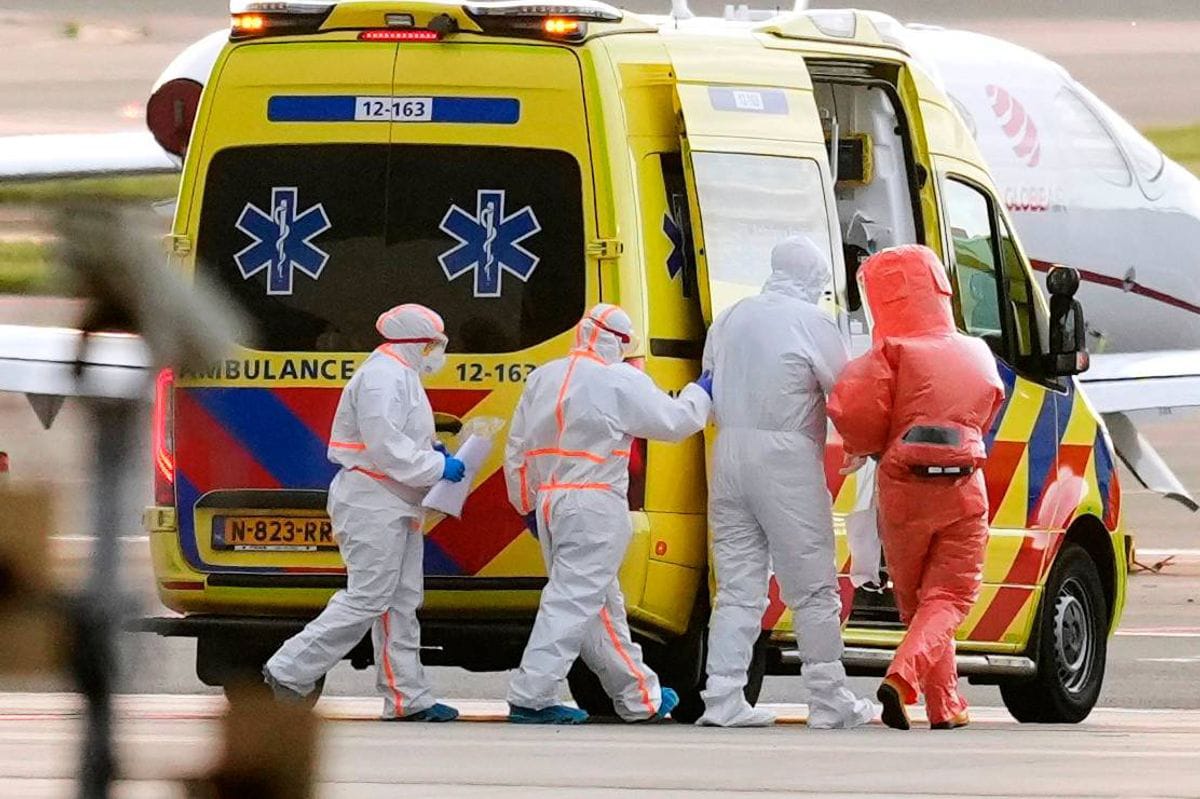
Martin Anstee, a 56-year-old retired British police officer who was serving as an expedition guide on the Hondius, was among those evacuated on Wednesday — airlifted to the Netherlands alongside a 41-year-old Dutch crew member and a 65-year-old German national. Anstee told the BBC he was “fine” and remained in stable condition. A 69-year-old British passenger with a confirmed case who was medically evacuated to South Africa at the end of April remains in intensive care but has been described by officials as “doing better.”
Read also: Hantavirus Cruise Ship Heads To Canary Isles After Evac Up
The MV Hondius is expected to dock in the Canary Islands over the weekend, where the British government has confirmed a chartered aircraft will be waiting to fly remaining British passengers and crew home. None of those still on board are currently displaying symptoms, but all will be required to self-isolate upon return. UK health officials indicated the isolation period would likely be 45 days — a duration that reflects the virus’s incubation timeline of two to four weeks after exposure, with additional buffer to account for uncertainty.
The tracing operation extends well beyond British nationals. Thirty passengers from a dozen countries disembarked the ship at St Helena on April 24 — ten days before the first confirmed hantavirus case was reported on May 4. Those passengers have been contacted by Oceanwide Expeditions, the ship’s operator. Four Britons who disembarked at St Helena remain there without symptoms but are in contact with health officials, and medical staff are being sent to the island to provide support. Contact tracing is simultaneously underway in Switzerland, the Netherlands and other countries where passengers traveled after leaving the ship.
The World Health Organization designated the outbreak a “serious incident” while stressing that the risk to the general public remained low and that the situation bore no resemblance to the early stages of the COVID-19 pandemic. WHO Director-General Tedros Adhanom Ghebreyesus told a news conference that the first two confirmed cases had traveled through Argentina, Chile and Uruguay on a bird-watching expedition that included visits to sites where the rodent species known to carry the virus was present — providing the most specific account yet of where and how exposure may have occurred.
Read more: Three Dead In Suspected Virus Outbreak On Atlantic Ship
Hantavirus spreads primarily through contact with infected rodents, their droppings or the environments they inhabit. What makes this outbreak scientifically notable is the apparent possibility of human-to-human transmission — a rare occurrence that experts say requires close and prolonged contact rather than the casual proximity of shared public spaces. The UKHSA was explicit on this point, stating that the virus was not spreading through everyday contact and that in the rare documented instances of person-to-person transmission, extended close contact had been the common factor.
The origin of the outbreak remains unconfirmed. It is not yet known whether anyone beyond the ship’s passengers and crew has been infected, and investigators have not established a definitive transmission chain that accounts for all five confirmed cases.
The Hondius, carrying the weight of an outbreak that has now claimed three lives, scattered patients across three continents and triggered contact tracing across multiple countries, is sailing toward the Canary Islands and, eventually, a thorough investigation into exactly what happened in the South Atlantic in April.