
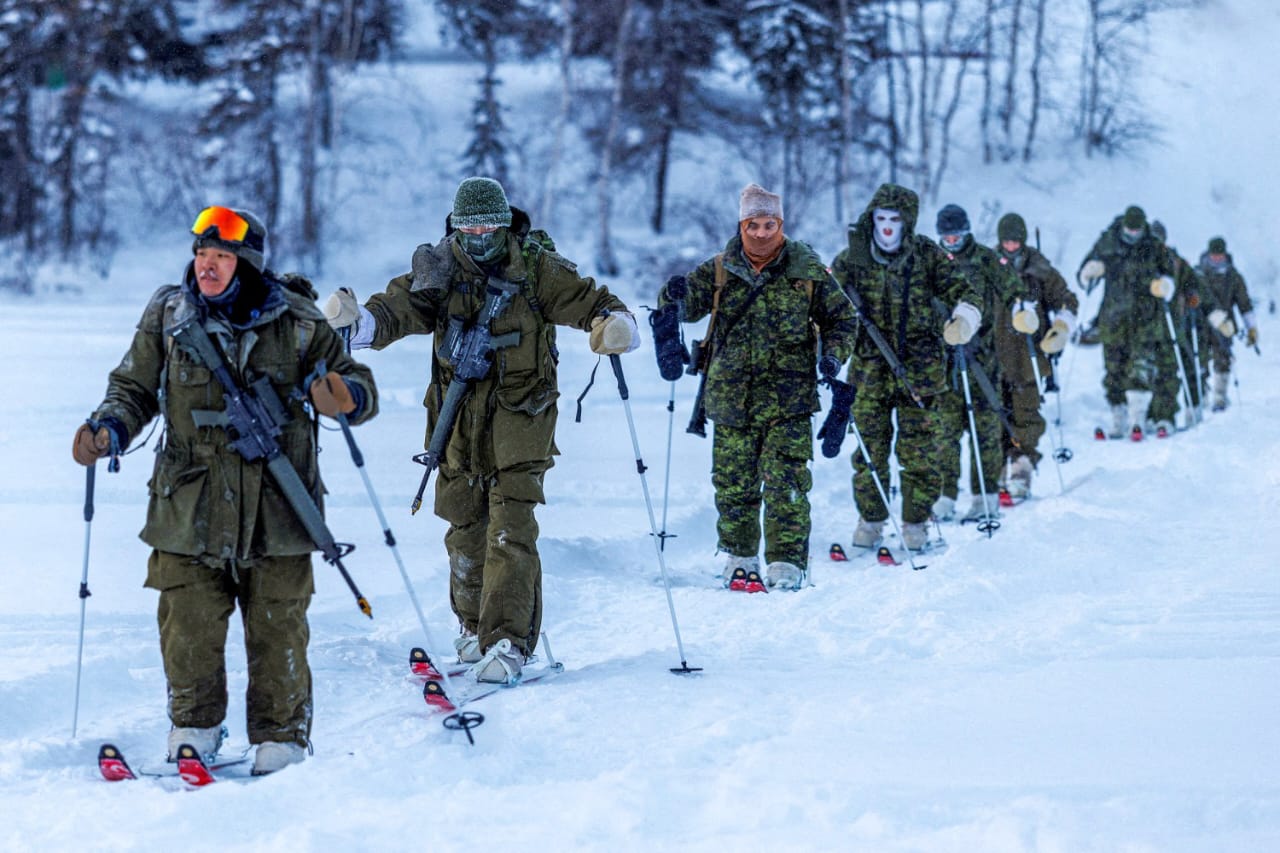
Greenland has been quietly asking Canada for help building its own Arctic defense force — and Canada, suddenly alive to the reality that its vast northern territory has been chronically under-protected, has been answering.
The conversations between Greenlandic, Danish and Canadian officials about establishing a Greenlandic version of the Canadian Rangers — the reserve military unit that maintains a year-round presence in some of the Arctic’s most isolated and inaccessible communities — have been underway for three years. They grew significantly more urgent after Donald Trump began publicly threatening to seize Greenland and the White House confirmed it was engaged in “diplomatic high-level technical talks” with Denmark and Greenland over US national security interests in the territory. A plan for how Greenland might adapt the Rangers model is expected before the end of this year.
The broader realignment happening around that specific conversation is more significant than the Rangers program alone.
Canada under Prime Minister Mark Carney is building a new security architecture in the Arctic that does not center on Washington — strengthening military and intelligence ties with Denmark, Finland, Iceland, Norway and Sweden, opening a consulate in Nuuk in February, inviting Nordic counterparts to visit Canada’s Arctic this year and deepening defense procurement coordination with the five Nordic countries in an agreement reached in March.
“The rhetoric coming out of the White House has sped up efforts to rebuff the idea that Arctic communities need the US to come in and save them,” said Whitney Lackenbauer, an honorary lieutenant-colonel Canadian Ranger and Arctic expert at Trent University who spoke to Reuters during a recent 5,000-kilometer Arctic snowmobile trek. “The Nordic countries and Canada, we’re increasingly realizing we can come together in military and diplomatic ways to send a message that carries moral weight.”
Read also: Ally Tensions May Endure Past Iran War, Analysts Warn
The message is directed at Russia as much as at Washington. Russia has more military bases in the Arctic than all other nations combined. China has been steadily expanding its Arctic presence, mostly in partnership with Moscow, drawn by the mineral wealth and the shipping routes that Arctic ice melt is making newly accessible.
Carney has been explicit that Russia represents the region’s primary threat — but the institutional response he is building is equally a hedge against American unreliability, framed publicly as strengthening “middle power” alliances in a world where Washington is no longer a predictable partner.
Finnish President Alexander Stubb became the first Finnish head of state to visit Canada in twelve years when he traveled to Ottawa in April, signing Arctic cooperation agreements and taking to the ice with Carney for a hockey practice.
Stubb told reporters afterward that he and Carney message each other almost every day. “Most of the time it’s about NATO or Ukraine or Iran,” Stubb said, though he acknowledged the conversations occasionally turn to hockey or baseball.
Read also: Religious Freedom On Agenda For Rubio-Pope Meeting
Canadian Foreign Affairs Minister Anita Anand said she meets regularly with Nordic counterparts on collective defense and Arctic security, while maintaining that the NORAD partnership with the United States remains critical. The two positions are not contradictory in her framing — Canada is building new relationships while preserving the existing one — but the emphasis has shifted in ways that would have been diplomatically unthinkable before Trump’s second term.
The candor about Canada’s historic underinvestment in Arctic defense has been another feature of the new posture. Among the eight Arctic nations, Canada has consistently ranked near the bottom in per-capita defense spending in the region, trailing Russia, the United States, Norway, Sweden, Denmark and Finland by significant margins, according to the Arctic Business Index. Canada only reached NATO’s two percent GDP defense spending target last year — at around CA$63 billion — after years of pressure from Trump and repeated complaints that Ottawa was free-riding on American security guarantees.
Neil O’Rourke, Director General at Canada’s Coast Guard for Fleet and Maritime Services, said the logic of Nordic partnership is simply geographic. “Up north, we’re just across the water and it makes much more sense to share resources than to get help from down south,” he said.
Not everyone is comfortable with the framing that Canada can meaningfully reduce its dependence on American military capability in the Arctic. Rob Huebert, an Arctic expert at the University of Calgary, said the US military’s technological superiority means working with Washington remains essential for any serious war-fighting scenario. “If we are talking about war-fighting capability, that means working with the US military,” he said — while acknowledging that Carney’s participation in a Norwegian-led NATO exercise in Bardufoss in March represented a meaningful departure from Canada’s historically token engagement in Nordic Arctic exercises.