
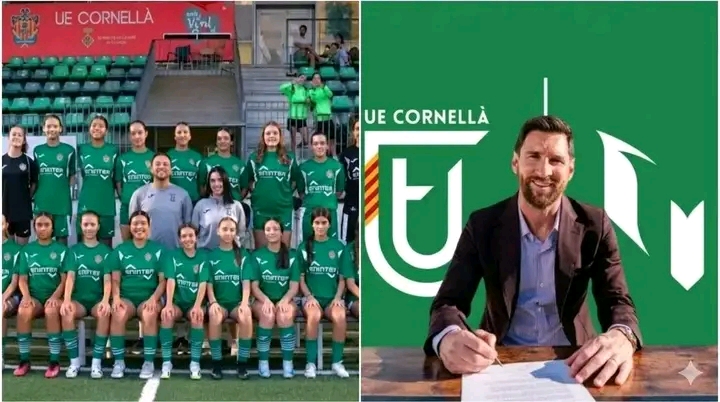
Lionel Messi’s growing influence in European football ownership is beginning to extend beyond symbolism and branding into institutional restructuring. The Argentine football icon, now majority owner of Spanish lower-division side UE Cornellà, has initiated what could become one of the club’s most consequential structural reforms: the creation of its first independently operated women’s senior football team.
The decision marks the clearest indication yet that Messi’s long-term vision for the Catalan club extends beyond short-term commercial visibility or player development. Instead, the move reflects a broader transformation increasingly reshaping modern football governance — one in which women’s football is no longer treated as a peripheral social initiative, but as a strategic sporting and economic pillar within club ecosystems.
Until now, women’s football linked to UE Cornellà had existed primarily through the club’s foundation structure rather than as an integrated competitive arm directly owned and operated by the club itself. Messi’s latest initiative seeks to alter that framework fundamentally. Reports from Spanish outlet El Nacional indicate that the new women’s senior team will function independently from the current foundation-run setup, with the eventual objective being the establishment of a fully club-owned women’s football division under the UE Cornellà identity.
Read also: China’s Xi Hails Trump Trade Deal, Issues Taiwan Alert
That distinction is significant. Across European football, the governance structure of women’s teams increasingly determines access to investment, sponsorship, infrastructure, and long-term sporting sustainability. Clubs operating women’s football through foundations or affiliated community entities often face structural limitations in commercial integration and resource allocation. By moving toward direct ownership and operational control, Messi appears to be positioning UE Cornellà within a growing model embraced by elite clubs seeking unified institutional identity across men’s and women’s football operations.
The timing of the move also aligns with accelerating commercial expansion in the women’s game globally. Over the past decade, women’s football has evolved from a largely developmental or community-based segment into one of the fastest-growing sectors in the sports industry. Attendance records, media rights valuations, sponsorship agreements, and investor interest have all risen sharply, particularly following the commercial success of recent FIFA Women’s World Cups and UEFA Women’s Champions League campaigns.
For smaller clubs such as UE Cornellà, participation in that growth curve represents both a sporting and economic opportunity. Unlike Europe’s financial heavyweights, lower-tier clubs often face tighter revenue constraints and reduced international visibility. Developing a women’s football structure offers an alternative pathway for institutional relevance, community expansion, and long-term commercial diversification.
Messi’s involvement adds another layer of strategic importance. Few athletes possess comparable global influence across sporting, commercial, and cultural sectors. His ownership role immediately elevates the visibility of any project associated with the club, including initiatives within women’s football. That influence could strengthen the club’s ability to attract sponsorships, academy partnerships, youth talent, and broader international attention that would otherwise remain inaccessible to a team operating outside Spain’s top professional divisions.
The project also reflects broader changes occurring within football ownership culture itself. Modern investors increasingly approach clubs not solely as competitive entities, but as multidimensional brands requiring social relevance, institutional credibility, and long-term developmental strategies. Women’s football has become central to that equation. Expanding female participation is now viewed not only through the lens of equality and representation, but also as a business and audience-growth imperative.
Spain offers a particularly important backdrop for such a development. The country has emerged as one of the global centres of women’s football growth in recent years, both competitively and politically. The success of the Spanish women’s national team, combined with increased domestic investment and ongoing debates around player rights, governance standards, and professional conditions, has transformed the women’s game into a major national sporting conversation.
Against that backdrop, Messi’s initiative at UE Cornellà may appear modest in scale compared to the operations of clubs such as FC Barcelona or Real Madrid. Yet structurally, it reflects the same broader trajectory: the integration of women’s football into the core identity of professional clubs rather than treating it as an auxiliary programme.
The symbolism of the move also carries weight beyond Spain. Messi remains one of football’s most recognisable global figures, particularly across Latin America, Europe, Africa, and parts of Asia where women’s football is still battling for institutional investment and visibility. His direct involvement in building a women’s football structure could influence perceptions among other players, investors, and club executives who continue to underestimate the strategic value of the women’s game.
Read more: Mali Rebels Issue Ultimatum For Russian Troop Withdrawal
There are, however, operational realities that will shape the project’s success. Establishing a sustainable women’s section requires far more than branding or public goodwill. Recruitment systems, youth development pipelines, coaching infrastructure, medical support, competitive licensing, and financial commitment all become central considerations once clubs transition from symbolic support to fully integrated competition structures.
UE Cornellà’s ability to compete effectively within Spain’s increasingly competitive women’s football pyramid will depend heavily on long-term planning and investment discipline. The challenge for emerging projects is not merely launching teams, but sustaining them within a professional environment where standards and expectations continue to rise rapidly.
Still, the broader direction of travel is unmistakable. Football’s global institutional model is evolving, and ownership groups increasingly understand that future growth lies in expansion rather than separation. Women’s football is no longer operating on the margins of elite strategy; it is becoming central to it.
For Messi, whose post-playing influence continues to expand beyond the pitch, the move may ultimately represent more than a local sporting project. It signals participation in a wider reshaping of football governance — one where legacy is measured not only by trophies and records, but by the structures left behind for future generations of the game.